Home
Class 11
PHYSICS
A sphere of steel of mass 1 kg moving wi...

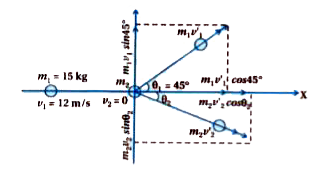
A sphere of steel of mass 1 kg moving with a velocity of 12m/s ,along X-axis collides elastically with a stationary sphere after the collision is 8 m/s and is moving at an angle of `45^(@)` with X -axis , find the magnitude and direction of the second sphere after the collision .

Text Solution

Verified by Experts

Momentum is conserved in collision ,
` :. M_(1)vec(v_(1)) +m_(2)vec(v_(2)) =m_(1)vec(v_(1))+m_(2)vec(v_(2))`
Taking X - components and `vec(v_(2))=0`
`m_(1)v_(1) =m_(1)v_(1)costheta_(1)+m_(2)v_(2)cos theta_(2) `
` :. 180 = 120 xx1/(sqrt(2)) +20 v_(2)cos theta_(2)`
` :. 180 = 120 xx1/(sqrt(2))+20v_(2)cos theta_(2)`
` :. 9- 3sqrt(2)=v_(2) cos theta_(2)" "......(1)`
Taking Y - components ,
` 0 =m_(1)v_(1) sin theta_(1)- m_(2) v_(2) sin theta_(2)`
` :. 0 = 15 xx 8 xx sin 45^(@) -20 v_(2) sin theta_(2)`
` :. 0 = 15 xx 8 xx sin 45^(@) - 20 v_(2) sin theta_(2)`
` :. 0 = 120 xx 1/(sqrt(2)) -20 v_(2) sin theta_(2)`
` :. 0 = 3sqrt(2) -v_(2) sin theta_(2)`
` :. 4.2425 =v_(2) sin theta_(2) " "........(2)`
Taking the ratio of equation (2) and (1) ,
` :. (v_(2)sintheta_(2))/(v_(2)costheta_(2)) =(4.2425)/(4.758)`
` :. tan theta_(2) =0.8916`
` :. theta_(2) =tan^(-1) (0.8916)`
` :. theta_(2) =41^(@)43`
` :. v_(2)sin (41^(@)43)=4.2425`
` :. v_(2) =(4.2425)/(sin (41^(@)43)) =(4.2425)/(0.6654)`
` :. v_(2) = 6.37 ms^(-1)`
Promotional Banner

Topper's Solved these Questions

  • WORK, ENERGY AND POWER

    KUMAR PRAKASHAN|Exercise SECTION - C Objective Questions (VSQs)|52 Videos
  • WORK, ENERGY AND POWER

    KUMAR PRAKASHAN|Exercise SECTION - D NCERT Exemplar Solutions (Multiple Choice Questions)|21 Videos
  • WORK, ENERGY AND POWER

    KUMAR PRAKASHAN|Exercise SECTION - B Numericals (Numerical From Textual Exercise)|42 Videos
  • WAVES

    KUMAR PRAKASHAN|Exercise SECTION-F (Questions From Module) (Sample questions for preparation of competitive exams)|23 Videos

Similar Questions

Explore conceptually related problems

A particle of mass m moving with velocity v is collide with a stationary particle of mass 2 m . The speed of the system , after collision will be ……….

On a frictionless surface , a block of mass . M moving at speed v collides elastically with another block of same mass M which is intially at rest /After collision the first block moes at an angle theta to its initial direction and has a speed v/3 The second block's speed after the collision is :

A smooth sphere A of mass m collides elastically with an identical sphere B at rest. The velocity of A before collision is 8 m//s in a direction making 60^(@) with the line of centres at the time of impact.

A ball moving with a velocity of 12ms^(-1) collides with another identical stationary ball . After the collision they move as shown in figure . Find the speed of the balls after the collision . Also , decide whether the condition is elastic or not .

A sphere of mass 50 g moving with velocity of 10m/s collide with the rest block at mass 950 g and embeded . The kinetic energy lost by sphere will be …….

A particle of mass 2kg moving with a velocity 5hatim//s collides head-on with another particle of mass 3kg moving with a velocity -2hatim//s . After the collision the first particle has speed of 1.6m//s in negative x-direction, Find (a) velocity of the centre of mass after the collision, (b) velocity of the second particle after the collision. (c) coefficient of restitution.

A ball A moving with a velocity 5 m/s collides elastically with another identical ball at rest such that the velocity of A makes an angle of 30^(@) with the line joining the centres of the balls. Then consider following statements : (A) Balls A an B move at right angles after collision (B) kinetic energy is conserved (C) speed of A after collision is (5/2) m/s (D) speed of B after collision is ( 5sqrt(3)//2 ) m/s Select correct alternative :-

A mass 'm' moves with a velocity 'v' and collides inelastieally with another identical mass . After collision the 1^(st) mass moves with velocity v/sqrt3 in a direction perpendicular to the initial direction of motion. Find the speed of the 2^(nd) mass after collision. undersetunderset ((before),(collision))(m)(*rarr) underset(m)* uparrow v//sqrt3 underset((after),(collision):)

A spherical ball of mass 1 kg moving with a uniform speed of 1 m//s collides symmetrically with two identical spherical balls of mass 1 kg each at rest touching each other. If the two balls move with 0.5 m//s in two directions at the same angle of 60^(@) with the direction of the first ball, the loss of kinetic energy on account of the collision is :-
