Home
Class 11
BIOLOGY
Observe the following diagrams of invert...

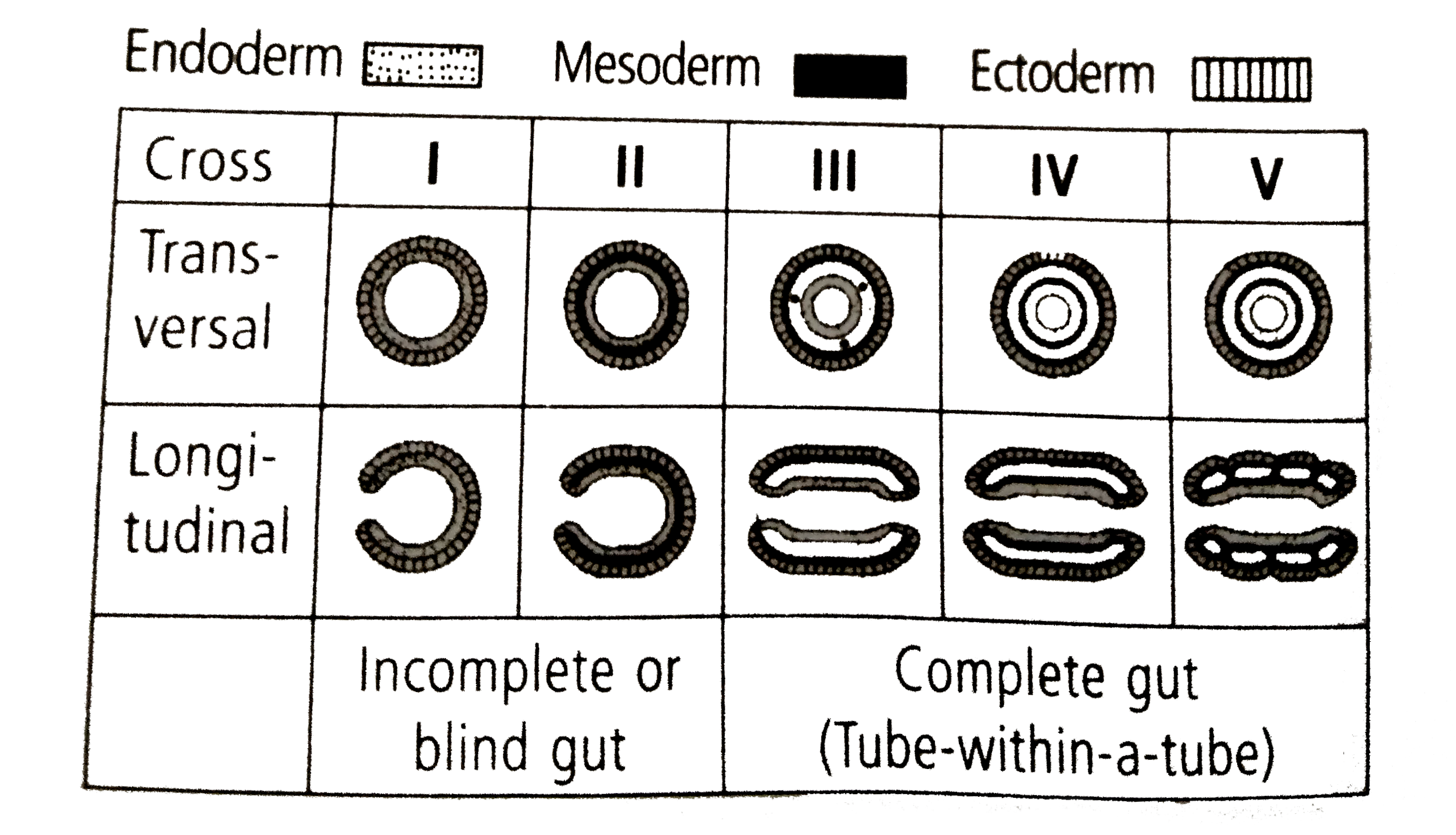
Observe the following diagrams of invertebrates embryos illustrating the characteristics of the body plan.
Reference

Select the correct sequence which corresponds to the phyla represented with I, II, III, IV and V.

A

`{:(" I"," II"," III"," IV"," V"),("Cnidaria","Platyhelminthes","Annelida","Nematoda","Arthropoda"):}`

B

`{:(" I"," II"," III"," IV"," V"),("Cnidaria","Platyhelminthes","Nematoda","Arthropoda","Annelida"):}`

C

`{:(" I"," II"," III"," IV"," V"),("Nematoda","Arthropoda","Platyhrlminthes","Cnidaria","Annelida"):}`

D

`{:(" I"," II"," III"," IV"," V"),("Annelida","Cnidaria","Arthropoda","Platyhrlminthes","Nematoda"):}`

Text Solution

Verified by Experts

The correct Answer is:

B

The embryo of animal I shows two germinal layers, ectoderm and mesoderm. This animal is diploblastic, it can be a poriferm and mesoderm. This animal is diploblastic, it can be a poriferan or cnidarian. The embroyos of all other animals have three germinal layers, the ectoderm, mesoderm and endoderm. These animals are triploblastic animals. They can be from Phylum Platyhelminthes to Phylum Mollusca. Embryos I and II have no coelom, III has pseudocoelom and IV and V have true coelom. Coelom is a fluid -filled cavity that forms the main body cavity of animals. it is formed by splitting of the mesoderm. Therefore, embryos I and II can be of poriferans, cnidarians, ctenophorans or platyhelminthes, embryo III is of nemathelminthes, whereas embryos of V shows internal divisions or segmentation in the body. Embryo V, thus is annelidan. So, we can conclude, embryo I is of cnidaria, embryo II is of platyhelminthes, embryo III is of namathelminthes, embryo IV is of arthropoda and embryo V is of annelida.
Promotional Banner

Topper's Solved these Questions

  • ANIMAL KINGDOM

    NCERT FINGERTIPS ENGLISH|Exercise NCERT examples problems|13 Videos
  • ANIMAL KINGDOM

    NCERT FINGERTIPS ENGLISH|Exercise Assertion & Reason corner|15 Videos
  • ANIMAL KINGDOM

    NCERT FINGERTIPS ENGLISH|Exercise Classification of chordates|62 Videos
  • ANATOMY OF FLOWERING PLANTS

    NCERT FINGERTIPS ENGLISH|Exercise Anatomy Of Flowering Plants|143 Videos
  • BIOLOGICAL CLASSIFICATION

    NCERT FINGERTIPS ENGLISH|Exercise Biological Classification|132 Videos

Similar Questions

Explore conceptually related problems

The following compounds are intermediates in the pathway of photorespiration I) Phosphoglycolate II) Serine III) glyoxylate IV) glycine The correct sequence of their appearance in the pathway is

The following compounds are intermediates in the pathway of photorespiration- I. phosphoglycolate- II. Serine- III. Glyoxylate- IV. Glycine- The correct sequence of their appearance in the pathway is

Identify the structure indicated by labels (i),(ii),(iii) and (iv) and select the correct option.

Which of the following are correct (B) and (C ) products, respectively ? I. II. , III. IV. , v.

The given graph represents V-I characteristic for a semiconductor device. which of the following statement is correct?

Arrang the following steps of hybridization procedure in as sequence Artificial cross pollination II) Selection of parents III) Bagging IV) Emasculation.

The diagram given below represents an endocrine gland in the human body. Study the diagram and answer the following questions : (i) Identify the endocrine gland. Where is it located? (ii) Why is the above gland referred to as the 'Master gland' ? (iii) Name the hormone which in deficiency causes Diabetes Insipidus. How does this disorder differ from Diabetes Mellitus ? (iv) Explain the term 'Hormone'. What is the role of Tropic hormones in the human body? (v) Which lobe of the above gland secretes: 1. Oxytocin 2. ACTH 3. Growth hormone.

Which of the following is/are not the characteristics of the Class Osteichthyes? (i) Body is streamlined and mouth is terminal. (ii) Gills are convered by operculum. (iii) Skin convered with cycloid and placoid scales. (iv) Many of them are viviparous.

Predict the order of reactivity of following compounds in dehydrohalogenation. a. I. II. III. IV. V. b. I. II. III. IV.

Define the following terms: (i)Observations (ii) data (iii) Frequency of an observation (iv) Frequency distribution
