Home
Class 11
BIOLOGY
Durning strenuous exercise, the muscle i...


Durning strenuous exercise, the muscle interstitial fluid `pO_(2)` falls to `20` mm Hg. The oxygen delivered by blood that passes through the exercising muscle tissus will be

A

five times as much as normal

B

double to the normal

C

three times as much as normal

D

none of these.

Text Solution

Verified by Experts

The correct Answer is:

C

The given graph shows the relationship between partial pressure of oxygen with the amount of oxygen that can bind with haemoglobi. The `PO_(2)` of the air within alveoli is about `100` mm Hg. As the blood travels through the systemic blood capillaries, oxygen leaves the blood and diffuses into the tissuess. Consquently, the blood that leaves the tissues in the veins has a `PO_(2)` that is decreasing (in a resting person) to about `40` mm Hg. Therefore, A depicts oxygenated blood and B depicts systemic blood.
The steep portion of the curve from `60` down to `20` mm Hg is ideal for unloading oxygen in the tissue, i.e., for a small decrease in `PO_(2)` (due to diffussion of oxygen) a large quantity of oxygen can be unloaded to the peripheral tissue capillary. Durning strenous exercise, the muscles acclerated metabolism uses more oxygen from the capillary blood and thus decreases the vanous blood `PO_(2)`, for example the `PO_(2)` of the venous blood could drop to `20` mm Hg. Hence, `D, E`, and `F` shows the venous blood in exercise, normal venous blood and normal arterial blood respectively.
As we know, in the resting person, the `PO_(2)` of tissue is `40` mm Hg, which is favourable for oxygen diffusion from artieral blood to the tissues. Oxygen unloaded to the tissues by arterial blood is `5 "mL"//100 "m"` of blood (`20` mL - `15` mL `= 5"mL"//100 "mL"`, from the graph). During strenous execrise, the muscle interstitial fluid is `15 "mL"1//100 "mL"` of blood , `(20 - 5) "mL"//10 "mL" = 15 "mL"//100 "mL"`, from the graph i.e., thre times as much as normal.
Promotional Banner

Topper's Solved these Questions

  • BREATHING AND EXCHANGE OF GASES

    NCERT FINGERTIPS ENGLISH|Exercise Exemplar Problems|13 Videos
  • BREATHING AND EXCHANGE OF GASES

    NCERT FINGERTIPS ENGLISH|Exercise Breathing And Exchange Of Gases|140 Videos
  • BREATHING AND EXCHANGE OF GASES

    NCERT FINGERTIPS ENGLISH|Exercise Breathing And Exchange Of Gases|140 Videos
  • BODY FLUIDS AND CIRCULATION

    NCERT FINGERTIPS ENGLISH|Exercise Body Fluids And Circulation|151 Videos
  • CELL - THE UNIT OF LIFE

    NCERT FINGERTIPS ENGLISH|Exercise Cell - The Unit Of Life|159 Videos

Similar Questions

Explore conceptually related problems

Parameter that remains unchanged during conditions of strenuous exercise in an individual is (a) Volume of oxygen delivered by oxygenated blood to tissues. (b) Number of lub and dub sounds heard through the stethoscope. (c) Partial pressure of oxygen inhaled from atmosphere at sea level (d) Frequency of impulse initiation by natural pacemaker.

Compared to the interstitial fluid that bathes active muscle cells, blood reaching that tissue in arteries has a :

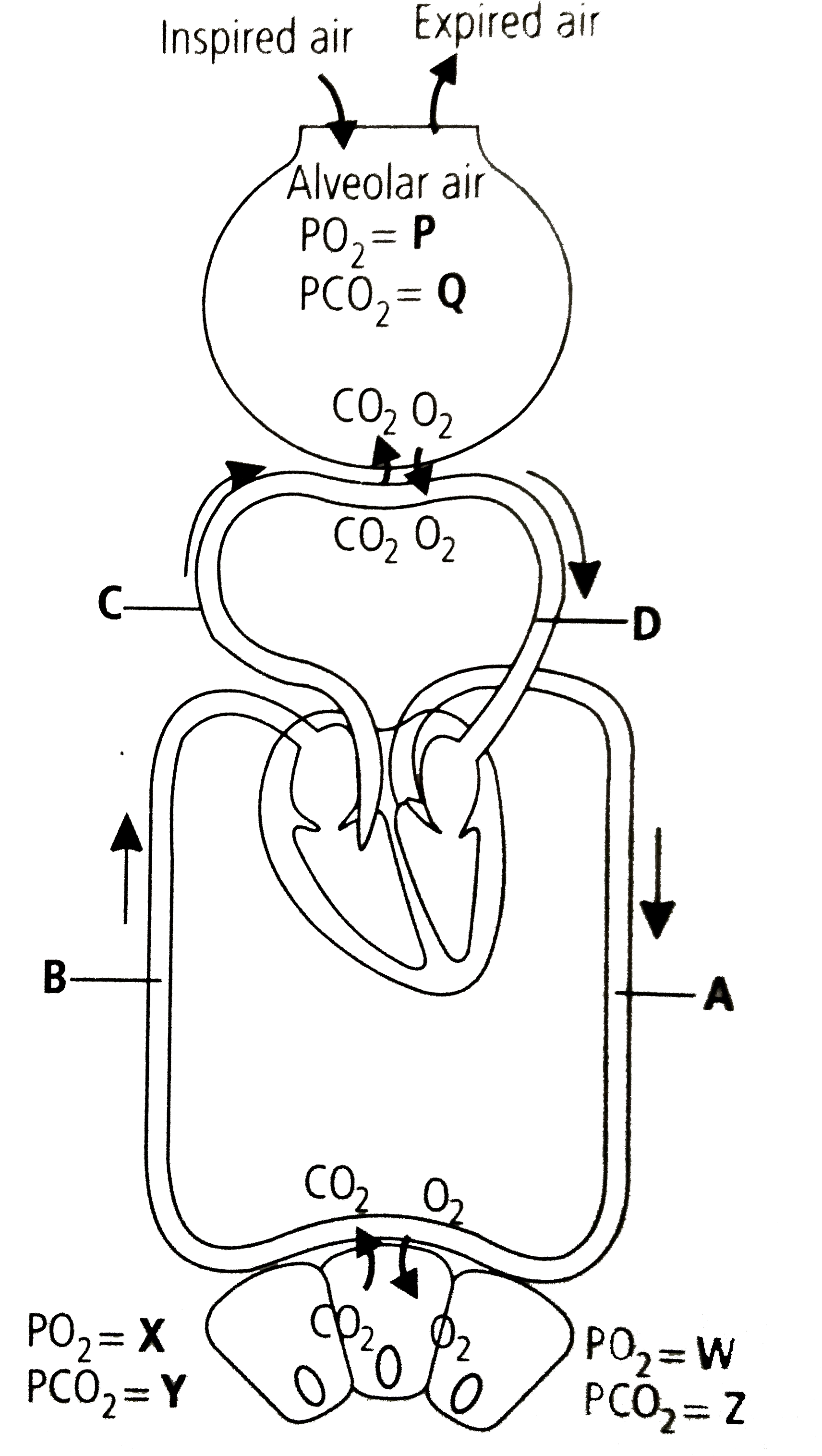
The partial pressure of O_2 in atmospheric air, alveoli, deoxygenated blood, oxygenated blood and tissues respectively (in mm Hg) is

Assertion : A sigmoid curve is obtained when percentage saturation of haemoglobin with O_(2) is plotted against the PO_(2) . Reason : Every 100 mL of oxygenated blood can deliver around 5mL of O_(2) to the tissues under normal physiological conditions.

The human ciculatory system can be thought of as a closed system of interconnecting pipes through which fluid is continuously circulated by two pumps the two pumps the right and left verticles of the heart, work as simple two-stroke force pumps. The muscles of the heart regulate the force by contracting and relaxing. the contraction (systole) lasts about 0.2s and a complete systole/diastole (contraction/relaxation) cycle lasts about 0.8s. For flood pressures and speeds in the normal range. the volume flow rate of blood through a blood vessel is directly proportional tot he pressure difference over a length of the vessel and to the fourth power of the radius of the vessel. The total mechanical energy per unit volume of blood just as it leaves the heart is E//V=rhogh+P+rhov^(2) Q. Why is diastolic blood pressure muchh lower than systolic pressure? A. because the heart exerts more force on the blood during diastole B. Because the heart exerts no force on the blood during diastole C. Because the radii of the blood vessels increase during diastole while the force exerted by the heart on the blood remains the same. D. Because the radii of the blood vessels increase during diastole while the force exerted by the heart on the blood remains the same.

Partial pressure of CO_2 in alveoli, oxygenated blood, deoxygenated blood, tissue respectively (in mm Hg) are

The human ciculatory system can be thought of as a closed system of interconnecting pipes through which fluid is continuously circulated by two pumps the two pumps the right and left verticles of the heart, work as simple two-stroke force pumps. The muscles of the heart regulate the force by contracting and relaxing. the contraction (systole) lasts about 0.2s and a complete systole/diastole (contraction/relaxation) cycle lasts about 0.8s. For flood pressures and speeds in the normal range. the volume flow rate of blood through a blood vessel is directly proportional tot he pressure difference over a length of the vessel and to the fourth power of the radius of the vessel. The total mechanical energy per unit volume of blood just as it leaves the heart is E//V=rhogh+P+rhov^(2) Q. During intense exercise the volume of blood pumped per second by an athlete,s heart increases by a factor of 7, and his blood pressure increases by 20%/by what factor does the power output of the heart increase during exercise?

11.2 g of carbon reacts with 21.1 litres of oxygen at 18^(@)C and 750 mm of Hg . The cooled gases are passed through 2 litre of 2.5 N NaOH . Determine the concetration of NaOH remaining in solution which is not converted to Na_(2) CO_(3) . Assume that CO does not react with NaOH : a. Whatis the mole fraction of CO in the gases? b. What is the concetration of NaOH which is not converted to Na_(2) CO_(3) in the remaining solution?

How many milliliters of CO_2 are in 100 ml of deoxygenated blood at rest, and how many milliliters of O_2 are in 100 ml of oxygenated blood during strenuous exercise?

What is the pressure drop (in mm Hg) in the blood as it passes through a capillary 1mm long and 2mu m in radius if the speed of the blood through the centre of the capillary is 0.66mm/s ? (The viscosity of whole blood is 4xx10^(-3) PI)
