Home
Class 11
BIOLOGY
The diagrams shows vertical sections of ...


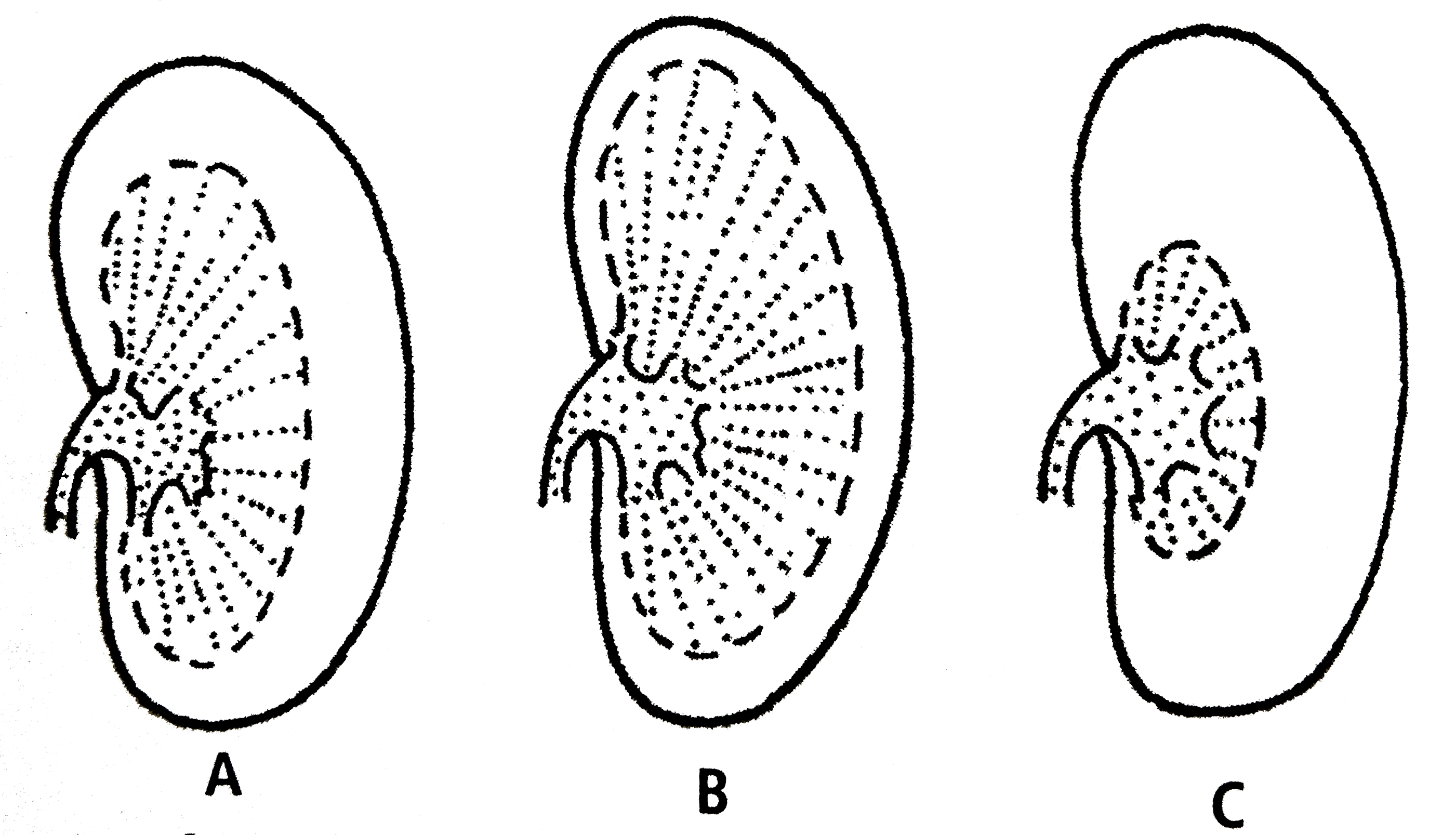
The diagrams shows vertical sections of kidneys of coypu, brown rat and kangaroo rat, showing the relative size and Coypu is found in freshwater and is never of short of water to drink. Brown rats are able to go some days without drinking. Kangaroo rats are able to live in deserts without drinking at all. Which kidney belongs to which animal.?

A

a) `{:(A,B,C),("Brown rat","Coypu","Kangaroo rat"):}`

B

b) `{:(A,B,C),("Brown rat","Kangaroo rat","Coypu"):}`

C

c) `{:(A,B,C),("Kangaroo rat","Brown rat","Coypu"):}`

D

d) `{:(A,B,C),("Kangaroo","Coypu","Brown rat"):}`

Text Solution

Verified by Experts

The correct Answer is:

B

The loop of henle has a key role in water conservation. Based on lengths of the loop of henle, there are two types of nephrons: (i) Cortical nephrons: they have short loops of henle which only just extend into the medulla which function most importantly when the suppy is normal to excessive, (ii) Juxtamedullary nephrons: they have long loops of Henle that extend deep into the medulla which function most importantly when water is in short supply. The lengths of loops of Henle and of the collecting ducts, and the general thickness of the medulla region of the kidneys, increase progressively in animals best adapted to the drier habitats.
Promotional Banner

Topper's Solved these Questions

  • EXCRETORY PRODUCTS AND THEIR ELIMINATION

    NCERT FINGERTIPS ENGLISH|Exercise Assertion & Reason|15 Videos
  • EXCRETORY PRODUCTS AND THEIR ELIMINATION

    NCERT FINGERTIPS ENGLISH|Exercise Excretory Products And Their Elimination|133 Videos
  • DIGESTION AND ABSORPTION

    NCERT FINGERTIPS ENGLISH|Exercise Digestion And Absorption|137 Videos
  • LOCOMOTION AND MOVEMENT

    NCERT FINGERTIPS ENGLISH|Exercise Locomotion And Movement|139 Videos

Similar Questions

Explore conceptually related problems

(A]: Kangaroo rat can live without drinking water. [R]: This is an adaptation to water scarcity in arid conditions

Consider the following water conservation mechanism A. Nasal countercurrent mechanism B. dependence on metabolic water C. Highly hypertonic urine D. Living more on protein rich diet The kangaroo rat living in desert can survive without drinking water because of

Consider the following water conservation mechanisms: (a) Nasal countercurrent mechanism (b) Dependence on metabolic water (c) Highly hypertonic urine (d) Living more on protein rich diet. A kangaroo rat living in desert can survive without drinking water because of

Which are true about the following statements about kangaroo rats (a) They have dark colour, high rate of reproduction and excrete solide urine (b) They do not drink water, breathe at slow rate, and have their body covered with thick hair (c) The feed on dry seeds and do not require drinking water (d) They excrete very concentrated urine and do not use water to regulate body temperature

Which are true about the following statements about kangaroo rats (a) They have dark colour, high rate of reproduction and excrete solide urine (b) They do not drink water, breathe at slow rate, and have their body covered with thick hair (c) The feed on dry seeds and do not require drinking water (d) They excrete very concentrated urine and do not use water to regulate body temperature

Consider the following four statements (i)-(iv) about certain desert animals such as kangaroo rat. i) They have dark colour and high rate of reproduction and excrete solid urine ii) They do not drink water, breathe at a slow rate to conserve water and have their body covered with thick hairs iii) They feed on dry seeds and do not required drinking water iv)They excrete very concentrated urine and do not use water to regulate body temperature. Out of these four, which two are correct :

NCERT FINGERTIPS ENGLISH-EXCRETORY PRODUCTS AND THEIR ELIMINATION-Excretory Products And Their Elimination
  1. If a healthy man drinks one litre of water on occasion A and one litre...

    Text Solution

    |

  2. The accompanying figure shows reabsorption of some constituents of glo...

    Text Solution

    |

  3. The diagrams shows vertical sections of kidneys of coypu, brown rat an...

    Text Solution

    |

  4. The following substances are the excretory products in animals. Choose...

    Text Solution

    |

  5. Filtration of the blood takes place at

    Text Solution

    |

  6. A large quantity of one of the following is removed from our body by l...

    Text Solution

    |

  7. The pH of human urine is approximately

    Text Solution

    |

  8. Which one of the following statements is incorrect?

    Text Solution

    |

  9. Which of the following pairs is wrong ?

    Text Solution

    |

  10. Which one of the following statement is incorrect?

    Text Solution

    |

  11. The condition of accumulation of urea in the blood is termed as

    Text Solution

    |

  12. Which one of the following is also known as antidiuretic hormone

    Text Solution

    |

  13. Match the terms given in column I with their physiological processes g...

    Text Solution

    |

  14. Match the abnormal conditions given in column A with their explanation...

    Text Solution

    |

  15. We can produce concentrated / dilute urine. This is facilitated by a s...

    Text Solution

    |

  16. Dialysing unit (artificial kidney) contains a fluid which is almost sa...

    Text Solution

    |

  17. Assertion: Sharks are said to be ammonotelic animals. Reason: Sharks...

    Text Solution

    |

  18. Assertion: Nephrons are of two types: cortical and juxtamedullary acco...

    Text Solution

    |

  19. Assertion: Vasa recta is absent or highly reduced in cortical nephrons...

    Text Solution

    |

  20. Assertion: Glomerular filtration requires expenditure of energy by kid...

    Text Solution

    |
