Home
Class 12
BIOLOGY
A long solenoid having n = 200 turns per...

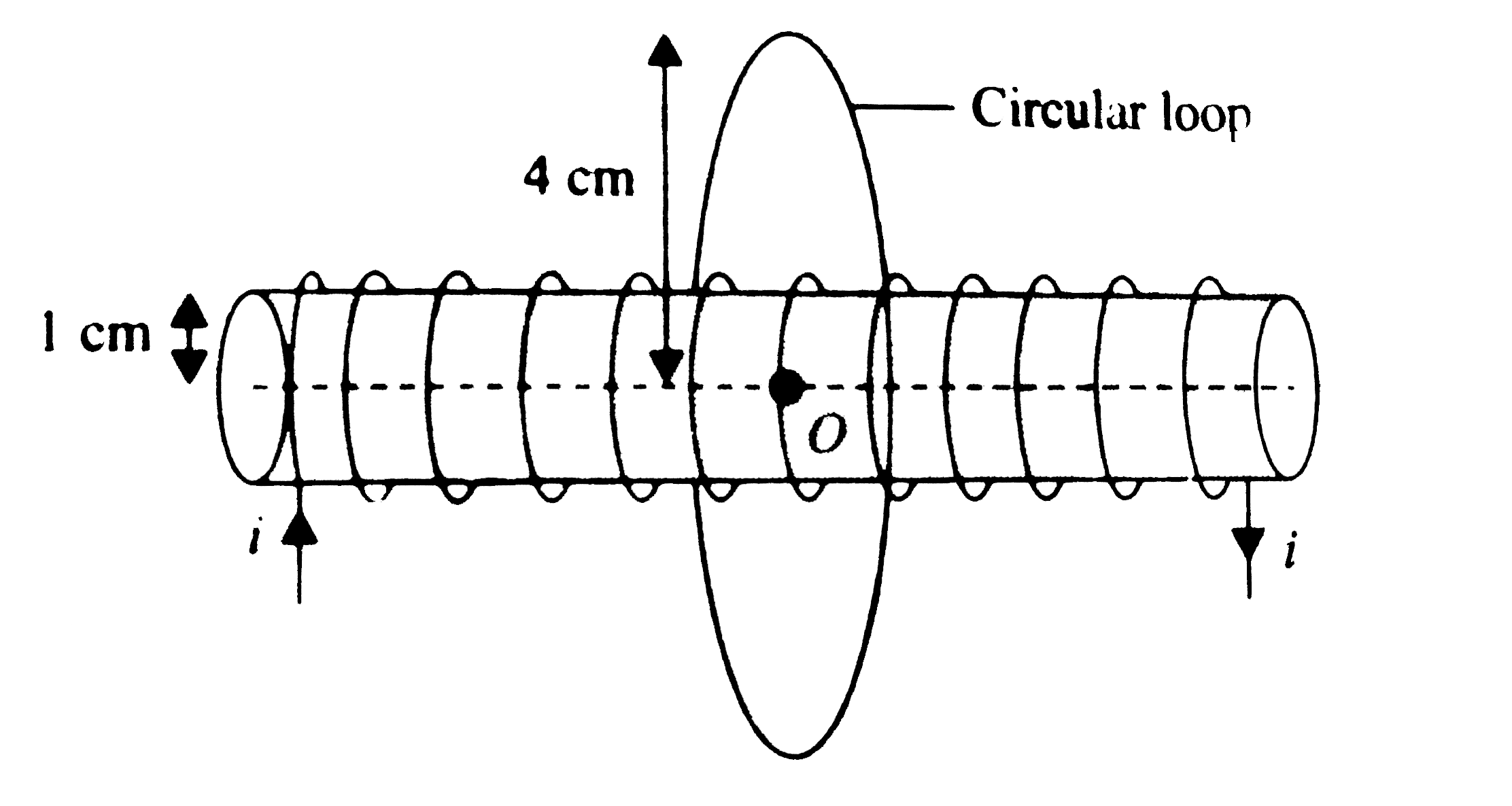
A long solenoid having n = 200 turns per metre has a circular cross-section of radius `a_(1) = 1 cm`. A circular conducting loop of radius `a_(2) = 4 cm` and resistance ` R = 5 (Omega)` encircles the solenoid such that the centre of circular loop coincides with the midpoint of the axial line of the solenoid and they have the same axis as shown in Fig.

A current 't' in the solenoid results in magnetic field along its axis with magnitude `B = (mu)ni` at points well inside the solenoid on its axis. We can neglect the insignificant field outside the solenoid. This results in a magnetic flux `(phi)_(B)` through the circular loop. If the current in the winding of solenoid is changed, it will also change the magnetic field `B = (mu)_(0)ni` and hence also the magnetic flux through the circular loop. Obvisouly, it will result in an induced emf or induced electric field in the circular loop and an induced current will appear in the loop. Let current in the winding of solenoid be reduced at a rate of `75 A //sec`.
When the current in the solenoid becomes zero so that external magnetic field for the loop stops changing, current in the loop will follow a differenctial equation given by [You may use an approximation that field at all points in the area of loop is the same as at the centre

A

parthenogenesis, which is a form of apomixis

B

parthenogenesis, which is a form of amphimixis

C

adventive embryony, which is a form of apomixis

D

agamospermy, which is a form of amphimixis.

Text Solution

Verified by Experts

The correct Answer is:

a

Apomixis (Gk. Apo-without, mixis-mixing) is a mode of reproduction which does not involve formation of zygote through gametic fusion. Apomixis, is thus asexual reproduction Parthenogenesis (Gk. Parthenos-virgin, genesis-produce) refers to development of an egg'ovum into a complete individual without fertilisation.
Promotional Banner

Topper's Solved these Questions

  • PRINCIPLES OF INHERITANCE & VARIATION

    NCERT FINGERTIPS ENGLISH|Exercise Principles Of Inheritance & Variation|167 Videos
  • REPRODUCTIVE HEALTH

    NCERT FINGERTIPS ENGLISH|Exercise Reproductive Health|133 Videos

Similar Questions

Explore conceptually related problems

A long solenoid having n = 200 turns per metre has a circular cross-section of radius a_(1) = 1 cm . A circular conducting loop of radius a_(2) = 4 cm and resistance R = 5 (Omega) encircles the solenoid such that the centre of circular loop coincides with the midpoint of the axial line of the solenoid and they have the same axis as shown in Fig. A current 't' in the solenoid results in magnetic field along its axis with magnitude B = (mu)ni at points well inside the solenoid on its axis. We can neglect the insignificant field outside the solenoid. This results in a magnetic flux (phi)_(B) through the circular loop. If the current in the winding of solenoid is changed, it will also change the magnetic field B = (mu)_(0)ni and hence also the magnetic flux through the circular loop. Obvisouly, it will result in an induced emf or induced electric field in the circular loop and an induced current will appear in the loop. Let current in the winding of solenoid be reduced at a rate of 75 A //sec . Magnitude of induced current that appears in the circular loop is

A long solenoid having n = 200 turns per metre has a circular cross-section of radius a_(1) = 1 cm . A circular conducting loop of radius a_(2) = 4 cm and resistance R = 5 (Omega) encircles the solenoid such that the centre of circular loop coincides with the midpoint of the axial line of the solenoid and they have the same axis as shown in Fig. A current 't' in the solenoid results in magnetic field along its axis with magnitude B = (mu)ni at points well inside the solenoid on its axis. We can neglect the insignificant field outside the solenoid. This results in a magnetic flux (phi)_(B) through the circular loop. If the current in the winding of solenoid is changed, it will also change the magnetic field B = (mu)_(0)ni and hence also the magnetic flux through the circular loop. Obvisouly, it will result in an induced emf or induced electric field in the circular loop and an induced current will appear in the loop. Let current in the winding of solenoid be reduced at a rate of 75 A //sec . Magentic flux through the loop due to external magnetic field will be I is the current in the loop a_(1) is the radius of solendoid and a_(1)=1cm (given) a_(2) is the radius of circular loop and a_(2)=4cm (given) i is hte current in the solenoid

A small, conducting circular loop is placed inside a long solenoid carrying a current. The plane of the loop contains the axis of the solenoid. If the current in the solenoid is varied, the current induced in the loop is

A small, conducting circular loop is placed inside a long solenoid carrying a current. The plane of the loop contains the axis of the solenoid. If the current in the solenoid is varied, the current induced in the loop is

A 90 cm long solenoid has six layers of windings of 450 turns each. If the diameter of solenoid is 2.2 cm and current carried is 6 A, then the magnitude of magnetic field inside the solenoid, near its centre is

A long solenoid has 800 turns per metre length of solenoid A currentof 1.6 A flow through it. The magnetic induction at the end of the solenoid on its axis is

A long thin solenoid has 900"tuns"//"metre" and radius 2.50cm ,. The current in the solenoid is increasing at a uniform rate of 60A//s . What is the magnitude of the induced electric field at a point? a. 0.5cm from the axis of the solenoid. b. 1.0cm from the axis of the solenoid.

Find mutual inductance if we have a square loop of side r instead of a small circular loop of side r at the centre of bigger circular loop.

In the figure, the current l enters the circular loop of uniform wire of radius r at A and leaves it at B. The magnetic field of the centre of circular loop is

Two solenoids having lengths L and 2L and the number of loops N and 4N, both have the same current, then ihe ratio of the magnetic field will be

NCERT FINGERTIPS ENGLISH-REPRODUCTION IN ORGANISM-All Questions
  1. Grafting is the union between two plants of closely related varieties....

    Text Solution

    |

  2. Given figures illustrate.

    Text Solution

    |

  3. A long solenoid having n = 200 turns per metre has a circular cross-se...

    Text Solution

    |

  4. Which of the following is wheat fruit?

    Text Solution

    |

  5. In these figures, two life-cycles are described. Mark the correct opti...

    Text Solution

    |

  6. In the figure given below, two particles of masses m and 2m are fixed ...

    Text Solution

    |

  7. The term "Linkage" was coined by

    Text Solution

    |

  8. Two identical blocks A and B, each of mass m=3kg, are connected with t...

    Text Solution

    |

  9. A few statements with regard to sexual reprodction are given below. ...

    Text Solution

    |

  10. The rate of formation of new organic matter by rabbit in a grass land ...

    Text Solution

    |

  11. The pressures at A and B in the atmosphere are, respectively,

    Text Solution

    |

  12. Select the correct statements.

    Text Solution

    |

  13. Fill in blanks (w.r.t. experimental material used by Morgan) (i) Fem...

    Text Solution

    |

  14. If three uniform spheres, each having mass M and radius R, are kept in...

    Text Solution

    |

  15. The value of escape speed from the surface of earth is

    Text Solution

    |

  16. Which of the following statements, support the view that elaborate sex...

    Text Solution

    |

  17. Offspring formed by sexual reproduction exhibit more variation than th...

    Text Solution

    |

  18. Pick out the correct statement from the following

    Text Solution

    |

  19. A block of mass m is suspended from one end of a light spring as shown...

    Text Solution

    |

  20. Phenotype of an organism is the result of

    Text Solution

    |
