Home
Class 12
BIOLOGY
The figure shows the restriction enzyme ...

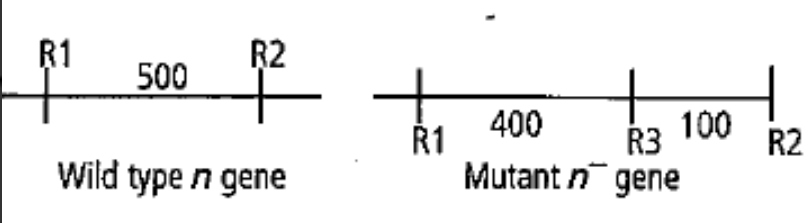
The figure shows the restriction enzyme cutting sites `(R1-R3)` in wild type (n) and mutant (n) gene.

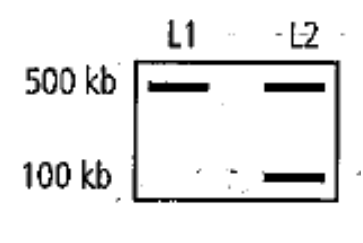
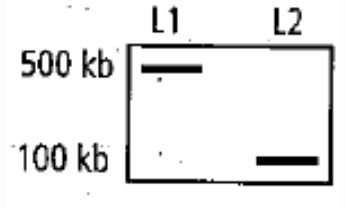
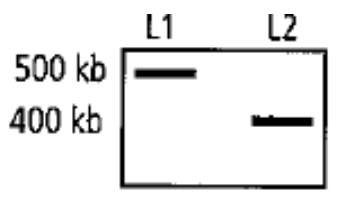
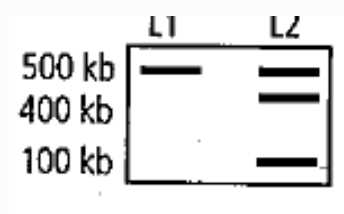
If a radioactively labelled probe (that hybridises at a sequence close to `R1)` is used for detecting the presence of DNA fragments after gel electrophoresis and Southern blotting, which of the following band patterns will yout expect ?
Note : L1 : wild type DNA, L2: mutant DNA

A

(a)

B

(b)

C

(c)

D

(d)

Text Solution

Verified by Experts

The correct Answer is:

C

Restriction enzymes recongise the base sequence of palindrome sites in DNA duplex and cut is strands. After the cutting of DNA by restriction enzymes, fragments of DNA are formed. Separation of DNA fragments according to their size is done by gel electrophoresis. since the probe hybridises close to `R1` it will give 500 kb band for `L1` and 400 kb band for `L2` after gel electrophoresis.
Promotional Banner

Topper's Solved these Questions

  • BIOTECHNOLOGY - PRINCIPLES AND PROCESSES

    NCERT FINGERTIPS ENGLISH|Exercise NCERT|19 Videos
  • BIOTECHNOLOGY - PRINCIPLES AND PROCESSES

    NCERT FINGERTIPS ENGLISH|Exercise Assertion & Reason|15 Videos
  • BIOTECHNOLOGY - PRINCIPLES AND PROCESSES

    NCERT FINGERTIPS ENGLISH|Exercise Biotechnology - Principles And Processes|139 Videos
  • BIODIVERSITY & CONSERVATION

    NCERT FINGERTIPS ENGLISH|Exercise Biodiversity & Conservation|140 Videos
  • BIOTECHNOLOGY AND ITS APPLICATION

    NCERT FINGERTIPS ENGLISH|Exercise Biotechnology And Its Application|137 Videos

Similar Questions

Explore conceptually related problems

In the figure below, the switches S_(1) and S_(2) are closed simultaneously at t =0 and a current starts to flow in the circuit. Both the batteries have the same magnitude of the electromotive force (emf) and the polarities are as indicated in the figure. Ignore mutual inductance between the inductors. The current ? in the middle wire reaches its maximum magnitude I_(max) at time t=tau . Which of the following statements is (are) true? A. I_("max")=(V)/(2R) B. I_("max")=(V)/(4R) C. tau=(L)/( R)""l n2 D. tau=(2L)/( R)" l n2

Entropy is a state function and its value depends on two or three variable temperature (T), Pressure(P) and volume (V). Entropy change for an ideal gas having number of moles(n) can be determined by the following equation. DeltaS=2.303 "nC"_(v)"log"((T_(2))/(T_(1))) + 2.303 "nR log" ((V_(2))/(V_(1))) DeltaS=2.303 "nC"_(P) "log"((T_(2))/(T_(1))) + 2.303 "nR log" ((P_(1))/(P_(2))) Since free energy change for a process or a chemical equation is a deciding factor of spontaneity , which can be obtained by using entropy change (DeltaS) according to the expression, DeltaG = DeltaH -TDeltaS at a temperature T What would be the entropy change involved in thermodynamic expansion of 2 moles of a gas from a volume of 5 L to a volume of 50 L at 25^(@) C [Given R=8.3 J//"mole"-K]

Let A be an mxxn matrix. If there exists a matrix L of type nxxm such that LA=I_(n) , then L is called left inverse of A. Similarly, if there exists a matrix R of type nxxm such that AR=I_(m) , then R is called right inverse of A. For example, to find right inverse of matrix A=[(1,-1),(1,1),(2,3)] , we take R=[(x,y,x),(u,v,w)] and solve AR=I_(3) , i.e., [(1,-1),(1,1),(2,3)][(x,y,z),(u,v,w)]=[(1,0,0),(0,1,0),(0,0,1)] {:(implies,x-u=1,y-v=0,z-w=0),(,x+u=0,y+v=1,z+w=0),(,2x+3u=0,2y+3v=0,2z+3w=1):} As this system of equations is inconsistent, we say there is no right inverse for matrix A. For which of the following matrices, the number of left inverses is greater than the number of right inverses ?
