Home
Class 12
BIOLOGY
The following grap[hs shows the lvevels ...


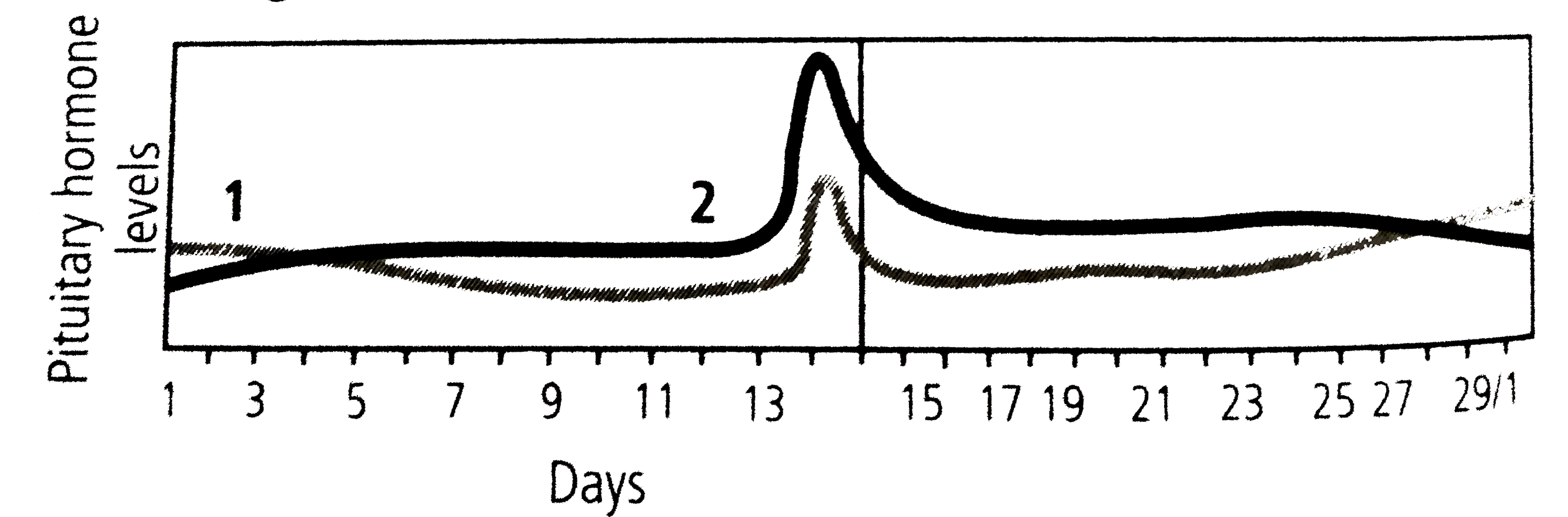
The following grap[hs shows the lvevels of pituitary hormones during a menstrual cycle. What do 1 and 2 represent?

A

`{:(1,2),(LH,FSH):}`

B

`{:(1,2),("Estrogen","Progeterone"):}`

C

`{:(1,2),("FSH","LH"):}`

D

`{:(1,2),("Progesterone","Estrogen"):}`

Text Solution

Verified by Experts

The correct Answer is:

C

In the given graph, 1 and 2 are FSH and LH respectively. The secretion of both LH and FSH attain peak level during the ovulation (`14^(th)` day of the cycle.)
Promotional Banner

Similar Questions

Explore conceptually related problems

The following graph shows the levels of ovarian hormones during a menstrual cycle. What do 1 and 2 represent?

The following graph shows the levels of ovarian hormones during a menstrual cycle. What do 1 and 2 represent ?

Mention the role of hormones during the menstrual cycle.

Desribe the roles of pituitary and ovarian hormones during the menstrual cycle in a human female .

Which of the following is correctly matched event occurring during menstrual cycle?

Which one of the following is the incorrect match of the events occurring during menstrual cycle ?

Refer to the given graph representing interplay of different hormones (A-D) during menstrual cycle in women and answer the question that follow. Which hormones is most effective in producing uterine changes during menstrual cycle?

Refer to the given graph representing interplay of different hormones (A-D) during menstrual cycle in women and answer the question that follow. Which hormone (A,B,C or D) is necessary for the final follicular grwoth and ovulation?

Refer to the given graph representing interplay of different hormones (A-D) during menstrual cycle in women and answer the question that follow. Cessation of secretion of which of these hormones may lead to osteoporosis?

Refer to the given graph representing interplay of different hormones (A-D) during menstrual cycle in women and answer the question that follow. Which hormones are excreted in urine after menopause?
