
Home
Class 11
PHYSICS
Two bars of same length and same cross-s...

Two bars of same length and same cross-sectional area but of different thermal conductivites `K_(1)` and `K_(2)` are joined end to end as shown in the figure. One end of the compound bar it is at temperature `T_(1)` and the opposite end at temperature `T_(2)` (where`T_(1) gt T_(2)`). The temperature of the junction is

A

`(K_(1)T_(1)+K_(2)T_(2))/(K_(1)+K_(2))`

B

`(K_(1)T_(2)+K_(2)T_(1))/(K_(1)+K_(2))`

C

`(K_(1)(T_(1)+T_(2)))/(K_(1)+K_(2))`

D

`K_(2)(T_(1)+T_(2))/(K_(1))`

Text Solution

Verified by Experts

The correct Answer is:
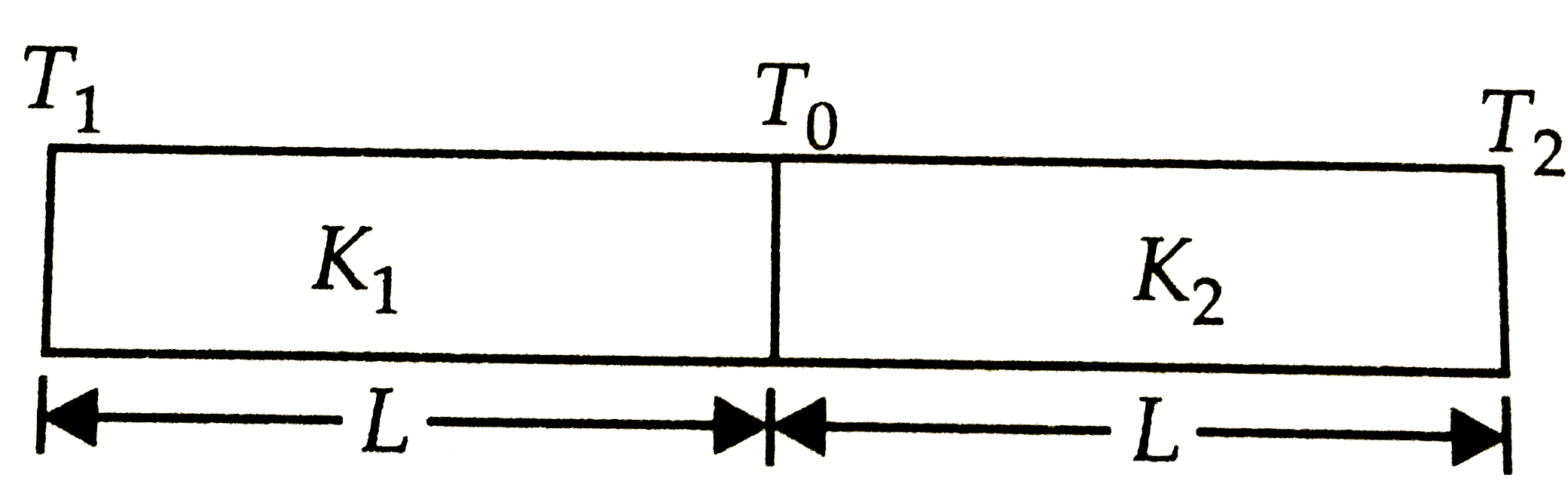
A


Let L and A be length and area of cross-section of each bar respectively.
`:.` Heat current through the bar 1 is
`H_(1) = (K_(1)A(T_(1) - T_(0)))/(L)`
Here `T_(0)` is junction temperature.
Heat current through the bar 2 is
`H_(2) = (K_(2)A(T_(0) - T_(2)))/(L)`
At steady state, `H_(1) = H_(2)`
`:. (K_(1)A(T_(1)-T_(0)))/(L) = (K_(2)A(T_(0) - T_(2)))/(L)`
`K_(1)(T_(1) - T_(0)) = K_(2) (T_(0) - T_(2))`
`K_(1)T_(1) - K_(1)T_(0) = K_(2)T_(0) - K_(2)T_(2)`
`K_(1)T_(0) + K_(2)T_(0) = K_(1)T_(1) + K_(2)T_(2)`
`T_(0)(K_(1)+K_(2)) = K_(1)T_(1) + K_(2)T_(2)`
`T_(0) = (K_(1)T_(1) + K_(2)T_(2))/((K_(1) + K_(2)))"......"(i)`
Promotional Banner

Topper's Solved these Questions

  • THERMAL PROPERTIES OF MATTER

    NCERT FINGERTIPS ENGLISH|Exercise Higher Order|8 Videos
  • THERMAL PROPERTIES OF MATTER

    NCERT FINGERTIPS ENGLISH|Exercise Exampler Problems|8 Videos
  • THERMAL PROPERTIES OF MATTER

    NCERT FINGERTIPS ENGLISH|Exercise Change of State|13 Videos
  • SYSTEM OF PARTICLES AND ROTATIONAL MOTIONS

    NCERT FINGERTIPS ENGLISH|Exercise NCERT Exemplar|8 Videos
  • THERMODYNAMICS

    NCERT FINGERTIPS ENGLISH|Exercise Assertion And Reason|15 Videos

Similar Questions

Explore conceptually related problems

Two identical rods are made of different materials whose thermal conductivities are K_(1) and K_(2) . They are placed end to end between two heat reservoirs at temperatures theta_(1) and theta_(2) . The temperature of the junction of the rod is

Three rods of equal length, area of cross section and thermal conductivity are connected as shown in the figure. There is no heat loss through lateral surface of the rods and temperature of ends are T_(A)=100^(@)C, T_(B)=70^(@)C and T_(C)=50^(@)C . Find the temperature of junction.

Three bars of equal lengths and equal areas of cross-section are connected in series. Their thermal conductivities are in the ratio of 2:4:3. If the open ends of the first and last bars are at temperatures 20^(@)C and 18^(@)C respectively in the steady state calculate the temperature of both the junctions.

A rod of length l and cross-section area A has a variable thermal conductivity given by K = alpha T, where alpha is a positive constant and T is temperature in kelvin. Two ends of the rod are maintained at temperature T_(1) and T_(2) (T_(1)gtT_(2)) . Heat current flowing through the rod will be

Two bodies of masses m_(1) and m_(2) and specific heat capacities S_(1) and S_(2) are connected by a rod of length l , cross-section area A , thermal conductivity K and negligible heat capacity. The whole system is thermally insulated. At time t=0 , the temperature of the first body is T_(1) and the temperature of the second body is T_(2)(T_(2)gtT_(1)) . Find the temperature difference between the two bodies at time t .

I-V graph for a metallie wire at two different tempearture, T_(1)and T_(2) is as shown in the figure. Which of the two temperatures is lower and why ?

Two walls of thickness d_(1) and d_(2) and thermal conductivites K_(1) and K_(2) are in contact. In the steady state, if the temperature at the outer surfaces are T_(1) and T_(2) the temperature at the common wall is

Two bodies of masses m_(1) and m_(2) and specific heat capacities S_(1) and S_(2) are connected by a rod of length l, cross-section area A, thermal conductivity K and negligible heat capacity. The whole system is thermally insulated. At time t=0 , the temperature of the first body is T_(1) and the temperature of the second body is T_(2)(T_(2)gtT_(1)) . Find the temperature difference between the two bodies at time t.

Two rods of length d_(1) and d_(2) and coefficients of thermal conductivites K_(1) and K_(2) are kept touching each other. Both have the same area of cross-section. The equivalent thermal conductivity.

Three bars of equal lengths and equal area of cross-section are connected in series fig. their thermal conducitives are in the ratio 2:3:4 . If at the steady state the open ends of the first and the last bars are at temperature 200^(@)C and 20^(@)C respectively, find the temperature of both the junctions. .

NCERT FINGERTIPS ENGLISH-THERMAL PROPERTIES OF MATTER-Heat Transper
  1. One end of a 0.25 m long metal bar is in steam and the other is in con...

    Text Solution

    |

  2. A pan filled with hot food cools from 94^(@)C to 86^(@)C in 2 minutes ...

    Text Solution

    |

  3. Two bars of same length and same cross-sectional area but of different...

    Text Solution

    |

  4. In the question number of 45, the equivalent thermal conductivity of t...

    Text Solution

    |

  5. Consider a compound slab consisting of two different material having e...

    Text Solution

    |

  6. Two rods of equal length and diameter have thermal conductivite 3 and ...

    Text Solution

    |

  7. Three metal rods of the same material and identical in all respect are...

    Text Solution

    |

  8. Three very large plates of same area are kept parrallel and close to e...

    Text Solution

    |

  9. A cubical ice box of side 50 cm has a thickness of 5.0 cm. if 5 kg of ...

    Text Solution

    |

  10. A wall has two layers A and B, each made of different material. Both t...

    Text Solution

    |

  11. Mud houses are cooler in summer and warmer in winter because

    Text Solution

    |

  12. Which of the following is the v(m) = T graph for a perfectly black bod...

    Text Solution

    |

  13. The equatorial and polar regions of the earth receive unequal sol...

    Text Solution

    |

  14. In which of the following process, convection does not take place pri...

    Text Solution

    |

  15. Wien's displacment law expresses relation between

    Text Solution

    |

  16. If lambda(m) denotes

    Text Solution

    |

  17. A black body has maximum wavelength lambda(m) at temperature 2000 K. I...

    Text Solution

    |

  18. The thermal radiation from a hot body travels with a velocity...

    Text Solution

    |

  19. Experimental investigations show that the intensity of solar radiat...

    Text Solution

    |

  20. The wavelength of maximum intensity of radiation emitted by a star is ...

    Text Solution

    |

