


Home
Class 12
PHYSICS
Identify the graph which correctly reper...

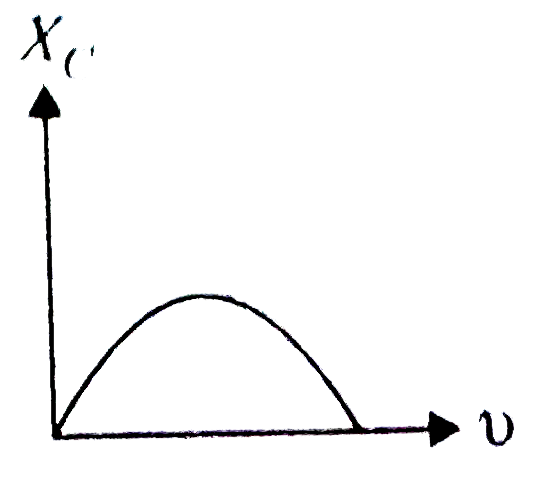
Identify the graph which correctly reperesents the variation of capacitive reactance `X_C` with frequency

A

B

C

D

Text Solution

AI Generated Solution

The correct Answer is:

To determine the variation of capacitive reactance \( X_C \) with frequency \( f \), we start by analyzing the relationship between these two quantities. ### Step-by-Step Solution: 1. **Understand the Formula for Capacitive Reactance**: The formula for capacitive reactance is given by: \[ X_C = \frac{1}{2 \pi f C} \] where \( X_C \) is the capacitive reactance, \( f \) is the frequency, and \( C \) is the capacitance. 2. **Identify the Relationship**: From the formula, we can see that \( X_C \) is inversely proportional to the frequency \( f \). This means: \[ X_C \propto \frac{1}{f} \] As the frequency increases, the capacitive reactance decreases, and vice versa. 3. **Graphical Representation**: Since \( X_C \) decreases as \( f \) increases, the graph of \( X_C \) versus \( f \) will not be a straight line. Instead, it will be a hyperbolic curve. Specifically, it will be a rectangular hyperbola. 4. **Characteristics of the Graph**: - The graph will approach the axes but never touch them, indicating that as frequency approaches zero, \( X_C \) approaches infinity, and as frequency approaches infinity, \( X_C \) approaches zero. - The shape of the graph will be such that it is in the first quadrant, with \( X_C \) on the y-axis and \( f \) on the x-axis. 5. **Conclusion**: The correct graph that represents the variation of capacitive reactance \( X_C \) with frequency \( f \) is a rectangular hyperbola.

To determine the variation of capacitive reactance \( X_C \) with frequency \( f \), we start by analyzing the relationship between these two quantities. ### Step-by-Step Solution: 1. **Understand the Formula for Capacitive Reactance**: The formula for capacitive reactance is given by: \[ X_C = \frac{1}{2 \pi f C} ...
Promotional Banner

Topper's Solved these Questions

  • ALTERNATING CURRENT

    NCERT FINGERTIPS ENGLISH|Exercise HOTS|8 Videos
  • ALTERNATING CURRENT

    NCERT FINGERTIPS ENGLISH|Exercise NCERT|7 Videos
  • ATOMS

    NCERT FINGERTIPS ENGLISH|Exercise Assertion And Reason|15 Videos

Similar Questions

Explore conceptually related problems

Which of the following curves correctly represent the variation of capacitve reactance ( underset(C )(X) ) with frequency (f) ?

Which of the following graphs represent the correct variation of inductive reactance X_(L) with frequency upsilon ?

The given graph shows the variation of velocity with displacement. Which one of the graphs given below correctly represents the variation of acceleration with displacement ?

The given graph shows the variation of velocity with displacement. Which one of the graphs given below correctly represents the variation of acceleration with displacement ?

Explain the term 'capacitive reactance'.Show graphically the variation of capacitive reactance with frequency of the applied alternating voltage. An a.c. voltage E=E_(0) sin omegat is applied a across a pure capacitor C .Show mathematically that the current flowing through it leads the applied voltage by a phase angle of pi//2

Which of the following graphs correctly represents the variation of g on the - Earth?

The velocity -displacement graph of a particle is as shown in the figure. Which of the following graphs correctly represents the variation of acceleration with displacement?

Which of the following graph correctly represents the variation of molar conductance (Delta_m) with dilution for a strong electrolyte ?

For a particle executing simple harmonic motion, the displacement x is given by x= Acosomegat . Identify the graph, which represents the variation of potential energy (U) as a function of time t and displacement x.

For a particle executing SHM, the displacement x is given by x = A cos omegat . Identify the graph which represents the variation of potential energy (PE) as a function of time t and displacement x . (a) I, III (b) II, IV (c ) II, III (d) I, IV

NCERT FINGERTIPS ENGLISH-ALTERNATING CURRENT -Assertion And Reason
  1. Identify the graph which correctly reperesents the variation of capaci...

    Text Solution

    |

  2. Assertion : An alternating current does not show any magnetic effect. ...

    Text Solution

    |

  3. Assertion: Average value of AC over a complete cycle is always zero. ...

    Text Solution

    |

  4. Assertion : The capacitive reactance limits the amplitude of the curre...

    Text Solution

    |

  5. Assertion : The inductive reactance limits amplitude of the current in...

    Text Solution

    |

  6. Assertion : In series LCR resonance circuit, the impedance is equal to...

    Text Solution

    |

  7. Assertion : In a purely inductive or capacitive circuit, the current i...

    Text Solution

    |

  8. Assertion : The only element that dissipates energy in an ac circuit i...

    Text Solution

    |

  9. Assertion : The power in ac circuit is minimum if the circuit has only...

    Text Solution

    |

  10. Assertion : Resonance is exhibited by a circuit only if both L and C a...

    Text Solution

    |

  11. Assertion : When a current flows in the coil of a transformer then its...

    Text Solution

    |

  12. Assertion : An ideal transformer does not vary the power. Reason : A...

    Text Solution

    |

  13. Assertion : A step-up transformer changes a low voltage into a high vo...

    Text Solution

    |

  14. Assertion : A given transformer can be used to step-up ot step-down th...

    Text Solution

    |

  15. Assertion : A laminated core is used in transformers to increase eddy ...

    Text Solution

    |

  16. Assertion : A transformer cannot work on dc supply. Reason : dc chan...

    Text Solution

    |
