Home
Class 12
PHYSICS
Consider a two slit interference arrange...

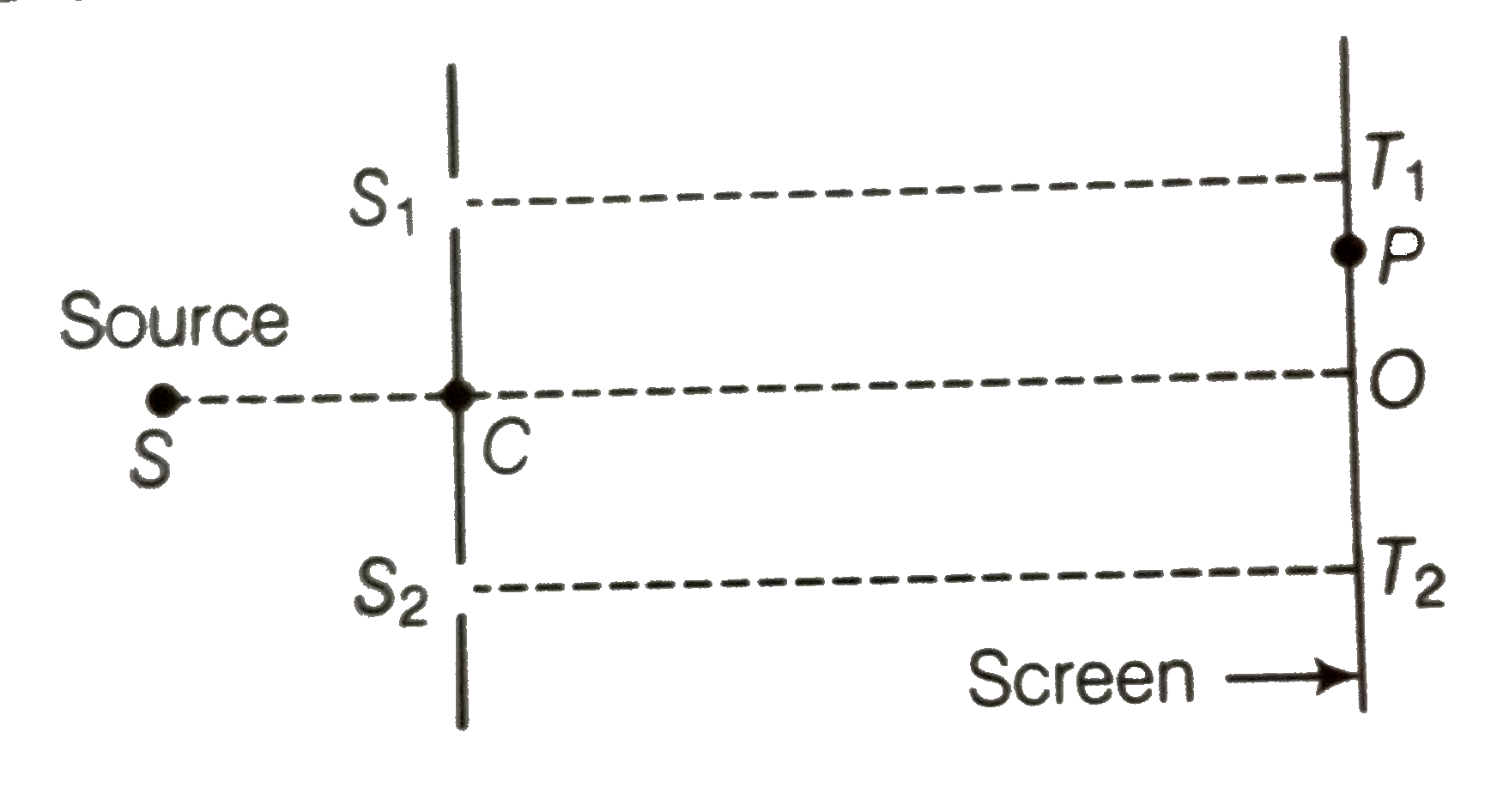
Consider a two slit interference arrangements (figure) such that the distance of the screen from the slits is half the distance between the slits. Obtain the value of D in terms of `lambda` such that the first minima on the screen falls at a distance D from the centre O.

A

`(lambda)/(2.472)`

B

`(lambda)/(2.236)`

C

`(lambda)/(1.227)`

D

`(lambda)/(3.412)`

Text Solution

Verified by Experts

The correct Answer is:
A


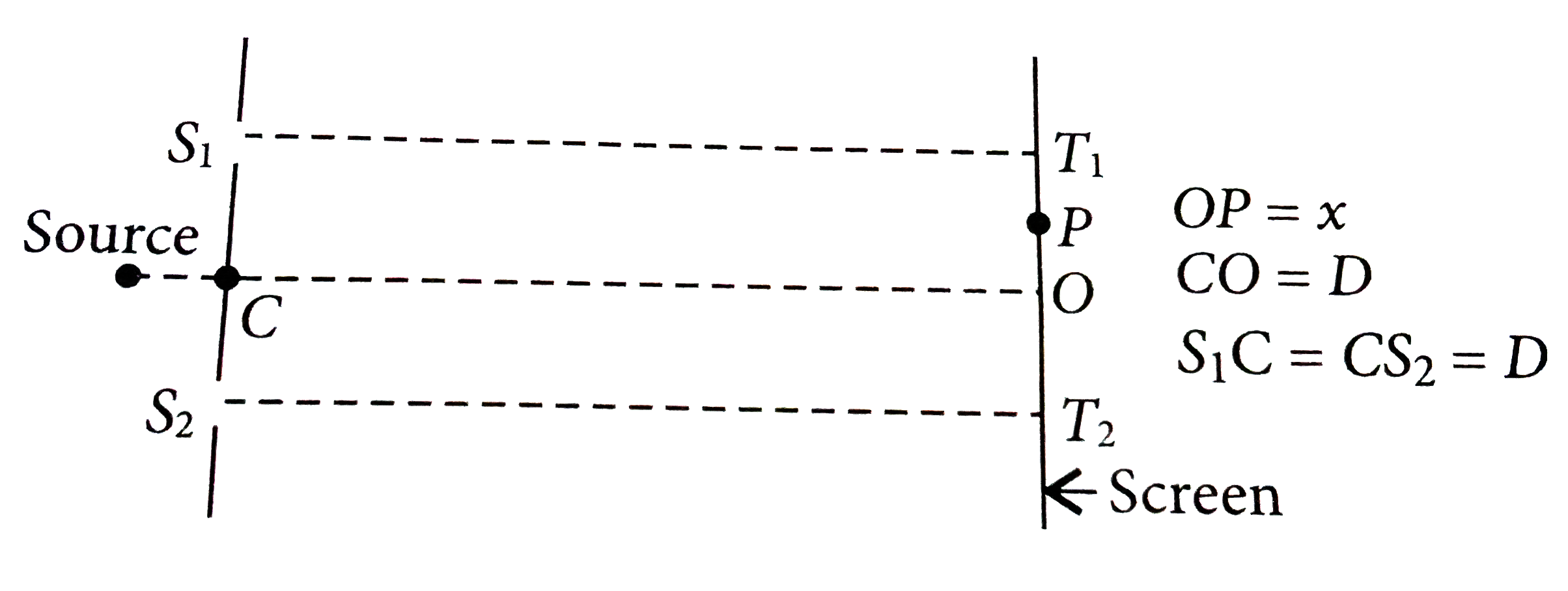
From diagram
`T_(1)P=T_(1)O-OP=(D-x)`
`T_(2)P=T_(2)O-OP=(D+x)`
Now `S_(1)P=sqrt((S_(1)T_(1))^(2)+(T_(1)P)^(2))=sqrt(D^(2)+(D-x)^(2))`
`S_(2)P=sqrt((S_(2)T_(2))^(2)+(T_(2)P)^(2))=sqrt(D^(2)+(D+x)^(2))`
Path difference `S_(2)P-S_(1)P=(lambda)/(2)`, for first minimum to occur
`sqrt(D^(2)+(D+x)^(2))-sqrt(D^(2)+(D-x)^(2))=(lambda)/(2)`
The first minimum falls at a distance D from the center, i.e., `x=D.`
`[D^(2)+4D^(2)]^(1//2)-D=(lambda)/(2)`
`D(sqrt(5)-1)=(lambda)/(2)`
`D(2.236-1)=(lambda)/(2)" , "D=(lambda)/(2.472)`
Promotional Banner

Topper's Solved these Questions

  • WAVE OPTICS

    NCERT FINGERTIPS ENGLISH|Exercise NCERT EXEMPLAR PROBLEMS|5 Videos
  • WAVE OPTICS

    NCERT FINGERTIPS ENGLISH|Exercise ASSERTION & REASON CORNER|15 Videos
  • WAVE OPTICS

    NCERT FINGERTIPS ENGLISH|Exercise Assertion And Reason|15 Videos
  • SEMICONDUCTOR ELECTRONICS : MATERIALS , DEVICES AND SIMPLE CIRCUITS

    NCERT FINGERTIPS ENGLISH|Exercise Assertion And Reason|15 Videos

Similar Questions

Explore conceptually related problems

Consider two slit interference arrangements as shown in figure . The distance of screen from the slits is half the distance between the slits. Then the value of 'D' if fisrt minima on screen falls at a distance D from the centre 'C' ( lambda is the wavelength of the source).

In a special arrangement of Young's double - slits d is twice the distance between the screen and the slits D, i.e. d = 2D. For the setup, the value of D such that the first minima on the screen fall at a distance D from the centre O is found to be (lambda)/(N) , where lambda is the wavelength of light used. What is the value of N ? ["Take "sqrt5=2.24]

In Young's double slit experiment, the sepcaration between the slits is halved and the distance between the slits and the screen is doubled. The fringe width is

In Young's double slit experiment, the sepcaration between the slits is halved and the distance between the slits and the screen is doubled. The fringe width is

In Young's double slit experiment, the separation between the slits is halved and the distance between the slits and the screen is doubled. The fringe width is

In Young's double-slit experiment, the separation between the slits is halved and the distance between the slits and the screen in doubled. The fringe width is

A beam of light consisting of two wavelenths, 6500 Å and 5200 Å is used to obtain interference fringes in a Young's double slit experiment (1 Å = 10^(-10) m). The distance between the slits is 2.0 mm and the distance between the plane of the slits and the screen in 120 cm. (a) Find the distance of the third bright frings on the screen from the central maximum for the wavelength 6500 Å (b) What is the least distance from the central maximum where the bright frings due to both the wavlelengths coincide ?

In young's double slit experiment, distance between the slit S_1 and S_2 is d and the distance between slit and screen is D . Then longest wavelength that will be missing on the screen in front of S_1 is

In Young's double slit experiment, if the distance between two slits is equal to the wavelength of used light. Then the maximum number of bright firnges obtained on the screen will be

In a double slit experiment ,the separation between the slits is d=0.25cm and the distance of the screen D=100 cm from the slits .if the wavelength of light used in lambda=6000Å and I_(0) is the intensity of the central bright fringe. The intensity at a distance x=4xx10^(-5) in form the central maximum is-

