Home
Class 11
PHYSICS
One mole of an ideal gas goes from an in...

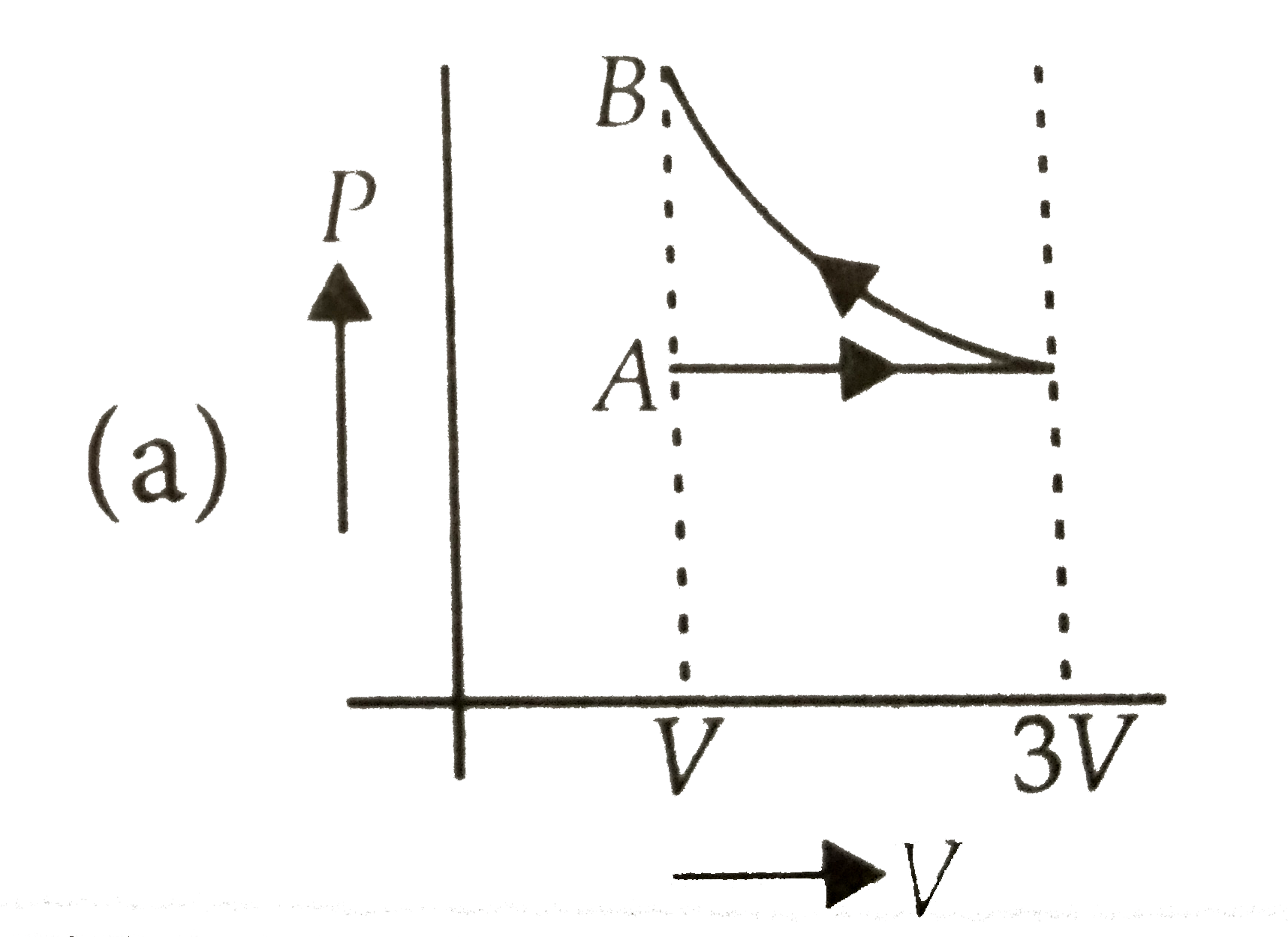
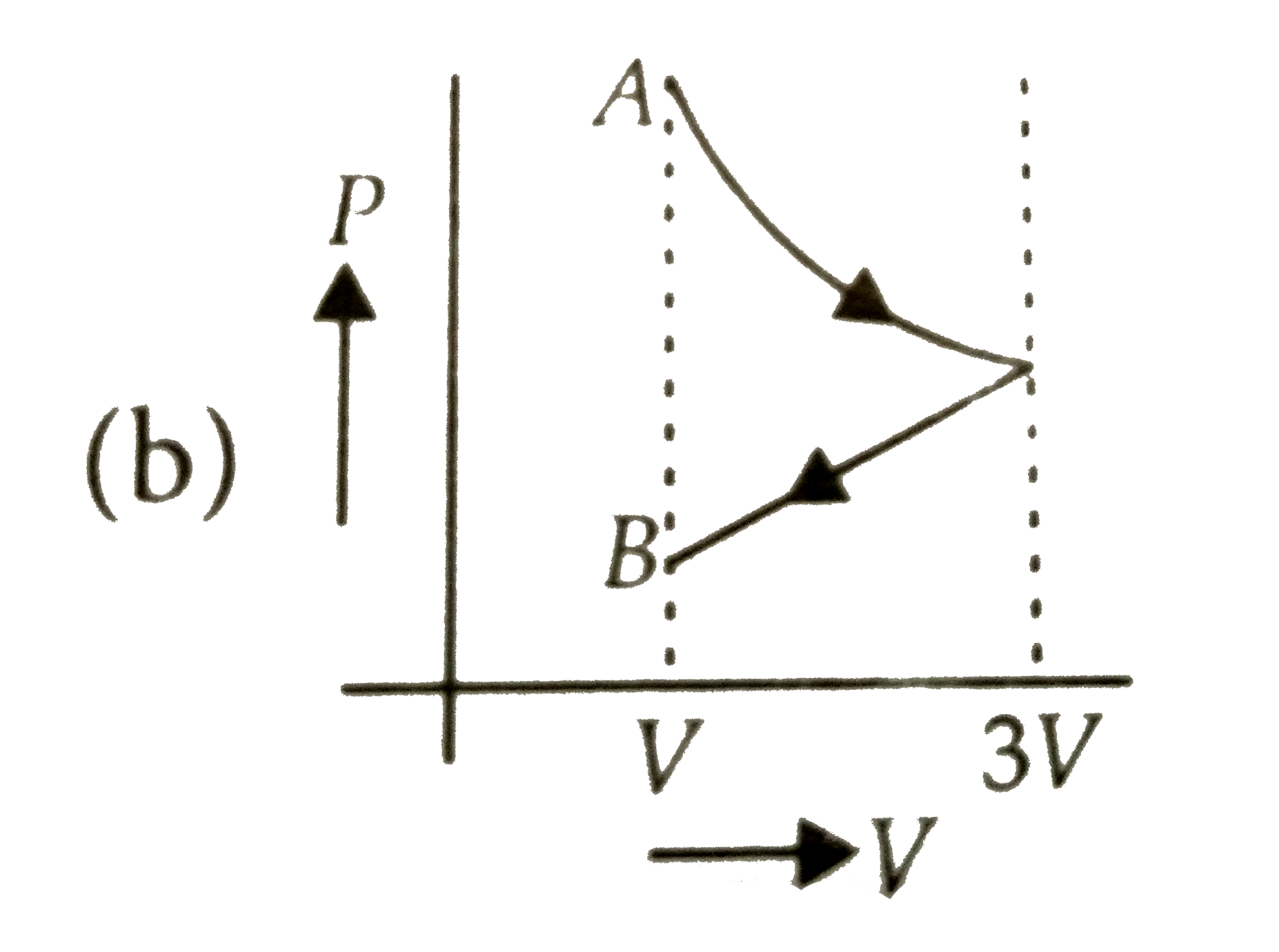
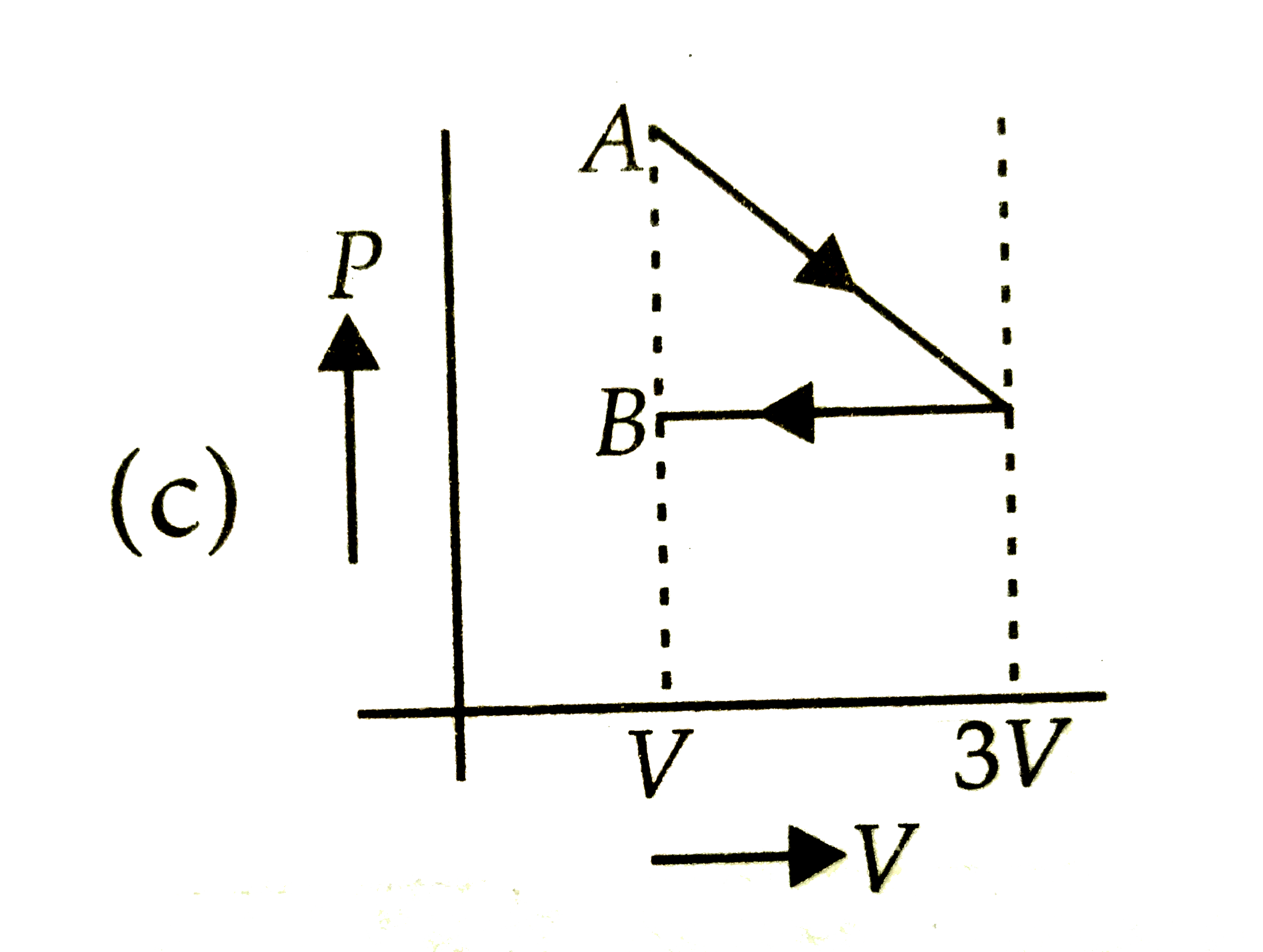
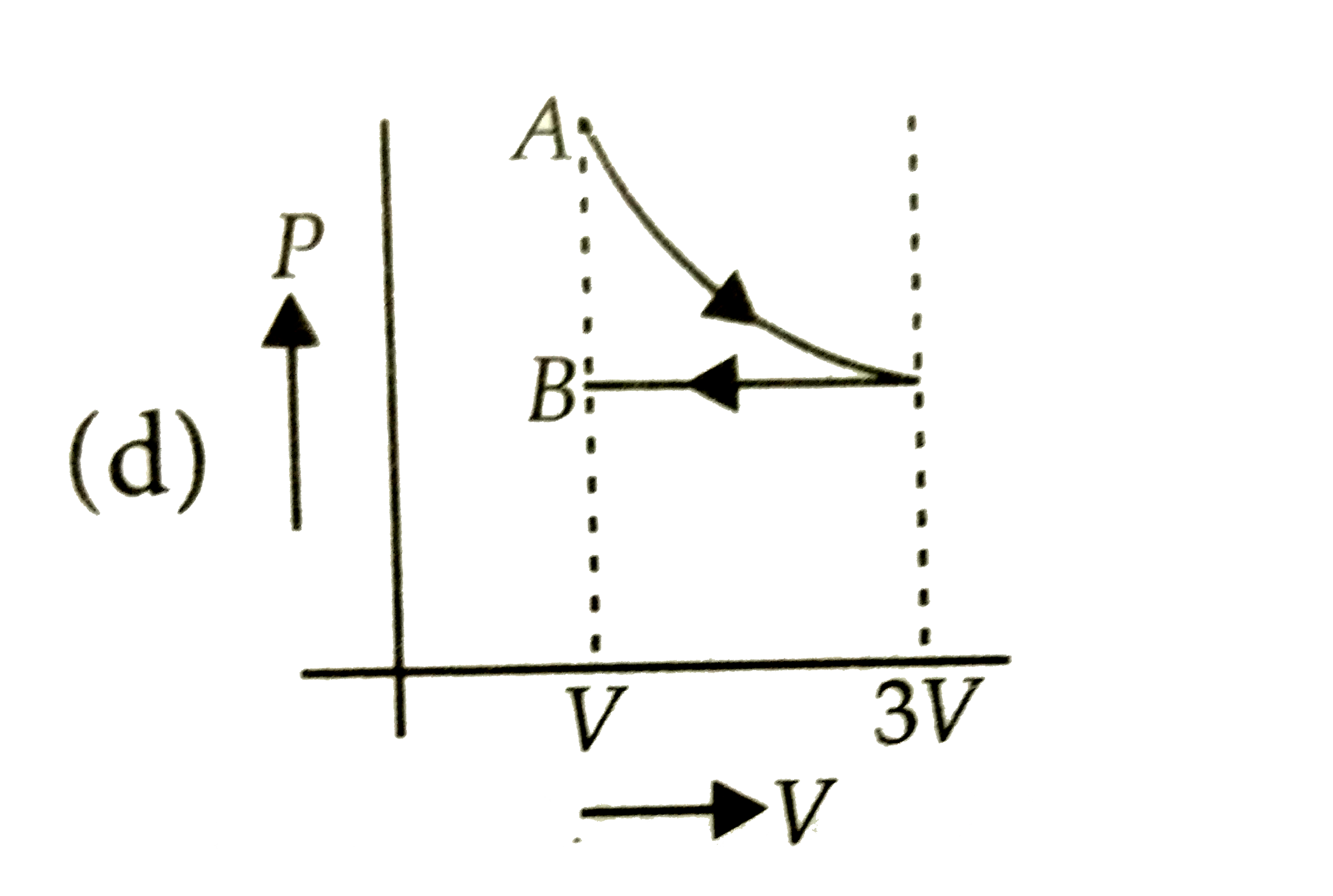
One mole of an ideal gas goes from an initial state A to final state B via two processs : It first undergoes isothermal expansion from volume `V` to `3 V` and then its volume is reduced from `3 V` to `V` at constant pressure. The correct `P-V` diagram representing the two process in (figure)

A

B

C

D

Text Solution

AI Generated Solution

The correct Answer is:

To solve the problem step by step, we will analyze the two processes that the ideal gas undergoes and then sketch the corresponding P-V diagram. ### Step 1: Identify the Initial and Final States - The initial state (A) has a volume of \( V \). - The final state (B) has a volume of \( V \) after going through two processes. ### Step 2: Process 1 - Isothermal Expansion - The gas undergoes an isothermal expansion from volume \( V \) to \( 3V \). - In an isothermal process, the temperature remains constant. According to the ideal gas law, \( PV = nRT \), where \( n \) is the number of moles and \( R \) is the gas constant. - Since \( n \) and \( R \) are constants, the product \( PV \) remains constant during this process. - As the volume increases from \( V \) to \( 3V \), the pressure must decrease. This relationship is inversely proportional, which means the graph will be a hyperbola that slopes downwards. ### Step 3: Process 2 - Isobaric Compression - The second process is a constant pressure (isobaric) process where the volume decreases from \( 3V \) to \( V \). - Since the pressure remains constant during this process, the P-V diagram will show a horizontal line at the pressure level corresponding to the pressure at volume \( 3V \). - The line will extend from \( 3V \) to \( V \), indicating that the volume is decreasing while the pressure remains constant. ### Step 4: Sketch the P-V Diagram - On the P-V diagram: - Start at point A (volume \( V \), pressure \( P_A \)). - Draw a curve from point A to point C (volume \( 3V \), pressure \( P_C \)), indicating the isothermal expansion. - From point C, draw a horizontal line to point B (volume \( V \), pressure \( P_C \)), indicating the isobaric compression. ### Step 5: Identify the Correct P-V Diagram - Based on the description of the processes, we can now identify the correct P-V diagram from the options provided. The correct diagram should show: - A downward-sloping curve from \( V \) to \( 3V \) for the isothermal process. - A horizontal line from \( 3V \) to \( V \) for the isobaric process. ### Conclusion The correct P-V diagram representing the two processes is option D, as it accurately reflects the isothermal expansion followed by the isobaric compression.

To solve the problem step by step, we will analyze the two processes that the ideal gas undergoes and then sketch the corresponding P-V diagram. ### Step 1: Identify the Initial and Final States - The initial state (A) has a volume of \( V \). - The final state (B) has a volume of \( V \) after going through two processes. ### Step 2: Process 1 - Isothermal Expansion - The gas undergoes an isothermal expansion from volume \( V \) to \( 3V \). ...
Promotional Banner

Topper's Solved these Questions

  • THERMODYNAMICS

    NCERT FINGERTIPS ENGLISH|Exercise HOTs|8 Videos
  • THERMODYNAMICS

    NCERT FINGERTIPS ENGLISH|Exercise Assertion & Reason|15 Videos
  • THERMAL PROPERTIES OF MATTER

    NCERT FINGERTIPS ENGLISH|Exercise Assertion And Reason|10 Videos
  • UNITS AND MEASUREMENTS

    NCERT FINGERTIPS ENGLISH|Exercise Assertion And Reason|15 Videos

Similar Questions

Explore conceptually related problems

An ideal gas undergoes isothermal process from some initial state i to final state f . Choose the correct alternatives.

P - V diagram of an ideal gas is shown. The gas undergoes from initial state A to final state B such that initial and final volumes are same. Select the correct alternative for given process AB.

One mole of an ideal gas is taken from state A to state B by three different processes (a) ACB , (b) ADB and (c ) AEB as shown in the P - V diagram. The heat absorbed by the gas is

One mole of an ideal gas is taken from state A to state B by three different processes (a) ACB , (b) ADB and (c ) AEB as shown in the P - V diagram. The heat absorbed by the gas is

The equation of a state of a gas is given by p(V-b)=nRT . If 1 mole of a gas is isothermally expanded from volume V and 2V, the work done during the process is

When a sample of ideal gas is changed from an initial state to a final state, various curves can be plotted for the process like P-V curve, V-T curve,P-T curve etc. For example, P-V curve for a fixed amount of an ideal gas at constant temperature is a rectangular hyperbola, V-T curve for a fixed amount of an ideal gas at constant volume is again a straight line. However, the shapes may vary if the constant parameters are also changed. Now, answer the following questions : Which of the following graphs is not possible for a fixed amount of ideal gas upon moving from initial state A to final state B :

When a sample of ideal gas is changed from an initial state to a final state, various curves can be plotted for the process like P-V curve, V-T curve,P-T curve etc. For example, P-V curve for a fixed amount of an ideal gas at constant temperature is a rectangular hyperbola, V-T curve for a fixed amount of an ideal gas at constant volume is again a straight line. However, the shapes may vary if the constant parameters are also changed. Now, answer the following questions : Two moles of an ideal gas is changed from its initial state (16 atm, 6L) to final state (4 atm, 15L) in such a way that this change can be represented by a straight line in P-V curve.The maximum temperature attained by the gas during the above change is :(Take : R=1/12L atm K^(-1) "mol"^(-1) )

The work done, W, during an isothermal process in which the gas expands from an intial volume V_(1) , to a final volume V_(2) is given by (R : gas constant, T : temperature )

The pressure P and volume V of an ideal gas both decreases in a process.

NCERT FINGERTIPS ENGLISH-THERMODYNAMICS-Assertion And Reason
  1. One mole of an ideal gas goes from an initial state A to final state B...

    Text Solution

    |

  2. Assertion: The zeroth law said that , when two systems A and B, are in...

    Text Solution

    |

  3. Assertion : When a bullet is fired from a gun the bullet pierces a woo...

    Text Solution

    |

  4. Assertion : First law of thermodynamics does not forbid flow of heat f...

    Text Solution

    |

  5. Assertion:A constant volume gas thermometer, reads temperature in term...

    Text Solution

    |

  6. Assertion: The isothermal curves intersect each other at a certain poi...

    Text Solution

    |

  7. Assertion : In an isothemal expansion the gas absorbs heat and does wo...

    Text Solution

    |

  8. Assertion : In an adiabatic process, change in internal energy of a ga...

    Text Solution

    |

  9. Assetion : The temperature of a gas does not change when it undergoes...

    Text Solution

    |

  10. Assertion : In an isolated system the entropy increases. Reason : Th...

    Text Solution

    |

  11. Assertion: A heat engine is the reverse of a refrigerator. Reason : ...

    Text Solution

    |

  12. Assertion : The efficiency of a heat engine can never be unity. Reas...

    Text Solution

    |

  13. Assetion : A refrigerator transfers heat from a lower temperature to a...

    Text Solution

    |

  14. Assertion : A quasi static isothermal expansion of an ideal gas in a c...

    Text Solution

    |

  15. Assertion: Thermodynamics process in nature are irreversible. Reason...

    Text Solution

    |

  16. Assetion : No engine can have efficiencyt greater than that of the car...

    Text Solution

    |
