


Home
Class 12
PHYSICS
In a hydrogen atom, the radius of n^(th)...

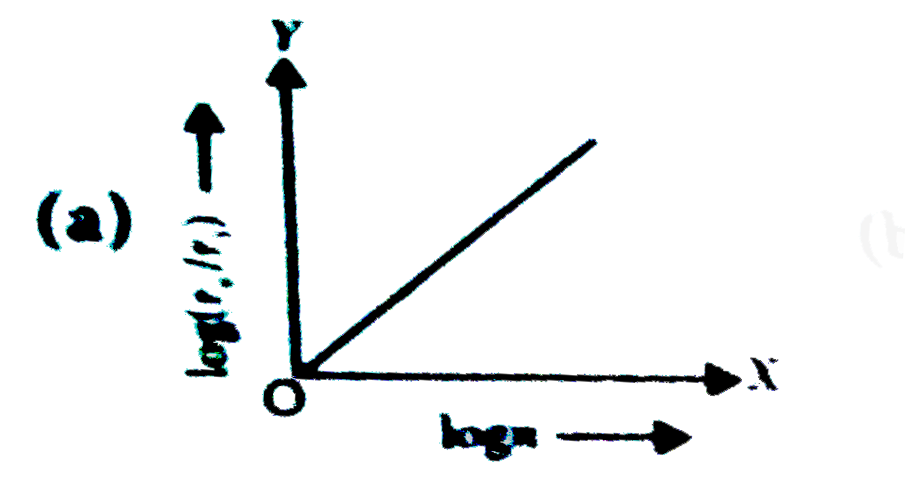
In a hydrogen atom, the radius of `n^(th)` bohr orbit is `r_n`. The graph between log `(r_n//r_1)` and logn will be

A

B

C

D

Text Solution

AI Generated Solution

The correct Answer is:

To find the graph between log \((r_n/r_1)\) and log \(n\) for a hydrogen atom, we can follow these steps: ### Step 1: Understand the relationship between the radius of the nth orbit and the first orbit The radius of the nth orbit \(r_n\) in a hydrogen atom is given by the formula: \[ r_n = n^2 r_1 \] where \(r_1\) is the radius of the first orbit. ### Step 2: Express \(r_n/r_1\) From the formula above, we can express the ratio of the radii: \[ \frac{r_n}{r_1} = n^2 \] ### Step 3: Take the logarithm of both sides Now, we take the logarithm of both sides of the equation: \[ \log\left(\frac{r_n}{r_1}\right) = \log(n^2) \] ### Step 4: Apply the logarithmic identity Using the logarithmic identity \(\log(a^b) = b \cdot \log(a)\), we can simplify the right side: \[ \log\left(\frac{r_n}{r_1}\right) = 2 \cdot \log(n) \] ### Step 5: Rearranging the equation This can be rearranged to show the relationship between \(\log\left(\frac{r_n}{r_1}\right)\) and \(\log(n)\): \[ \log\left(\frac{r_n}{r_1}\right) = 2 \log(n) \] ### Step 6: Identify the graph characteristics This equation is in the form of \(y = mx\), where \(y = \log\left(\frac{r_n}{r_1}\right)\), \(x = \log(n)\), and \(m = 2\). This indicates that the graph will be a straight line passing through the origin with a slope of 2. ### Conclusion Thus, the graph between \(\log\left(\frac{r_n}{r_1}\right)\) and \(\log(n)\) is a straight line passing through the origin with a slope of 2. ---

To find the graph between log \((r_n/r_1)\) and log \(n\) for a hydrogen atom, we can follow these steps: ### Step 1: Understand the relationship between the radius of the nth orbit and the first orbit The radius of the nth orbit \(r_n\) in a hydrogen atom is given by the formula: \[ r_n = n^2 r_1 \] where \(r_1\) is the radius of the first orbit. ...
Promotional Banner

Topper's Solved these Questions

  • ATOMS

    NCERT FINGERTIPS ENGLISH|Exercise Higher order thinking skills|8 Videos
  • ATOMS

    NCERT FINGERTIPS ENGLISH|Exercise NCERT Examplar problems|7 Videos
  • ALTERNATING CURRENT

    NCERT FINGERTIPS ENGLISH|Exercise Assertion And Reason|15 Videos
  • COMMUNITCATION SYSTEMS

    NCERT FINGERTIPS ENGLISH|Exercise Assertion And Reason|30 Videos

Similar Questions

Explore conceptually related problems

Derive an expression for the radius of n^(th) Bohr’s orbit in Hydrogen atom.

If, in a hydrogen atom, radius of nth Bohr orbit is r_(n) frequency of revolution of electron in nth orbit is f_(n) and area enclosed by the nth orbit is A_(n) , then which of the pollowing graphs are correct?

The radius of second Bohr’s orbit of Hydrogen atom is:

In Bohr.s model of hydrogen atom, radius of the first orbit of an electron is r_(0) . Then, radius of the third orbit is:

If the radius of the first Bohr orbit of the H atom is r then for the Li^(2+) ion it will be:

Radius of Bohr's orbit of hydrogen atom is

Radius of Bohr's orbit of hydrogen atom is

From quantisation of angular momentum one gets for hydrogen atom, the radius of the n^th orbit as r_n=((n^2)/(m_e))((h)/(2pi))^2((4piepsilon_0)/(e^2)) For a hydrogen like atom of atomic number Z,

Suppose an electron is attracted toward the origin by a force (k)/(r ) where k is a constant and r is the distance of the electron from the origin .By applying Bohr model to this system the radius of the n^(th) orbital of the electron is found to be r_(n) and the kinetic energy of the electron to be T_(n) , Then which of the following is true ?

Suppose an electron is attracted toward the origin by a force (k)/(r ) where k is a constant and r is the distance of the electron from the origin .By applying Bohr model to this system the radius of the n^(th) orbital of the electron is found to be r_(n) and the kinetic energy of the electron to be T_(n) , Then which of the following is true ?

NCERT FINGERTIPS ENGLISH-ATOMS -Assertion And Reason
  1. In a hydrogen atom, the radius of n^(th) bohr orbit is rn. The graph b...

    Text Solution

    |

  2. (A) atoms of each element are stable and emit characteristic spectrum....

    Text Solution

    |

  3. (A) atom as a whole is electrically neutral. (R)atom contains equal ...

    Text Solution

    |

  4. (A) according to classical electromagnetic theory an accelerated parti...

    Text Solution

    |

  5. (A) in alpha particle scattering number of alpha paritcle undergoing h...

    Text Solution

    |

  6. (A) most of the mass of the atom is concentrated in its nucleus. (R)...

    Text Solution

    |

  7. (A) the trajetory traced by an incident particle depends on the impact...

    Text Solution

    |

  8. (A) in the experiment of alpha particle scattering, extremely thin gol...

    Text Solution

    |

  9. (A) the total energy of an electron revolving in any stationary orbit ...

    Text Solution

    |

  10. Statement -1 : Large angle scattering of alpha particles led to the di...

    Text Solution

    |

  11. Assertion: For the scattering of alpha-particles at a large angles, on...

    Text Solution

    |

  12. Assertion: Hydrogen atom consists of anly one electron but its emissio...

    Text Solution

    |

  13. (A) bohr model can not be extended to two or more electron atoms. (R...

    Text Solution

    |

  14. Assertion: Bohr had to postulate that the electrons in stationary orbi...

    Text Solution

    |

  15. (A) bohr's third postulaate states that the stationary orbits are thos...

    Text Solution

    |

  16. Assertion: Electrons in the atom are held due to coulomb forces. Rea...

    Text Solution

    |
