Home
Class 12
PHYSICS
A spherical insulator of radius R is cha...

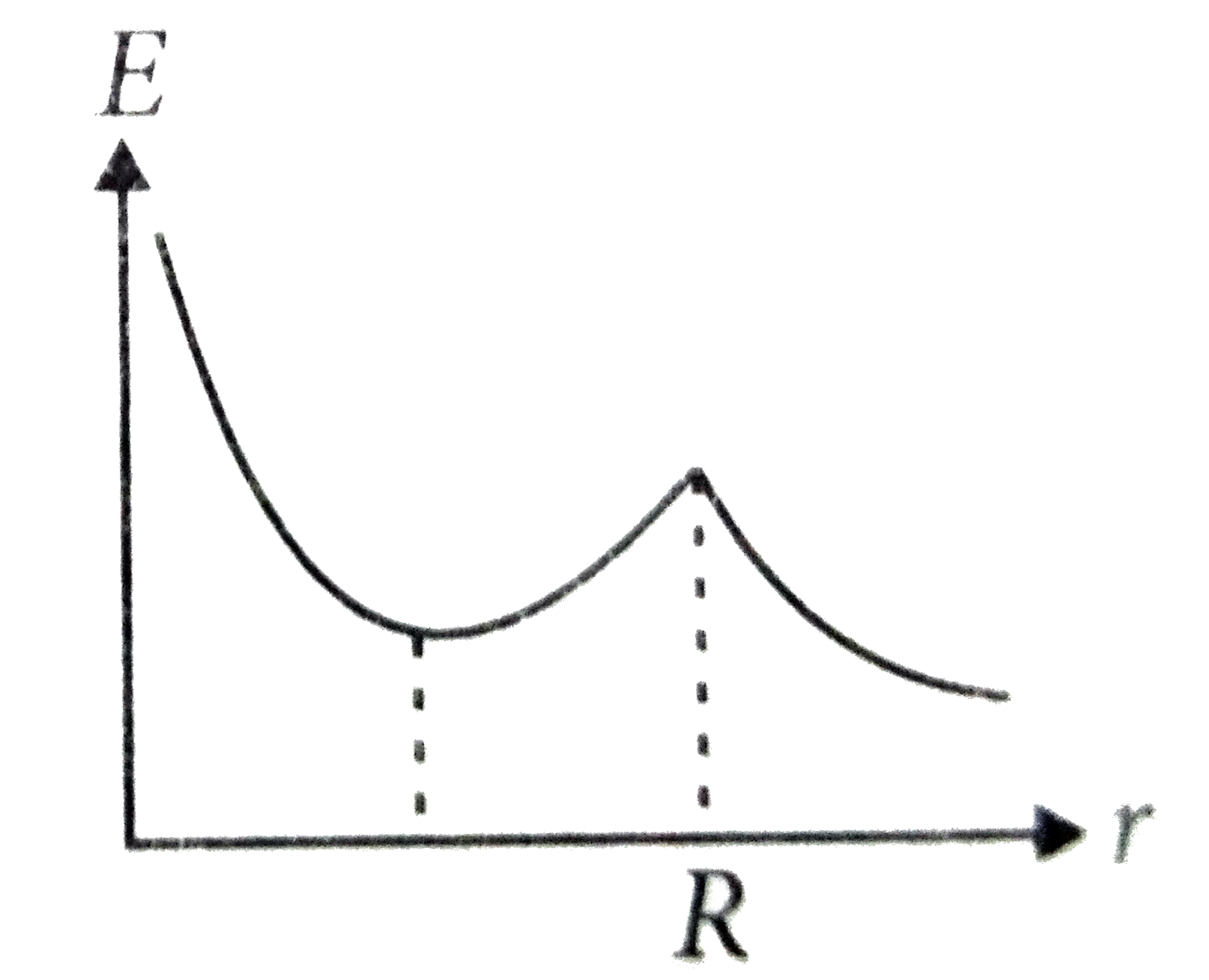
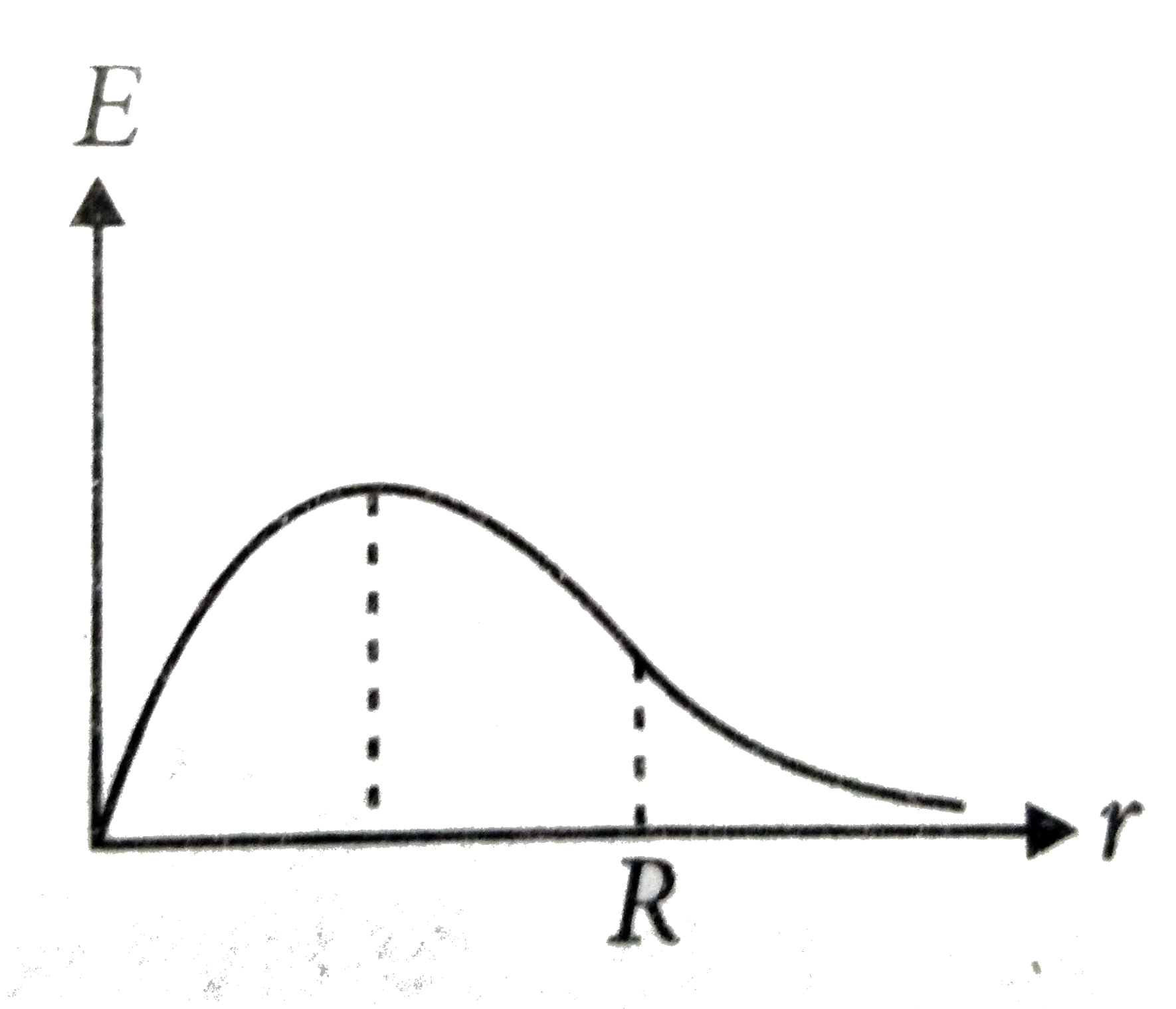
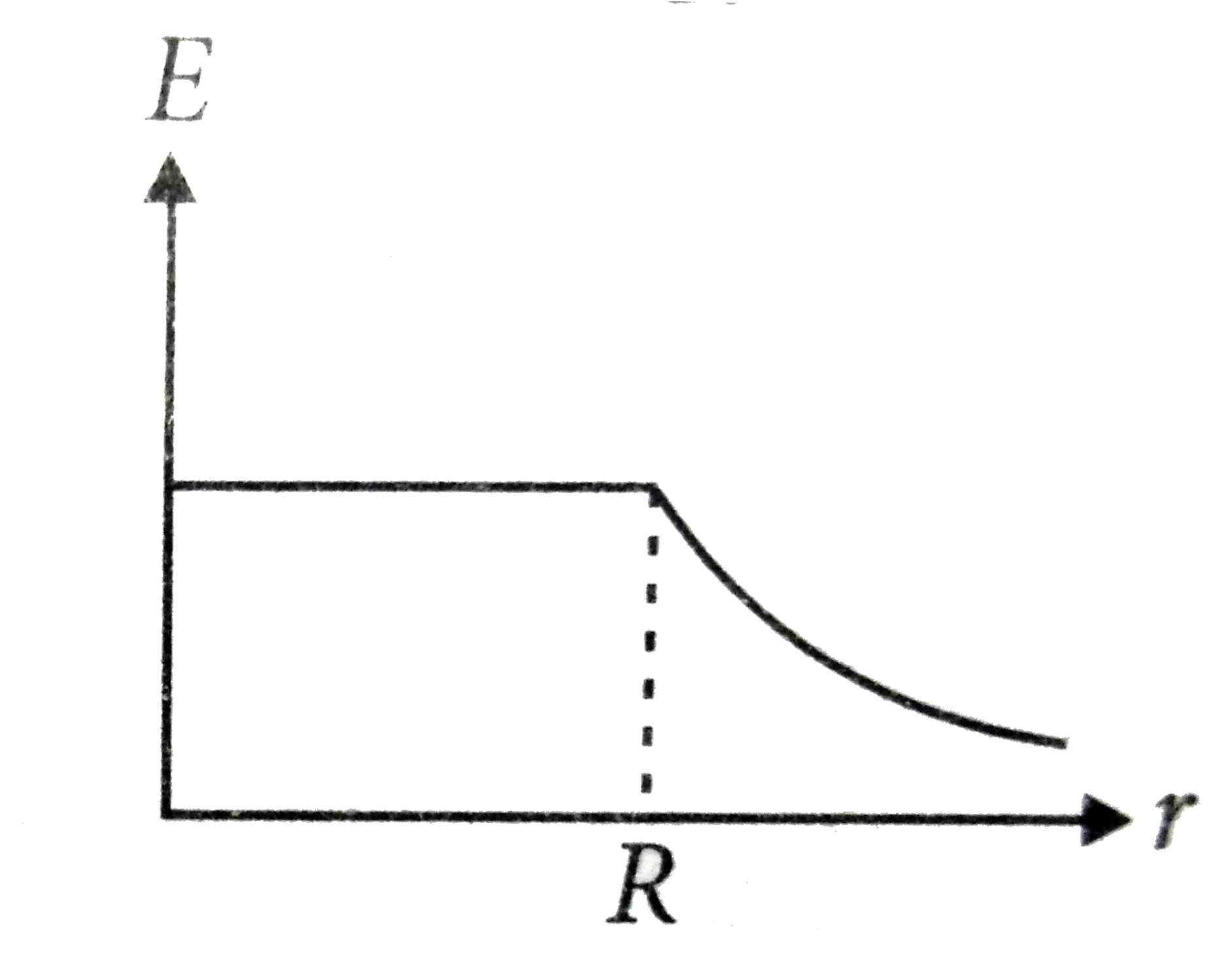
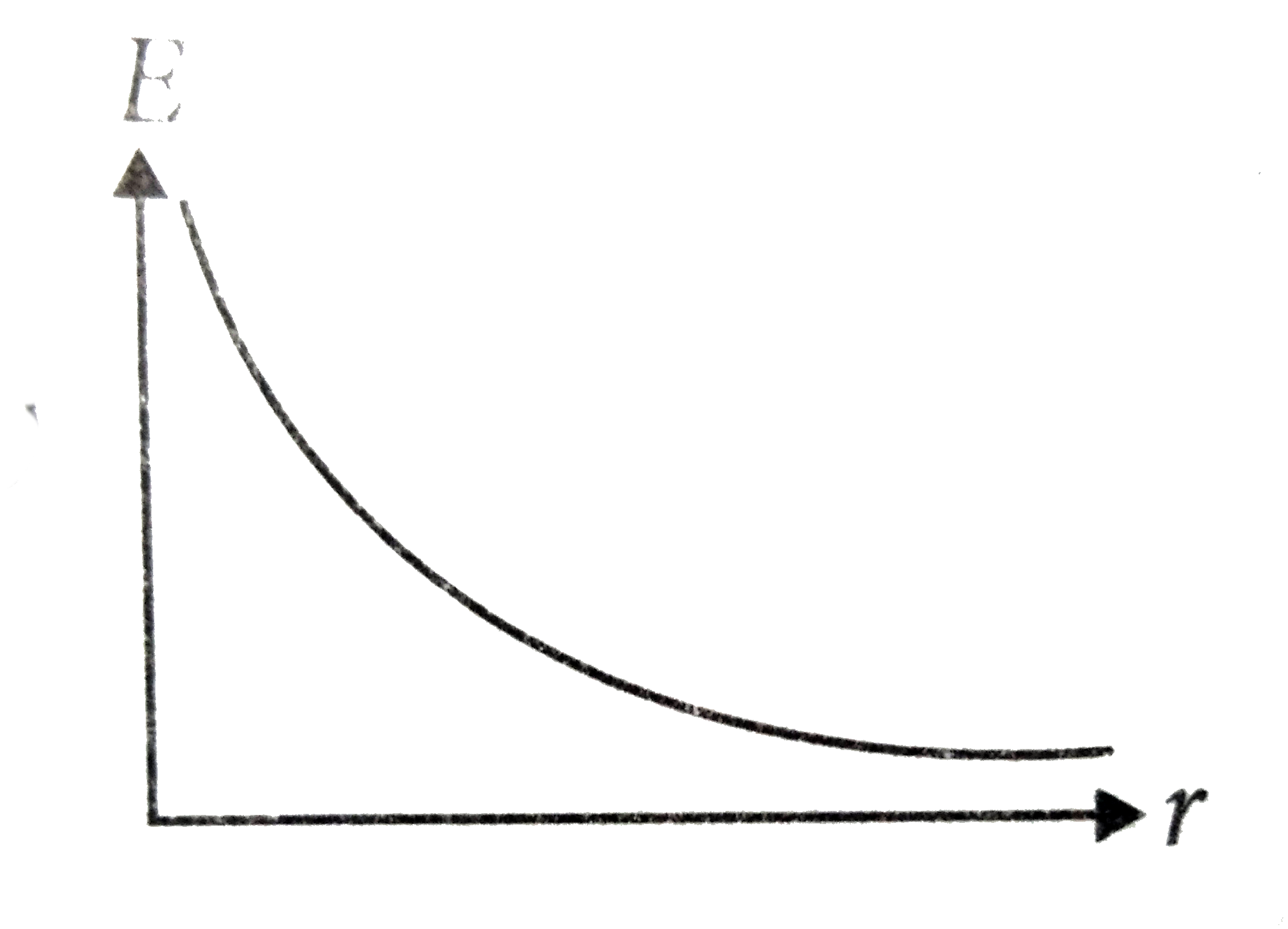
A spherical insulator of radius R is charged uniformly with a charge Q throughout its volume and contains a point charge `Q/16` located at its centre. Which of the following graphs best represents qualitatively, the variation of electric field intensity E with distance r from the centre?

A

B

C

D

Text Solution

AI Generated Solution

The correct Answer is:

To solve the problem of determining the variation of electric field intensity \( E \) with distance \( r \) from the center of a uniformly charged spherical insulator containing a point charge at its center, we can follow these steps: ### Step 1: Understand the Setup We have a spherical insulator of radius \( R \) uniformly charged with a total charge \( Q \) and a point charge \( \frac{Q}{16} \) located at its center. We need to analyze how the electric field \( E \) behaves at different distances \( r \) from the center. ### Step 2: Electric Field Inside the Sphere For a point inside the uniformly charged sphere (i.e., \( r < R \)), the electric field due to the uniformly charged sphere can be calculated using Gauss's law. The charge enclosed within a Gaussian surface of radius \( r \) is given by: \[ Q_{\text{enc}} = \frac{Q}{V} \times \text{Volume of sphere of radius } r = \frac{Q}{\frac{4}{3} \pi R^3} \times \frac{4}{3} \pi r^3 = Q \frac{r^3}{R^3} \] The electric field \( E \) at a distance \( r \) from the center is given by: \[ E = \frac{1}{4 \pi \epsilon_0} \frac{Q_{\text{enc}}}{r^2} = \frac{1}{4 \pi \epsilon_0} \frac{Q \frac{r^3}{R^3}}{r^2} = \frac{Q}{4 \pi \epsilon_0 R^3} r \] Additionally, we must consider the electric field due to the point charge \( \frac{Q}{16} \): \[ E_{\text{point}} = \frac{1}{4 \pi \epsilon_0} \frac{\frac{Q}{16}}{r^2} \] Thus, the total electric field \( E \) inside the sphere (for \( r < R \)) becomes: \[ E_{\text{total}} = \frac{Q}{4 \pi \epsilon_0 R^3} r + \frac{1}{4 \pi \epsilon_0} \frac{\frac{Q}{16}}{r^2} \] ### Step 3: Electric Field Outside the Sphere For distances greater than \( R \) (i.e., \( r > R \)), the total charge affecting the electric field is the sum of the charge of the sphere and the point charge: \[ E = \frac{1}{4 \pi \epsilon_0} \frac{Q + \frac{Q}{16}}{r^2} = \frac{1}{4 \pi \epsilon_0} \frac{\frac{17Q}{16}}{r^2} \] ### Step 4: Analyzing the Graph 1. **For \( r < R \)**: The electric field \( E \) increases linearly with \( r \) due to the uniform charge distribution and the point charge. 2. **At \( r = R \)**: The electric field reaches a maximum value. 3. **For \( r > R \)**: The electric field decreases with the square of the distance \( r^2 \). ### Step 5: Conclusion Based on the analysis, the graph representing the electric field \( E \) will show: - A linear increase in \( E \) for \( r < R \). - A maximum at \( r = R \). - A decrease as \( r \) increases beyond \( R \). The correct option is the one that shows this behavior, typically resembling a curve that increases linearly, peaks at \( R \), and then decreases as \( r \) increases.

To solve the problem of determining the variation of electric field intensity \( E \) with distance \( r \) from the center of a uniformly charged spherical insulator containing a point charge at its center, we can follow these steps: ### Step 1: Understand the Setup We have a spherical insulator of radius \( R \) uniformly charged with a total charge \( Q \) and a point charge \( \frac{Q}{16} \) located at its center. We need to analyze how the electric field \( E \) behaves at different distances \( r \) from the center. ### Step 2: Electric Field Inside the Sphere For a point inside the uniformly charged sphere (i.e., \( r < R \)), the electric field due to the uniformly charged sphere can be calculated using Gauss's law. The charge enclosed within a Gaussian surface of radius \( r \) is given by: ...
Promotional Banner

Topper's Solved these Questions

  • ELECTRIC CHARGES AND FIELDS

    NCERT FINGERTIPS ENGLISH|Exercise Higher Order Thinking Skills|7 Videos
  • ELECTRIC CHARGES AND FIELDS

    NCERT FINGERTIPS ENGLISH|Exercise NCERT Exemplar|5 Videos
  • ELECTRIC CHARGES AND FIELDS

    NCERT FINGERTIPS ENGLISH|Exercise Application Of Gauss Law|9 Videos
  • DUAL NATURE OF RADIATION AND MATTER

    NCERT FINGERTIPS ENGLISH|Exercise Assertion And Reason|15 Videos
  • ELECTROMAGNETIC INDUCTION

    NCERT FINGERTIPS ENGLISH|Exercise NCERT Exemplar|6 Videos

Similar Questions

Explore conceptually related problems

Which one of the following graphs represents the variation of electric field with distance r from the centre of a charged spherical conductor of radius R?

Figure shows two concentric shells of radii a and b uniformly distributed charges q and -q. Which of the following graphs gives correct variation of electric field intensity E with the distance r from the centre?

A metallic spherical shell of radius R has a charge -Q on it. A point charge +Q is placed at the centre of the shell. Which of the graphs shown below may correctly represent the variation of electric field E with distance r from the centre of shell ?

For a uniformly charged non conducting sphere of radius R which of following shows a correct graph between the electric field intensity and the distance from the centre of sphere –

A charge Q is uniformly distributed in a dielectric sphere of radius R (having dielectric constant unity). This dielectric sphere is enclosed by a concentric spherical shell of radius 2R and having uniformly distributed charge 2Q. Which of the following graph correctly represents variation of electric field with distance r from the common centre?

A thin spherical shell of radius R has charge Q spread uniformly over its surface. Which of the following graphs most closely represents the electric field E(r) produced by the shell in the range 0lerltoo , where r is the distance from the centre of the shell?

A thin spherical shell of radius R has charge Q spread uniformly over its surface. Which of the following graphs most closely represents the electric field E(r) produced by the shell in the range 0lerltoo , where r is the distance from the centre of the shell?

A hallow metal sphere of radius R is uniformly charged. The electric field due to the sphere at a distance r from the centre:

A solid sphere of radius R is charged uniformly through out the volume. At what distance from its surface is the electric potential 1/4 of the potential at the centre?

A non conducting sphere of radius a has a net charge +q uniformly distributed throughout its volume. A spherical conducting shell having inner and outer radii b and c and net charge -q is concentric with the sphere (see the figure). Read the following statements (i) The electric field at a distance r from the centre of the sphere for r lt a is 1/(4piepsilon_(0))(qr)/a^(3) (ii) The electric field at distance r for a lt r lt b is 0 (iii) The electric field at distance r for b lt r lt c is 0 (iv) The charge on the inner surface of the spherical shell is - q (v) The charge on the outer surface of the spherical shell is + q Which of the above statements are true?
