Home
Class 12
PHYSICS
A sliding rod AB of resistance R is show...

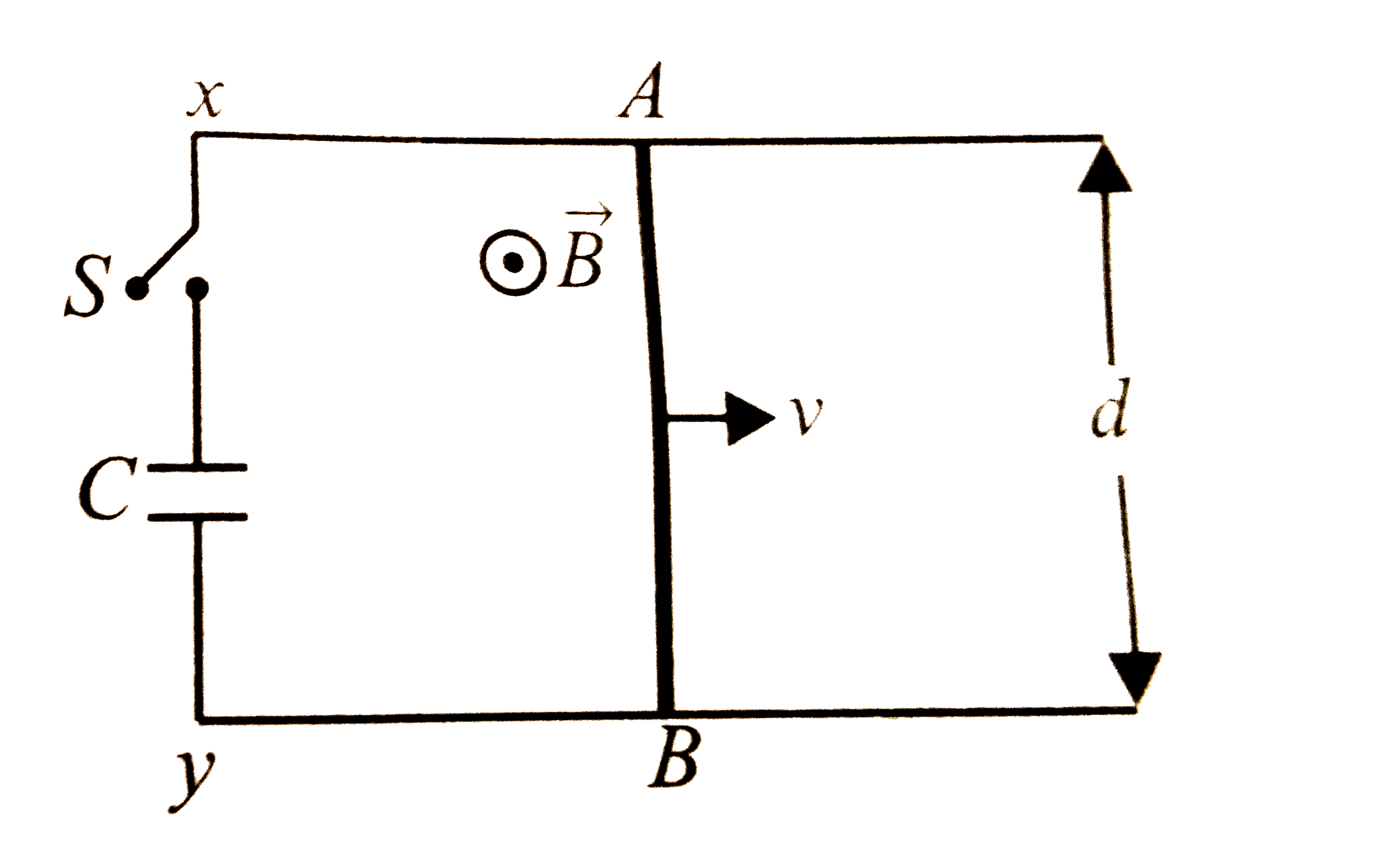
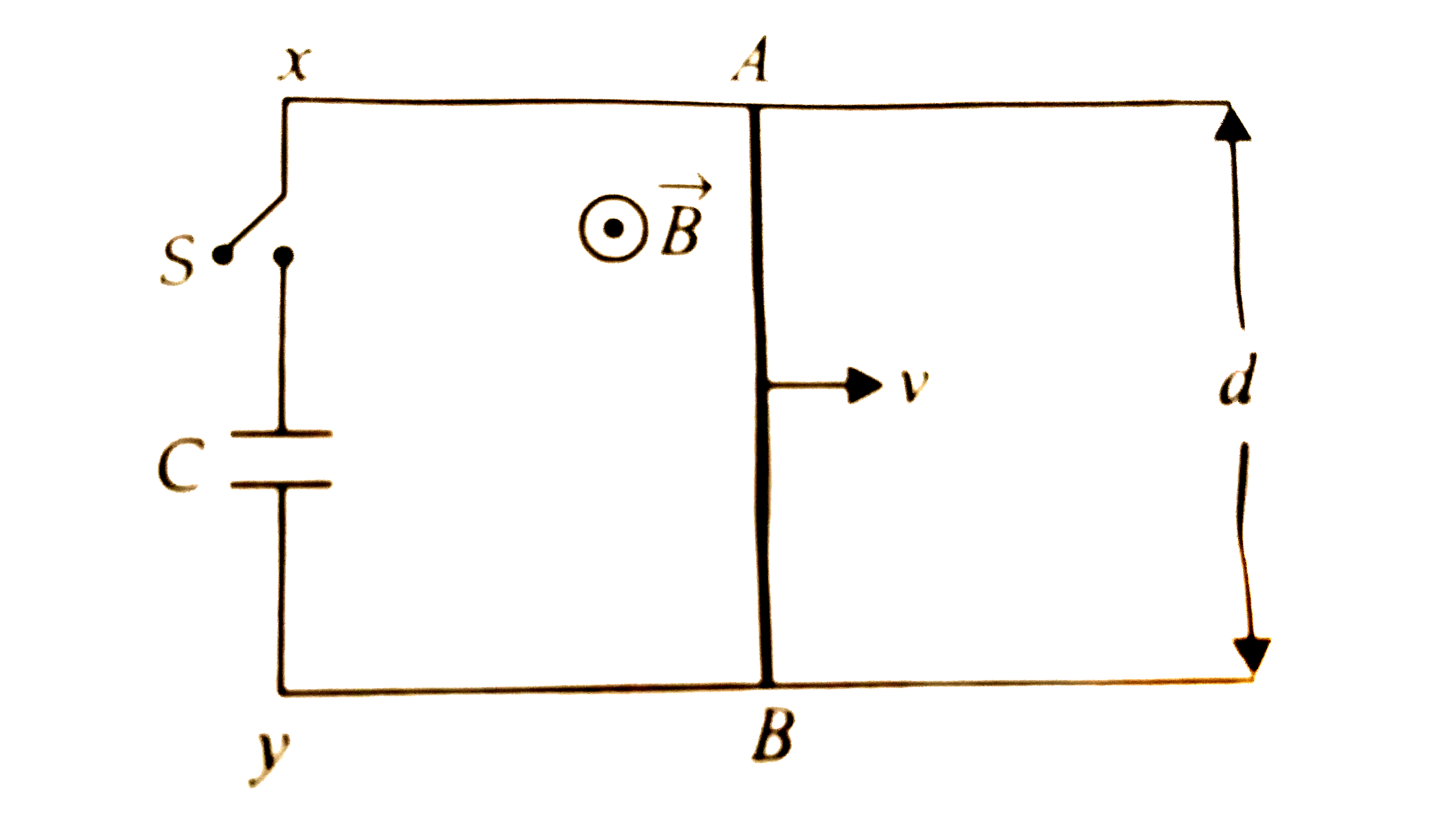
A sliding rod AB of resistance R is shown in the figure. Here magnetic field B is constant and is out of the paper. Parallel wires have no resistance and the rod is moving with constant velocity v. The current in the sliding rod AB when switch S is closed at time t=0 is

A

`(vBd)/(R)e^(-t//C)`

B

`(vBd)/(R)e^(-t//RC)`

C

`(vBd)/(R)e^(tRC)`

D

`(vBd)/(R)e^(t//RC)`

Text Solution

Verified by Experts

The correct Answer is:
B

Here magnetic field `vec(B)` is constant and is out of paper.
When the sliding rod AB moves with a velocity v in the direction shown in the figure, he induced current in AB is from A to B.

As the switch S is closed at time t=0, the capacitor gets charged.
If q is the charge on the capacitor then, `I=(dq)/(dt)=(Bdv)/(R)-(q)/(RC)or (q)/(RC)+(dq)/(dt)=(Bdv)/(R)`
or `q=vBdC+A e^(-t//RC)" " ("where A is contant") .....(i)`
At `t=0,q=0`
`:. =-vBdC`
From (i) `q=vBdC[1-e^(-t//RC)]`
`I=(dq)/(dt)=vBdCx(1)/(RC)e^(-t//RC)=(vBd)/(R)`
Promotional Banner

Topper's Solved these Questions

  • ELECTROMAGNETIC INDUCTION

    NCERT FINGERTIPS ENGLISH|Exercise EXEMPLAR PROBLEMS|3 Videos
  • ELECTROMAGNETIC INDUCTION

    NCERT FINGERTIPS ENGLISH|Exercise ASSERTION AND REASON|15 Videos
  • ELECTRIC CHARGES AND FIELDS

    NCERT FINGERTIPS ENGLISH|Exercise Assertion And Reason|15 Videos
  • ELECTROMAGNETIC WAVES

    NCERT FINGERTIPS ENGLISH|Exercise Assertion And Reason|15 Videos

Similar Questions

Explore conceptually related problems

Find the current in the sliding rod AB (resistance = R) for the arranged shown in Fig. B is constant and is out of the paper. Paralllel wires have no resistance. upsilon is constant. Switch is closed at time t = 0.

A rod having length l and resistance R is moving with velocity v on a pi shape conductor. Find the current in the rod.

The end B of the rod AB which makes angle theta with the floor is being pulled with a constant velocity v_(v) as shown. The length of the rod is l .

A rod AB moves with a uniform velocity v in a uniform magnetic field as shown in figure

A conducting rod is moved with a constant velocity v in a magnetic field. A potential difference appears across the two ends

A conducting rod of length l is moving in a transverse magnetic field of strength B with veocity v. The resistance of the rod is R. The current in the rod is

A magnetic field B = B_(0) sin (omega t) hat k covers a large region where a wire AB slides smoothly over two parallel conductors separated by a distance d, Fig. The wires are in the x-y plane. The wire AB (of length d) has resistance R and parallel wires have negligible resistance. If AB is moving with velocity upsilon , what is the current in the circuit ? What is the force needed to keep the wire moving at constant velocity ?

Two long parallel conducting rails are placed in a uniform magnetic field. On one side, the rails are connected with a resistance R . Two rods MN and M'N' each having resistance r are placed as showing in Fig. Now on the rods MN and M'N' forces are applied such that the rods move with constant velocity v . The current flowing through resustance R if both the rods move with the same speed v toward right is

Figure shows a wire of resistance R sliding on two parallel, conducting fixed thick rails placed at a separation l. A magnetic fild B exist in a direction perpendicular to the plane of the rails. The wire is moving with a constant velocity v. Find current through the wire

Two long parallel conducting rails are placed in a uniform magnetic field. On one side, the rails are connected with a resistance R . Two rods MN and M'N' each having resistance r are placed as showing in Fig. Now on the rods MN and M'N' forces are applied such that the rods move with constant velocity v . (i). The current flowing through resistance R if the rod Mn moves toward left and the rod M'N' moves toward the right is

