Home
Class 12
CHEMISTRY
Standard electrode potentials of few hal...

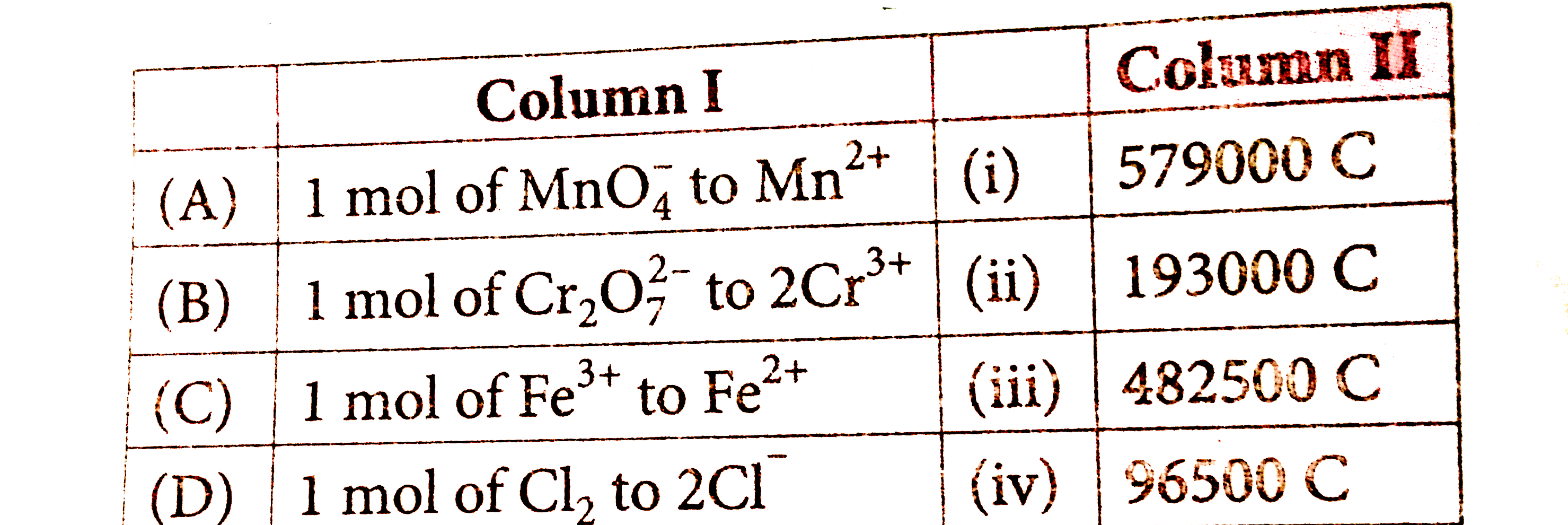
Standard electrode potentials of few half-cell reactions are given below :
`{:(MnO_4^(-)+8H^(+)+5e^(-) to Mn^(2+)+ 4H_2O,,E^@=1.51V),(Cr_2O_7^(2-)+14H^(+)+6e^(-)to 2Cr^(3+)+7H_2O,,E^@=1.33V),(Fe^(3+)+e^(-)to Fe^(2+),,E^@=0.77V),(Cl_2+2e^(-) to 2Cl^(-),,E^@=1.36):}`
Based on the above information match the column I with column II and mark the appropriate choice.

A

A-(i),B-(ii),C-(iii),D-(iv)

B

A-(ii),B-(iii),C-(i),D-(iv)

C

A-(iii),B-(i),C-(iv),D-(ii)

D

A-(iv),B-(ii),C-(iii),D-(i)

Text Solution

Verified by Experts

The correct Answer is:

C

`MnO_4^(-)`=96500 x 5 F = 482500 C
`Cr_2O_7^(2-)`=96500 x 6 F = 579000 C
`Fe^(3+)` = 96500 x 1 F = 96500 C
`Cl_2`=96500 x 2 F = 193000 C
Promotional Banner

Topper's Solved these Questions

  • ELECTROCHEMISTRY

    NCERT FINGERTIPS ENGLISH|Exercise Batteries|2 Videos
  • ELECTROCHEMISTRY

    NCERT FINGERTIPS ENGLISH|Exercise Fuel Cells|1 Videos
  • ELECTROCHEMISTRY

    NCERT FINGERTIPS ENGLISH|Exercise Conductance Of Electrolytic Solutions|23 Videos
  • COORDINATION COMPOUNDS

    NCERT FINGERTIPS ENGLISH|Exercise Assertion And Reason|15 Videos
  • GENERAL PRINCIPLES AND PROCESSES OF ISOLATION OF ELEMENTS

    NCERT FINGERTIPS ENGLISH|Exercise Assertion And Reason|15 Videos

Similar Questions

Explore conceptually related problems

The standard reduction potentials of some half cell reactions are given below: PbO_2+4H^++2e^(-)hArrPb^(2+)+2H_(2)O , E^@=1.455 V MnO_4^(-)+8H^++5e^(-)hArrMn^(2+)+4H_(2)O , E^@=1.51 V Ce^(4+)+e^(-)hArrCe^(3+), E^@=1.61 V H_2O_2+2H^++2e^(-)hArr 2H_2O, E^@=1.71 V Pick out the correct statement:

Standard electrode potential data are useful for understanding the suitability of an oxidant in a redox titration. Some half cell reaction and their standard potentials are given below: MnO_(4)^(-)(aq) +8H^(+)(aq) +5e^(-) rarr Mn^(2+)(aq) +4H_(2)O(l) E^(@) = 1.51V Cr_(2)O_(7)^(2-)(aq) +14H^(+) (aq) +6e^(-) rarr 2Cr^(3+)(aq) +7H_(2)O(l), E^(@) = 1.38V Fe^(3+) (aq) +e^(-) rarr Fe^(2+) (aq), E^(@) = 0.77V CI_(2)(g) +2e^(-) rarr 2CI^(-)(aq), E^(@) = 1.40V Identify the only correct statement regarding quantitative estimation of aqueous Fe(NO_(3))_(2)

MnO_(4)^(-) + 8H^(+) + 5e^(-) rightarrow Mn^(2+) + 4H_(2)O , E^(@) = 1.51V MnO_(2) + 4H^(+) + 2e^(-) righarrow Mn^(2+) + 2H_(2)O E^(@) = 1.23V E_(MnO_(4)^(-)|MnO_(2)

Standard reduction potentials of the half reactions are given below {:(F_(2(g))+2e^(-) rarr 2F^(-)""_((aq)),,E^(@)=+2.85V), (Cl_(2(g))+2e^(-) rarr 2Cl^(-)""_((aq)),, E^(@)=+1.36V), (Br_(2(l))+2e^(-) rarr 2Br^(-)""_((aq)),,E^(@)=+1.06V), (l_(2(s))+2e^(-) rarr 2l^(-)""_((aq)),, E^(@)=+0.53V):} The strongest oxidising and reducing agents respectively are

The standard electrode potential for the following reaction is +1.33 V. What is the potential at pH=2.0? Cr_(2)O_(7)^(2-)(aq,1M)+14H^(+)(aq)+6e^(-)to2Cr^(3+)(aq,1M)+7H_(2)O(l)

E^(c-) of some elements are given as : {:(I_(2)+2e^(-)rarr 2I^(c-),,,,E^(c-)=0.54V),(MnO_(4)^(c-)+8H^(o+)+5e^(-)rarr Mn^(2+)+4H_(2)O,,,,E^(c-)=1.52V),(Fe^(3+)+e^(-)rarr Fe^(2+),,,,E^(c-)=0.77V),(Sn^(4+)+2e^(-)rarr Sn^(2+),,,,E^(c-)=0.1V):} Select the strongest oxidant and weakest oxidant among these elements.

For the reactions {:(MnO_(4)^(-)+8H^(+)+5e^(-)rarr Mn^(2+)4H_(2)O","E^(o) = + 1.51 V),(MnO_(2)+4H^(+)+ 2e^(-) rarr Mn^(2+)+2H_(2)O"," E^(o)= + 1.23 V ):} then for the reaction : MnO_(4)^(-) + 4H^(+) + 3e^(-) rarr MnO_(2)+2H_(2)O","E^(o)

MnO_(4)^(-)+8H^(+)+5e to Mn^(2+)+4H_(2)O" "E^(0)=+1.51V Fe^(3+)+e to Fe^(2+)" "E^(0)=+0.77V Cl_(2)+2e to 2Cl^(-) " "E^(0)=+1.36V Ce^(4+)+e to Ce^(3+) " "E^(0)=1.76 Choose the incorrect statement among the following:

The standard reduction potential of TiO^(2+) and Ti^(3+) are given by TiO_(2+)+2H^(+)+e^(-)toTi^(3+)+H_(2)O" "E^(@)=0.10V Ti^(3+)+3e^(-)toTi" "E^(@)=-1.21V

E^(o) of some elements are given as : {:(I_(2)+2e^(-)rarr 2I^(-),,,,E^(o)=0.54V),(MnO_(4)^(-)+8H^(o+)+5e^(-)rarr Mn^(2+)+4H_(2)O,,,,E^(o)=1.52V),(Fe^(3+)+e^(-)rarr Fe^(2+),,,,E^(o)=0.77V),(Sn^(4+)+2e^(-)rarr Sn^(2+),,,,E^(o)=0.1V):} a. Select the strongest reductant and weakest oxidant among these elements. b. Select the weakest reductant and strongest oxidant among these elements.

NCERT FINGERTIPS ENGLISH-ELECTROCHEMISTRY-Electrolytic Cells And Electrolysis
  1. If a current of 1.5 ampere flows through a metallic wire for 3 hours, ...

    Text Solution

    |

  2. How many coulombs of electricity is required to reduce 1 mole of Cr2O7...

    Text Solution

    |

  3. An electric charge of 5 Faradays is passed through three electrolytes...

    Text Solution

    |

  4. A current of 1.40 ampere is passed through 500 mL of 0.180 M solution ...

    Text Solution

    |

  5. How much time is required to deposit 1xx10^(-3) cm thick layer of sil...

    Text Solution

    |

  6. How much metal will be deposited when a current of 12 ampere with 75% ...

    Text Solution

    |

  7. Same amount of electric current is passed through the solutions of AgN...

    Text Solution

    |

  8. When during electrolusis of a solution of AgNO3, 9650 coulmbs of char...

    Text Solution

    |

  9. The amount of chlorine evolved by passing 2 A of current in an aqueous...

    Text Solution

    |

  10. How many moles of Pt may be deposited on the cathode when 0.80F of ele...

    Text Solution

    |

  11. An electric current is passed through silver nitrate solution using si...

    Text Solution

    |

  12. If 54 g of silver is deposited during an electrolysis reaction, how mu...

    Text Solution

    |

  13. Standard electrode potentials of few half-cell reactions are given bel...

    Text Solution

    |

  14. An acidic solution of Cu^(2+) ions containing 0.4 g of Cu^(2+) ions is...

    Text Solution

    |

  15. Choose the option with correct words to fill in the blanks. Accordi...

    Text Solution

    |

  16. Which of the following statement is true?

    Text Solution

    |

  17. During the electrolysis of dilute sulphuric acid, the following proces...

    Text Solution

    |

  18. In electrolysis of dilute H(2)SO(4) what is liberated at anode?

    Text Solution

    |

  19. When an aqueous solution of AgNO3 is electroysed between platinum elec...

    Text Solution

    |

  20. Electrolysis of an aqueous solution of AgNO3 with silver electrodes pr...

    Text Solution

    |
