Home
Class 12
CHEMISTRY
Which of the following energy level diag...

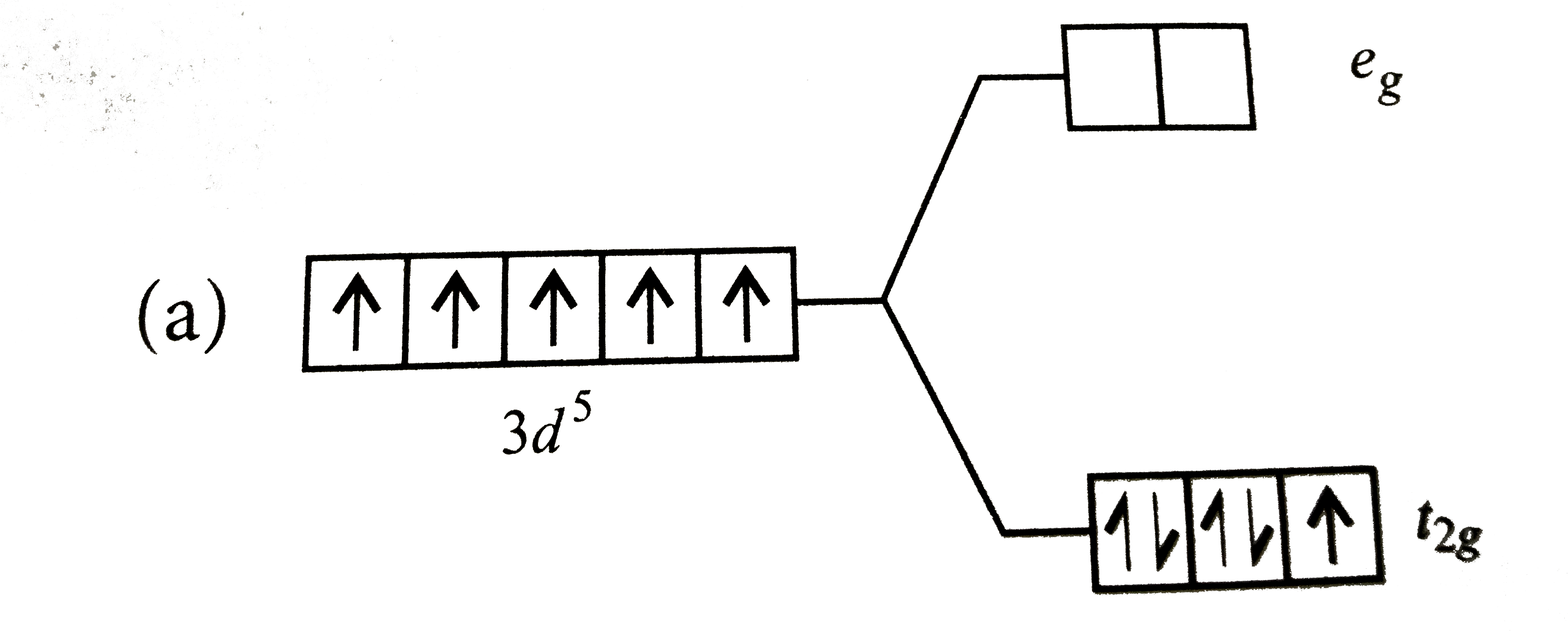
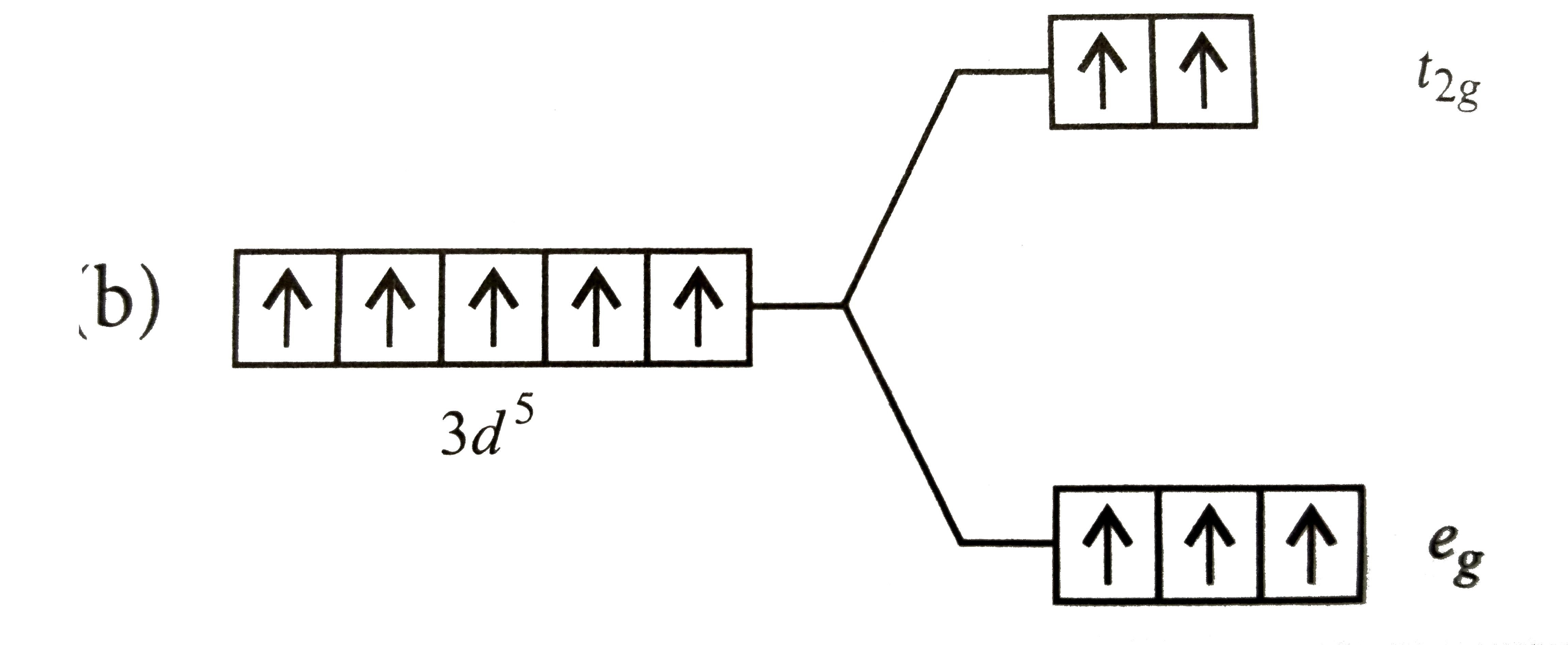
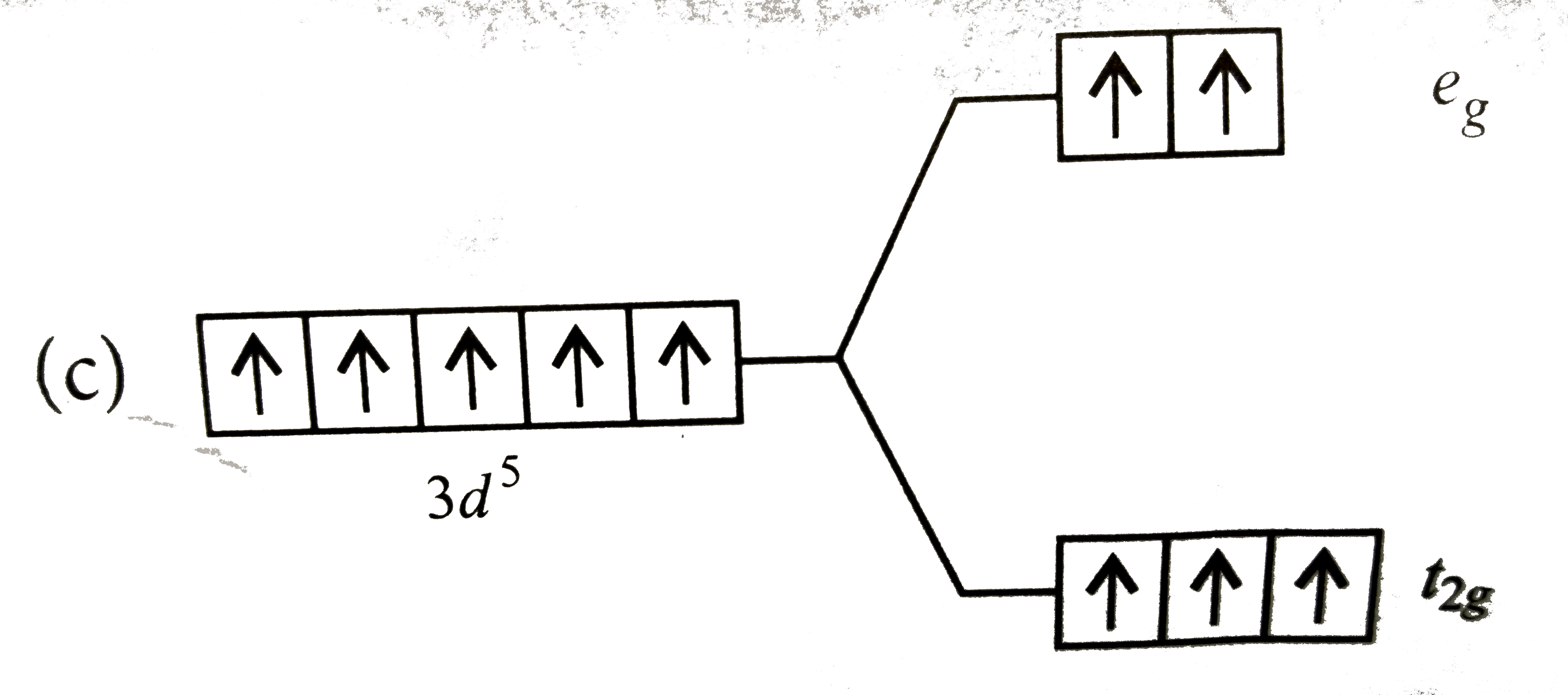
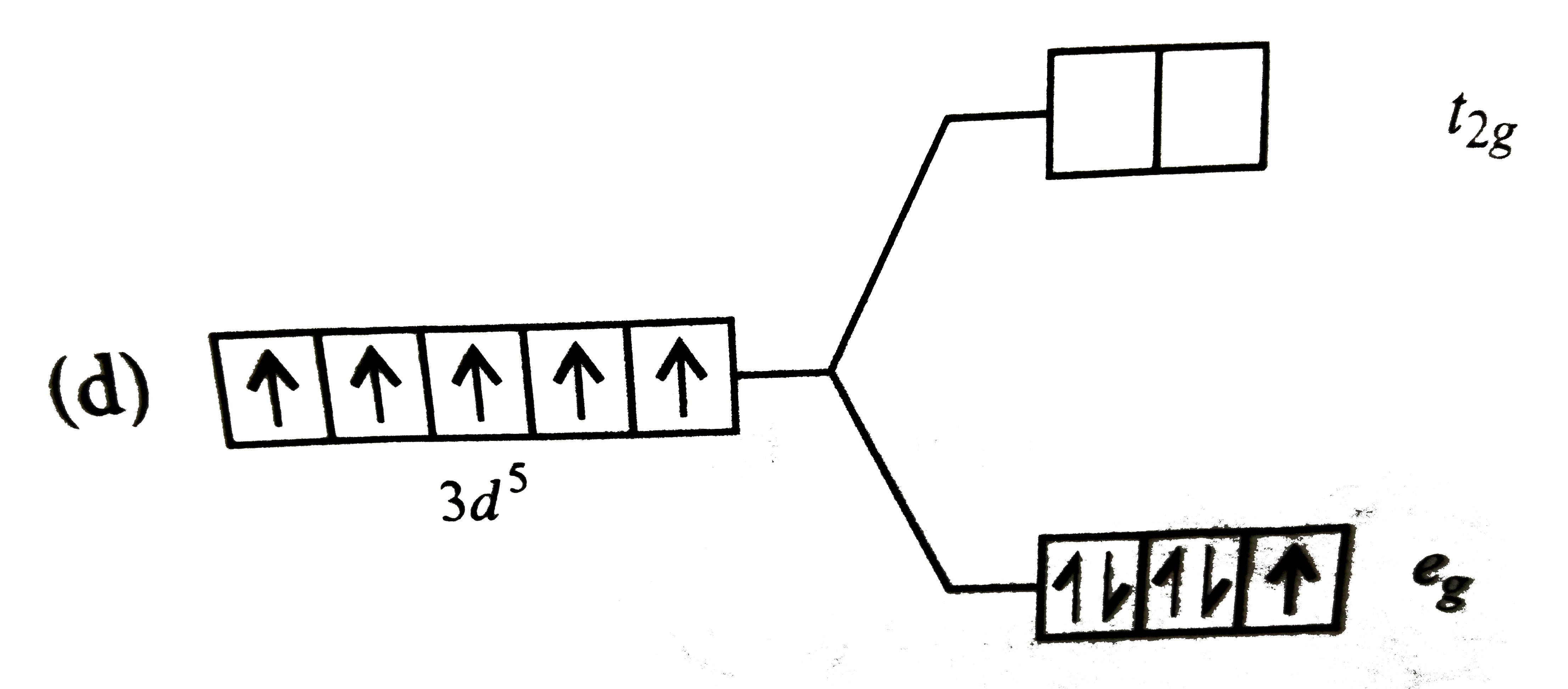
Which of the following energy level diagram for `[FeF_(6)]^(3-)` is correct on the basis of crystal field theory ?

A

B

C

D

Text Solution

AI Generated Solution

The correct Answer is:

To determine the correct energy level diagram for the complex ion \([FeF_6]^{3-}\) based on crystal field theory, we will follow these steps: ### Step 1: Determine the oxidation state of Iron (Fe) 1. The complex ion is \([FeF_6]^{3-}\). 2. Each fluorine (F) has an oxidation state of -1. 3. Let the oxidation state of Fe be \(x\). 4. The equation can be set up as follows: \[ x + 6(-1) = -3 \] \[ x - 6 = -3 \implies x = +3 \] Therefore, the oxidation state of Fe in \([FeF_6]^{3-}\) is +3. ### Step 2: Write the electronic configuration of Fe 1. The atomic number of Fe is 26, and its ground state electronic configuration is: \[ [Ar] 3d^6 4s^2 \] 2. Since Fe is in the +3 oxidation state, it loses 3 electrons. The electrons are removed first from the 4s orbital and then from the 3d orbital: \[ [Ar] 3d^5 \] ### Step 3: Identify the geometry of the complex 1. \([FeF_6]^{3-}\) is an octahedral complex because it has six ligands (F) surrounding the central metal ion (Fe). ### Step 4: Determine the splitting of d-orbitals 1. In an octahedral field, the 3d orbitals split into two sets: \(t_{2g}\) (lower energy) and \(e_g\) (higher energy). 2. The energy level diagram for the d-orbitals in an octahedral field is as follows: - \(t_{2g}\) (three orbitals) - \(e_g\) (two orbitals) ### Step 5: Consider the nature of the ligand 1. Fluoride (F) is a weak field ligand, which means it does not cause strong pairing of electrons. 2. Therefore, the electrons will occupy the available orbitals singly before pairing occurs. ### Step 6: Fill the d-orbitals according to Hund's rule 1. Since we have \(3d^5\) configuration and F is a weak field ligand: - The first three electrons will fill the \(t_{2g}\) orbitals singly. - The next two electrons will fill the \(e_g\) orbitals singly. The filling will look like this: - \(t_{2g}\): 3 electrons - \(e_g\): 2 electrons ### Step 7: Draw the energy level diagram 1. The correct energy level diagram will show: - \(t_{2g}\) with 3 electrons - \(e_g\) with 2 electrons ### Conclusion The correct energy level diagram for \([FeF_6]^{3-}\) based on crystal field theory is that there are 3 electrons in the \(t_{2g}\) level and 2 electrons in the \(e_g\) level.
Promotional Banner

Topper's Solved these Questions

  • COORDINATION COMPOUNDS

    NCERT FINGERTIPS ENGLISH|Exercise HOTS|8 Videos
  • COORDINATION COMPOUNDS

    NCERT FINGERTIPS ENGLISH|Exercise NCERT EXEMPLAR PROBLEMS|14 Videos
  • CHEMISTRY IN EVERYDAY LIFE

    NCERT FINGERTIPS ENGLISH|Exercise NCERT Exemplar|15 Videos
  • ELECTROCHEMISTRY

    NCERT FINGERTIPS ENGLISH|Exercise Assertion And Reason|15 Videos

Similar Questions

Explore conceptually related problems

Consider the following energy level diagram: Answer the following question on the basis of the given diagram In the given diagram z refers to

Consider the following energy level diagram: Answer the following question on the basis of the given diagram The heat of formation of glucose is

Which of the following energy diagrams shows the electron distribution according to the crystal field model of the 3d-electrons in [CoCl_(4)]^(2-) ?

Consider the following energy level diagram: Answer the following question on the basis of the given diagram The quantity y is equal to

Electronic configuration of [Cu(NH_(3))_(6)]^(2+) on the basis of crystal field splitting theory is

Explain the violet colour of the complex [Ti(H_(2)O)_(6)]^(3+) on the basis of crystal field theory.

Change with descent it the basis of which theory :

Which of the following postulates of kinetic theory of gases is not correct ?

(i) What type of isomerism is shown by the complex [Cr(H_(2)O)_(6)]Cl_(3) ? (ii) On the basis of crystal field theory, write the electronic configuration for d^(4) ion if Delta_(0)gtP. (iii) Write the hybridization and shape of [CoF_(6)]^(3-) . (Atomic number of Co=27)

Which of the following statement(s) is /are correct with respect to the crystal field theory ?

NCERT FINGERTIPS ENGLISH-COORDINATION COMPOUNDS -Assertion And Reason
  1. Which of the following energy level diagram for [FeF(6)]^(3-) is corre...

    Text Solution

    |

  2. Assertion : Aqueous solution of the compound CoCl(3) * 4NH(3) when tre...

    Text Solution

    |

  3. Assertion : The complex K(3) [Cr(C(2)O(4))(3)] when present in aqueous...

    Text Solution

    |

  4. Assertion : N(CH(2)CH(2)NH(2))(3) and EDTA are examples of polydentate...

    Text Solution

    |

  5. Assertion : Coordination number of Fe and Co in [Fe(C(2) O(4))(3)]^(3-...

    Text Solution

    |

  6. Assertion : [Co(NH(3))(5)Br]SO(4) gives white precipitate with barium ...

    Text Solution

    |

  7. Assertion : Tetrahedral complexes having two different types of uniden...

    Text Solution

    |

  8. Assertion : In a coordination entity [PtCl(2)(en)(2)]^(2+) only the ci...

    Text Solution

    |

  9. Assertion : Inner orbital complexes are low spin complexes . Reason...

    Text Solution

    |

  10. Assertion : [Fe(H(2)O)(6)]^(2+) is sp^(3) d^(2) hybridised and paramag...

    Text Solution

    |

  11. Assertion : In tetrahedral complexes low spin configuration are rarel...

    Text Solution

    |

  12. Assertion : [Ti(H(2)O)(6)]Cl(3) on heating becomes colourless . Reas...

    Text Solution

    |

  13. Assertion : According to crystal field theory , during complex formati...

    Text Solution

    |

  14. [Fe(H2O)6]^(3+) is strongly paramagnetic whereas [Fe(CN)6]^(3-) is wea...

    Text Solution

    |

  15. Assertion : K(2)[Ni(EDTA)] is more stable than K(3)[Al(C(2)O(4))(3)]. ...

    Text Solution

    |

  16. Assertion : Geometrical isomerism is also called cis-trans isomerism ....

    Text Solution

    |
