Home
Class 12
CHEMISTRY
In [NiCl(4)]^(2-) ,the number of unparie...

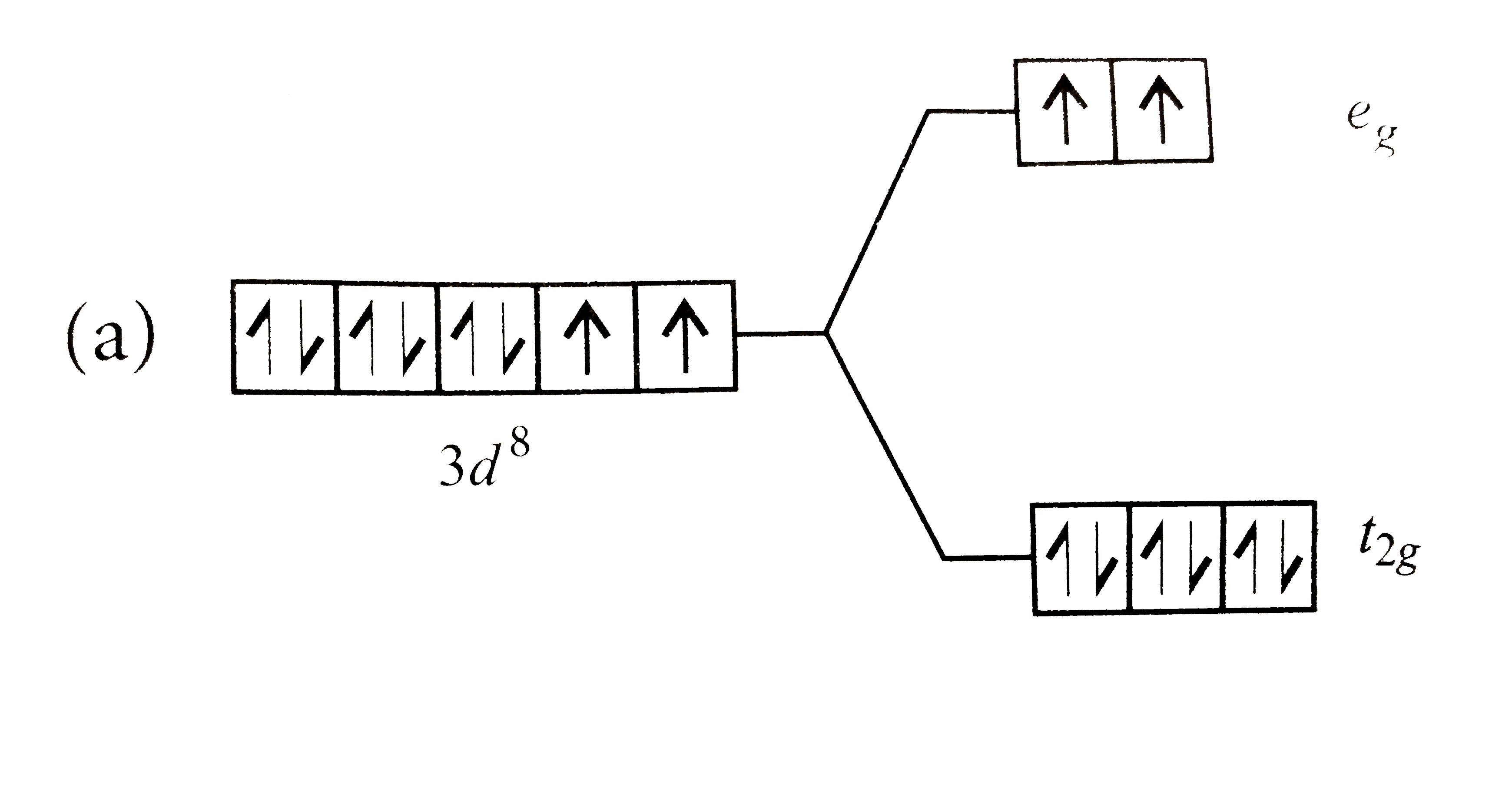
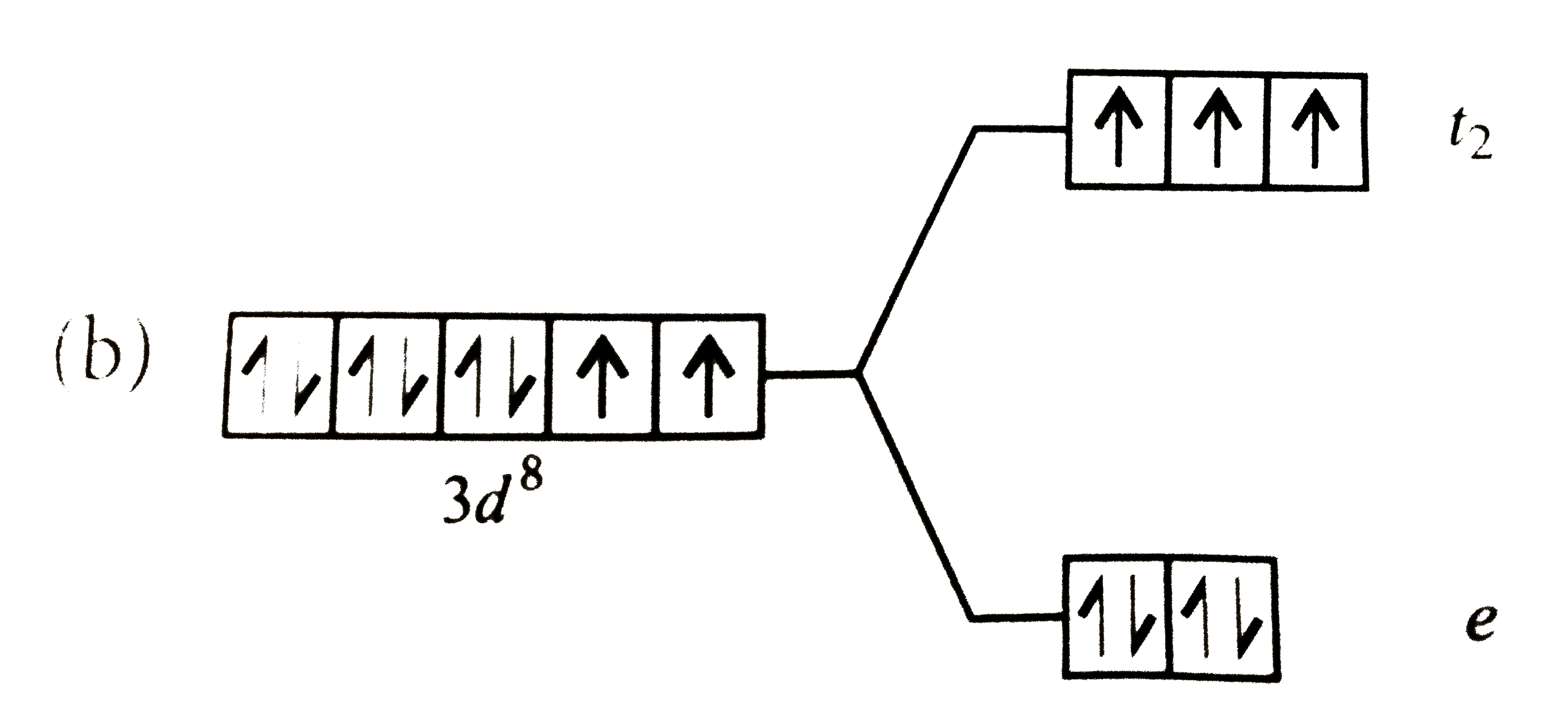
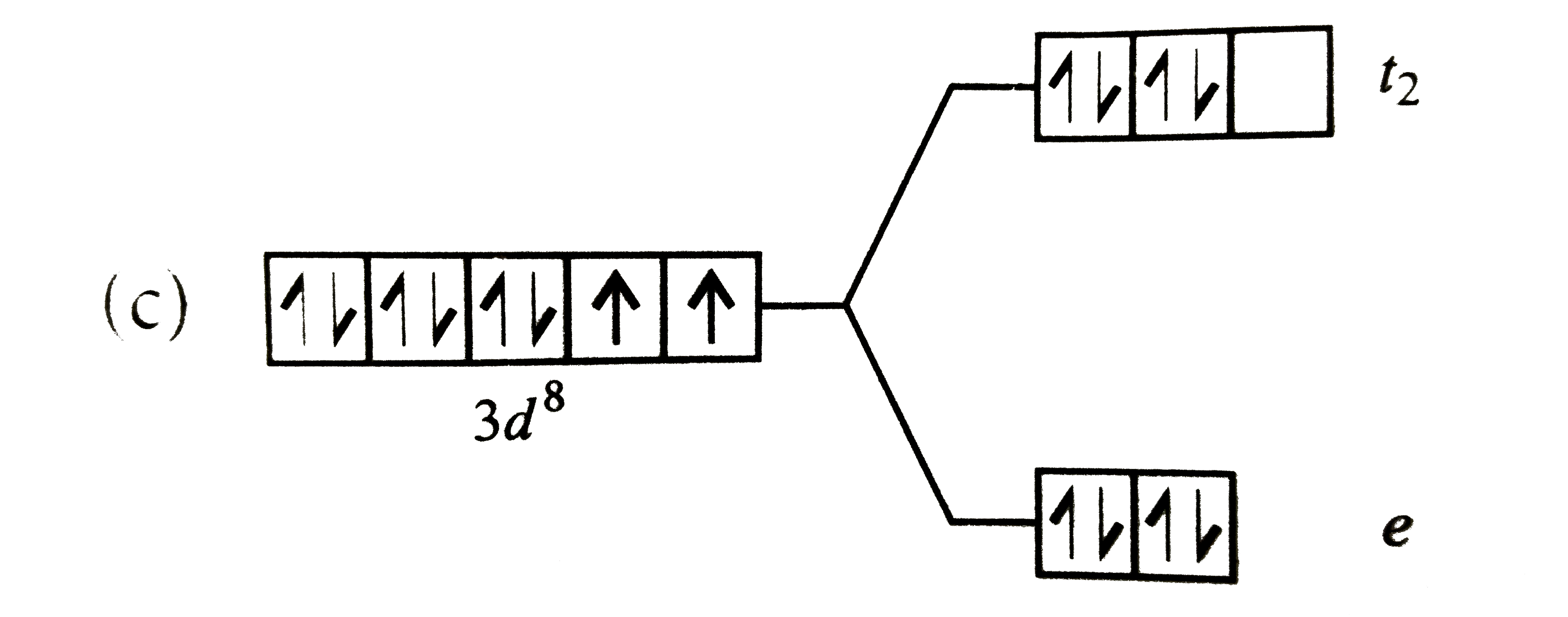
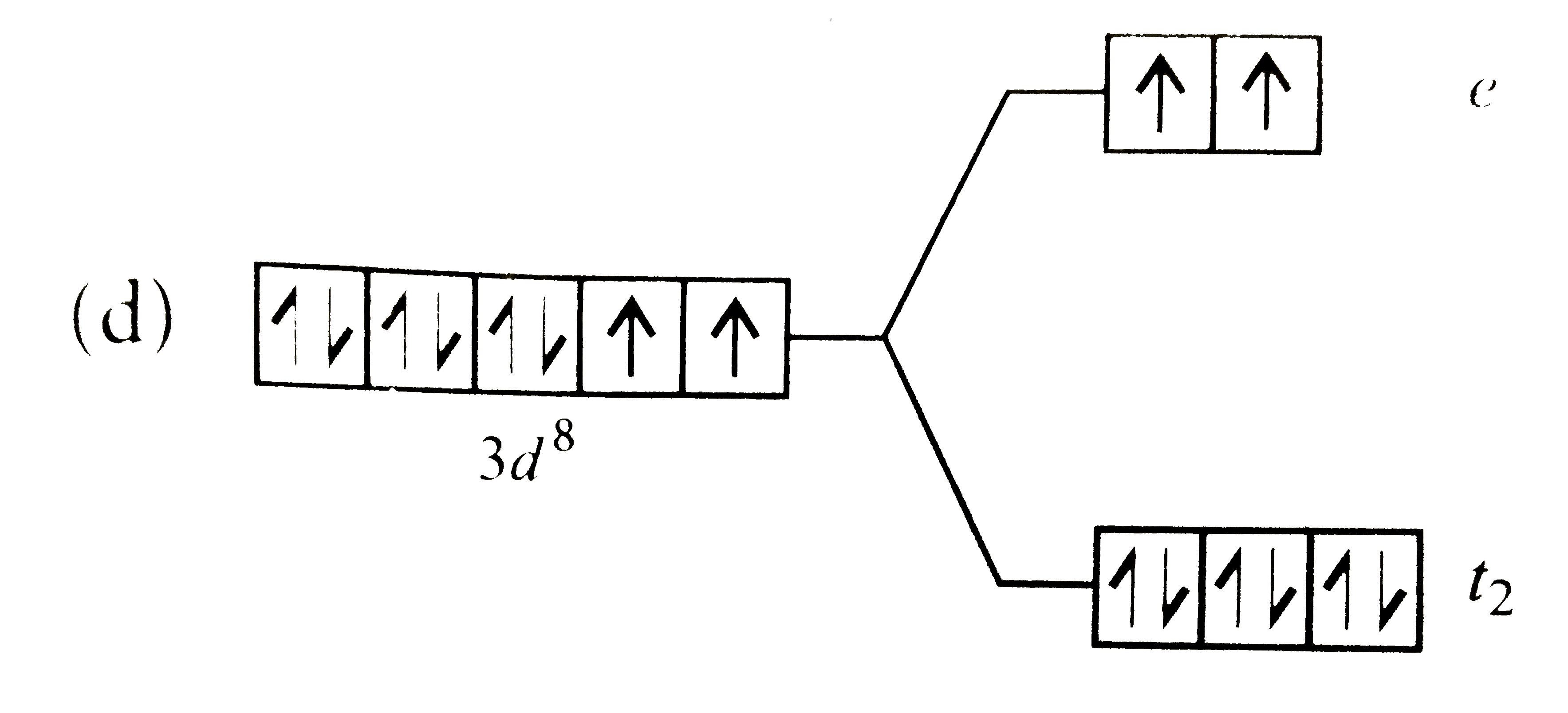
In `[NiCl_(4)]^(2-)` ,the number of unparied electron is

A

B

C

D

Text Solution

AI Generated Solution

The correct Answer is:

To determine the number of unpaired electrons in the complex ion \([NiCl_4]^{2-}\), we can follow these steps: ### Step 1: Determine the oxidation state of Nickel The first step is to find the oxidation state of nickel in the complex. The formula for the complex is \([NiCl_4]^{2-}\). - Let the oxidation state of nickel be \(X\). - The oxidation state of each chloride ion (Cl) is \(-1\). - Since there are 4 chloride ions, the total contribution from chloride is \(4 \times (-1) = -4\). - The overall charge of the complex is \(-2\). Setting up the equation: \[ X + (-4) = -2 \] Solving for \(X\): \[ X = -2 + 4 = +2 \] Thus, the oxidation state of nickel in \([NiCl_4]^{2-}\) is \(+2\). ### Step 2: Write the electron configuration of Nickel The atomic number of nickel (Ni) is 28. The electron configuration of neutral nickel is: \[ [Ar] 3d^8 4s^2 \] For the nickel ion \(Ni^{2+}\), we remove two electrons (the 4s electrons are removed first): \[ Ni^{2+} : [Ar] 3d^8 \] ### Step 3: Analyze the ligand field Chloride ion (Cl\(^-\)) is a weak field ligand. Weak field ligands do not cause significant splitting of the d-orbitals, which means that the energy difference between the split d-orbitals is small. ### Step 4: Splitting of d-orbitals In an octahedral field, the \(3d\) orbitals split into two sets: - \(t_{2g}\) (lower energy) - \(e_g\) (higher energy) However, since we have a tetrahedral complex here, the splitting is different: - The \(3d\) orbitals split into \(e\) (higher energy) and \(t_2\) (lower energy). ### Step 5: Filling the d-orbitals For \(Ni^{2+}\) with \(3d^8\): - The electrons will fill the orbitals according to Hund's rule and the Pauli exclusion principle. - In a weak field, the electrons will occupy the higher energy \(e\) orbitals before pairing occurs in the lower energy \(t_2\) orbitals. Filling the \(3d\) orbitals: - The first 6 electrons will fill the \(t_2\) orbitals (3 electrons in \(t_2\) and 5 in \(e\)). - The last 2 electrons will pair up in the \(t_2\) orbitals. ### Step 6: Count the unpaired electrons After filling the orbitals: - The \(t_2\) orbitals will have 2 paired electrons. - The \(e\) orbitals will have 2 unpaired electrons. Thus, the total number of unpaired electrons in \([NiCl_4]^{2-}\) is **2**. ### Final Answer The number of unpaired electrons in \([NiCl_4]^{2-}\) is **2**. ---
Promotional Banner

Topper's Solved these Questions

  • COORDINATION COMPOUNDS

    NCERT FINGERTIPS ENGLISH|Exercise HOTS|8 Videos
  • COORDINATION COMPOUNDS

    NCERT FINGERTIPS ENGLISH|Exercise NCERT EXEMPLAR PROBLEMS|14 Videos
  • CHEMISTRY IN EVERYDAY LIFE

    NCERT FINGERTIPS ENGLISH|Exercise NCERT Exemplar|15 Videos
  • ELECTROCHEMISTRY

    NCERT FINGERTIPS ENGLISH|Exercise Assertion And Reason|15 Videos

Similar Questions

Explore conceptually related problems

The number of unpaired electron in Ni^(2+) is

The number of unpaired electron in Cr^(+2) is

In the conplex [Ni(H_(2)O)_(2)(NH_(3))_(4)]^(2+) the number of unpaired electrons is

The number of unpaired electrons in Zn^(2+) is

Number of unpaired electrons in Mn^(2+) is

The number of unpaired electrons in Ni (CO)_(4) is

The number of unpaired electrons in Ni (CO)_(4) is

The electronic configuration of Re^(3+) is (Xe)4f^(14)5d^(4) , the number of unpaired electrons in this ion is ____________.

Number of valence electrons in O^(2-) is :

Write the electronic configuration of (i) Mn4+, (ii) Fe3+ (iii) Cr2+ Mention the number of unpaired electrons in each case.

NCERT FINGERTIPS ENGLISH-COORDINATION COMPOUNDS -Assertion And Reason
  1. In [NiCl(4)]^(2-) ,the number of unparied electron is

    Text Solution

    |

  2. Assertion : Aqueous solution of the compound CoCl(3) * 4NH(3) when tre...

    Text Solution

    |

  3. Assertion : The complex K(3) [Cr(C(2)O(4))(3)] when present in aqueous...

    Text Solution

    |

  4. Assertion : N(CH(2)CH(2)NH(2))(3) and EDTA are examples of polydentate...

    Text Solution

    |

  5. Assertion : Coordination number of Fe and Co in [Fe(C(2) O(4))(3)]^(3-...

    Text Solution

    |

  6. Assertion : [Co(NH(3))(5)Br]SO(4) gives white precipitate with barium ...

    Text Solution

    |

  7. Assertion : Tetrahedral complexes having two different types of uniden...

    Text Solution

    |

  8. Assertion : In a coordination entity [PtCl(2)(en)(2)]^(2+) only the ci...

    Text Solution

    |

  9. Assertion : Inner orbital complexes are low spin complexes . Reason...

    Text Solution

    |

  10. Assertion : [Fe(H(2)O)(6)]^(2+) is sp^(3) d^(2) hybridised and paramag...

    Text Solution

    |

  11. Assertion : In tetrahedral complexes low spin configuration are rarel...

    Text Solution

    |

  12. Assertion : [Ti(H(2)O)(6)]Cl(3) on heating becomes colourless . Reas...

    Text Solution

    |

  13. Assertion : According to crystal field theory , during complex formati...

    Text Solution

    |

  14. [Fe(H2O)6]^(3+) is strongly paramagnetic whereas [Fe(CN)6]^(3-) is wea...

    Text Solution

    |

  15. Assertion : K(2)[Ni(EDTA)] is more stable than K(3)[Al(C(2)O(4))(3)]. ...

    Text Solution

    |

  16. Assertion : Geometrical isomerism is also called cis-trans isomerism ....

    Text Solution

    |
