Home
Class 11
CHEMISTRY
Given below are the critical temperature...

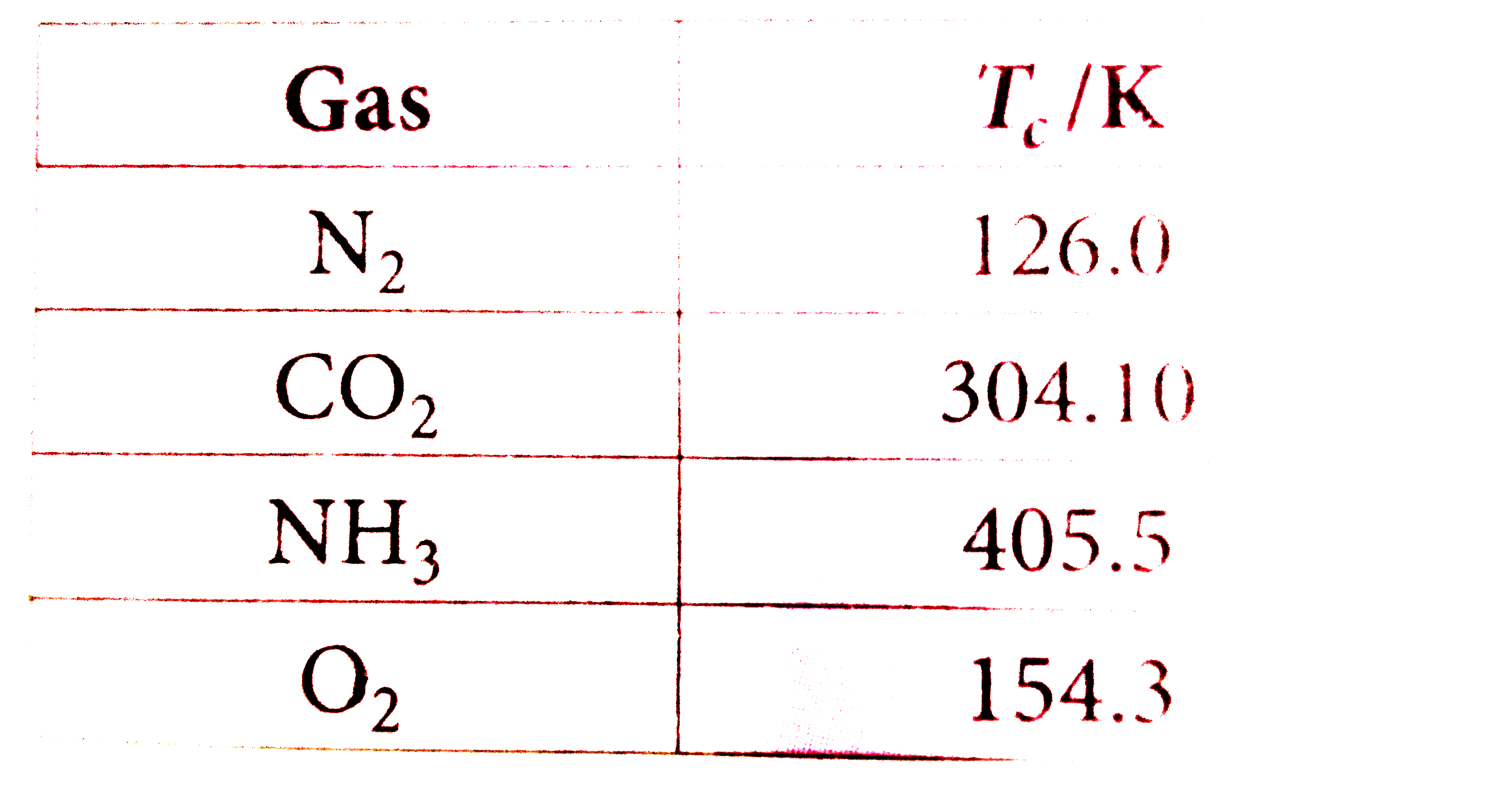
Given below are the critical temperatures of a few gases . When the gases are started cooling , which gas will liquefy first and which will liquefy in the end ?

A

`N_(2)` will liquefy first and `NH_(3)` at last .

B

`NH_(3)` will liquefy first and `CO_(2)` at last .

C

`NH_(3)` will liquefy first and `N_(2)` at last .

D

`CO_(2)` will liquefy first and `NH_(3)` at last .

Text Solution

Verified by Experts

The correct Answer is:

C

Higher the critical temperature, faster is the liquefaction of the gas. Hence, `NH_(3)` will liquefy first and `N_(2)` at last.
Promotional Banner

Topper's Solved these Questions

  • STATES OF MATTER

    NCERT FINGERTIPS ENGLISH|Exercise HOTS (HIGHER ORDER THINKING SKILLS)|10 Videos
  • STATES OF MATTER

    NCERT FINGERTIPS ENGLISH|Exercise NCERT (EXEMPLAR PROBLEMS)|11 Videos
  • SOME BASIC CONCEPTS OF CHEMISTRY

    NCERT FINGERTIPS ENGLISH|Exercise NCERT Exemplar|11 Videos
  • STRUCTURE OF ATOM

    NCERT FINGERTIPS ENGLISH|Exercise Assertion And Reason|15 Videos

Similar Questions

Explore conceptually related problems

The temperature below which a gas does not obey ideal gas laws is

Gases possess characteristic critical temperature which depends upon the magnitude of intermolecualr forces between the gas particles, critical temperatures of ammonia and carbon dioxide are 405.5 K and 304.10 K respectively. Which of these gases will liquefy first when you start cooling from 500 K to their critical temperature ?

The gas which will be most easily liquefied is

Which gas will liquefy easily ( a and b are van der Waals constants)?

Name the temperature at which real gases behave as ideal gases over appreciable range of pressure.

Gases possess characteristic critical temperature which depends upon the magnitude of intermolecular forces between the gas particles. Critical temperatures of ammonia and carbon dioxide are 405.5 K and 304.10 K respectively. Which of these gases will liquify first when you start cooling from 500 K to their critical temperature ?

Critical temperatures for A, B, C and D gases are 25^(@)C, 10^(@)C, -80^(@)C and 15^(@)C respectively. Which gas will be liquefied more easily ?

Two different gases 'A' and 'B' are filled in separate containers of equal capacity under the same condition of temperature and pressure. On increasing the pressure slightly the gas 'A' liquefies but gas B does not liquify even on applying high pressure until it is cooled. Explain this phenomenon.

Boyle's temperature of various gases are given below: Which can be liquefied most easily

An ideal gas obeying the kinetic theory of gases can be liquefied if

NCERT FINGERTIPS ENGLISH-STATES OF MATTER -Assertion And Reason
  1. Given below are the critical temperatures of a few gases . When the g...

    Text Solution

    |

  2. Assertion : Dipole - dipole forces acting between the molecules posses...

    Text Solution

    |

  3. Assertion : Liquids and solids are hard to compress . Reason : Magn...

    Text Solution

    |

  4. Assertion : Gases become denser at high pressure . Reason : At hig...

    Text Solution

    |

  5. Assertion : The lowest hypothetical or imaginary temperature at which ...

    Text Solution

    |

  6. Assertion : At constant temperature PV vs P plot for real gases is not...

    Text Solution

    |

  7. Assertion : Molar volume of an ideal gas at 273 . 15 K and 1 bar is 22...

    Text Solution

    |

  8. Assertion : In Maxwell - Boltzmann distribution of speeds , the curve ...

    Text Solution

    |

  9. Assertion : The gases show ideal behaviour when the volume occupied is...

    Text Solution

    |

  10. Assertion : Compressibility factor (Z) is the ratio of actual molar vo...

    Text Solution

    |

  11. Assertion :- On cooling ,ammonia lirquifies first whereas CO(2) requi...

    Text Solution

    |

  12. Assertion : All the gases should be cooled below their critical temper...

    Text Solution

    |

  13. Assertion : At high altitudes , liquids boil at lower temperatures in ...

    Text Solution

    |

  14. Assertion : The normal boiling point of water is 100 C^(@) and standar...

    Text Solution

    |

  15. Assertion : Viscosity of liquids decreases as the temperature rises . ...

    Text Solution

    |

  16. Assertion : Windowpanes of old building become thicker at the bottom t...

    Text Solution

    |
