Home
Class 11
CHEMISTRY
In an experiment, NO(2) gas is prepared ...

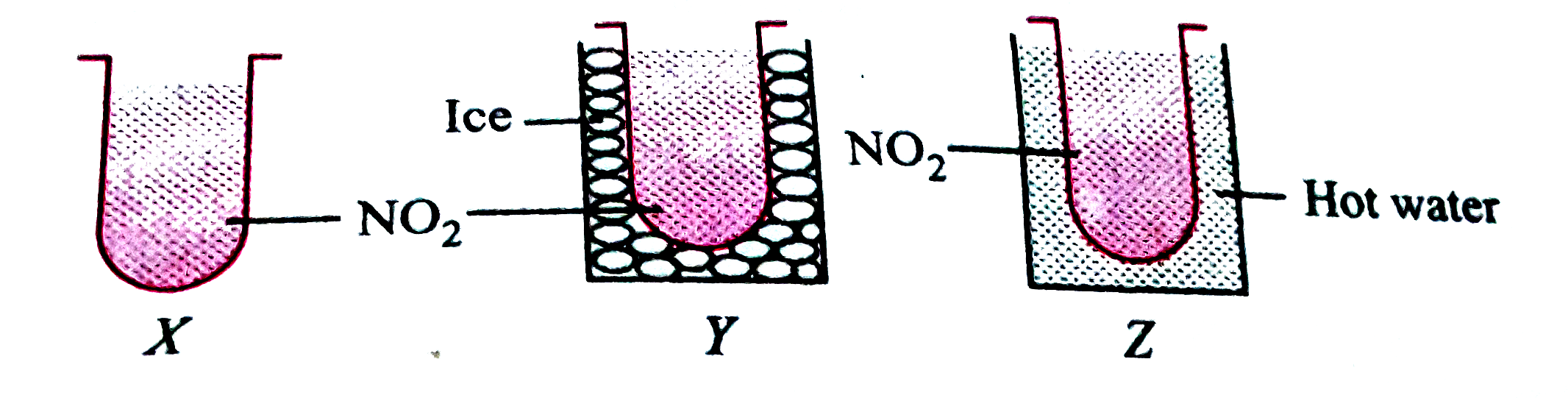
In an experiment, `NO_(2)` gas is prepared and taken into 3 test tubes X,Y and Z. `NO_(2)` gas which is brown in colour dimerises into `N_(2)O_(4)` which is colourless. Test tube X is kept at roop temperature, Y is kept in ice and Z is kept in hot water. What colour changes will you observe in the test tubes and why
`underset("Broun")(2NO_(2(g)))hArrunderset("Colourless")(N_(2)O_(4(g))),DeltaH=-57.2"kJ mol"^(-1)`

A

a. In test tube X, brown colour intensifies since backward reaction is favoured at low temperature.

B

b.In test tube Y, brown colour intensifies since backward reaction takes place at roop temperature.

C

c. In test tube Z, brown colour intensifies since high temperature favours the backward reaction.

D

d. Brown colour of test tubes X,Y and remains same since there is no effect of change in temperature on the reaction .

Text Solution

Verified by Experts

The correct Answer is:

C

It is an exothermic reaction, hance the forward reaction is favoured at temperature which means colourless `N_(2)O_(4)` will be formed resulting in decrease in intensity of brown colour. High temperature favours backward reaction resulting in formation of `NO_(2)`. thus intensifying brown colour.
Promotional Banner

Topper's Solved these Questions

  • EQUILIBRIUM

    NCERT FINGERTIPS ENGLISH|Exercise HOTS|6 Videos
  • EQUILIBRIUM

    NCERT FINGERTIPS ENGLISH|Exercise EXEMPLAR PROBLEMS|19 Videos
  • ENVIRONMENTAL CHEMISTRY

    NCERT FINGERTIPS ENGLISH|Exercise Assertion And Reason|15 Videos
  • HYDROCARBONS

    NCERT FINGERTIPS ENGLISH|Exercise Assertion And Reason|15 Videos

Similar Questions

Explore conceptually related problems

In the experiment to show that CO_(2) is given out during respiration, which chemical is taken in the small test tube two show the liberation of CO_(2) gas

Two test tubes containing a nitrate and a bromide are treated separately with H_(2)SO_(4) ; brown fumes evolved are passed in water . The water will be coloured by vapours evolved from the test tube containing:

When a sample of NO_(2) is placed in a container, this equilibrium is rapidly estabilished. 2NO_(2)(g) hArr N_(2)O_(4)(g) Iff this equilibrium mixture is a darker colour at high temperatures annd at low pressure, which of these statements about the reaction is true?

In a flask colourless N_2O_4 is in equilibrium with brown coloured NO_2 . At equilibrium, when the flask is heated at 100^@C the brown colour deepens and on cooling it becomes less coloured. The change in enthalpy, DeltaH for this system is

A metal X on heating in nitrogen gas gives Y,Y on treatment with H_(2)O gives a colourless gas which when passed through CuSO_(4) solution gives a blue colour. Y is:

Mgoverset(N_(2)triangle)to Y overset(H_(2)O)to Z ("colourless gas")overset(CuSO_(4))to T (blue colour) Then , substances Y and T are

One mole of N_(2)O_(4)(g) at 100 K is kept in a closed container at 1.0 atm pressure. It is heated to 300 K , where 30% by mass of N_(2)O_(4)(g) decomposes to NO_(2)(g) . The resultant pressure will be

One "mole" of N_(2)O_(4)(g) at 100 K is kept in a closed container at 1.0 atm pressure. It is heated to 400 K , where 30% by mass of N_(2)O_(4)(g) decomposes to NO_(2)(g) . The resultant pressure will be

One mole of N_(2)O_(4)(g) at 300 K is kept in a closed container under one atmosphere. It is heated to 600K when 20% by mass of N_(2)O_(4) (g) decomposes to NO_(2) (g). The resultant pressure is:

At 340 K and 1 atm pressure, N_(2)O_(4) is 66% into NO_(2) . What volume of 10 g N_(2)O_(4) occupy under these conditions?

NCERT FINGERTIPS ENGLISH-EQUILIBRIUM -Assertion And Reason
  1. In an experiment, NO(2) gas is prepared and taken into 3 test tubes X,...

    Text Solution

    |

  2. Assertion : When ice and water are kept in a perfectly insulated therm...

    Text Solution

    |

  3. Assertion : The equilibrium constant for the reverse reaction is equa...

    Text Solution

    |

  4. Assertion : For the reaction : N(2(g))+3H(2(g))hArr2NH(3(g)),K(p)=K(c)...

    Text Solution

    |

  5. Assertion : K(p) can be less than, greater than or equal to K(c) Rea...

    Text Solution

    |

  6. Assertion : If reaction quotient, Q(c) for a particular reaction is gr...

    Text Solution

    |

  7. Assertion : In the dissociation of PCl(5) at constant pressure and tem...

    Text Solution

    |

  8. Assertion : Weak acids have very strong conjugate bases while strong a...

    Text Solution

    |

  9. Assertion :- A solution of NH(4)Cl in water is acidic in nature. ...

    Text Solution

    |

  10. Statement: The pH of an aqueous solution of acetic acid remains unchan...

    Text Solution

    |

  11. Assertion : Higher order ionization constants (K(a(2)),K(a(3))) are sm...

    Text Solution

    |

  12. Assertion : Benzoic acid is stronger acid than acetic acid. Reason ...

    Text Solution

    |

  13. Assertion : The strength of haloacids increases in the order : HIltltH...

    Text Solution

    |

  14. Assertion : The pH of NH(4)Cl solution in water is less than 7 and pH ...

    Text Solution

    |

  15. Assertion : pH of the buffer solution is not affected by dilution. ...

    Text Solution

    |

  16. Assertion : The solubility of salts of weak acids like phosphates decr...

    Text Solution

    |
