Home
Class 11
CHEMISTRY
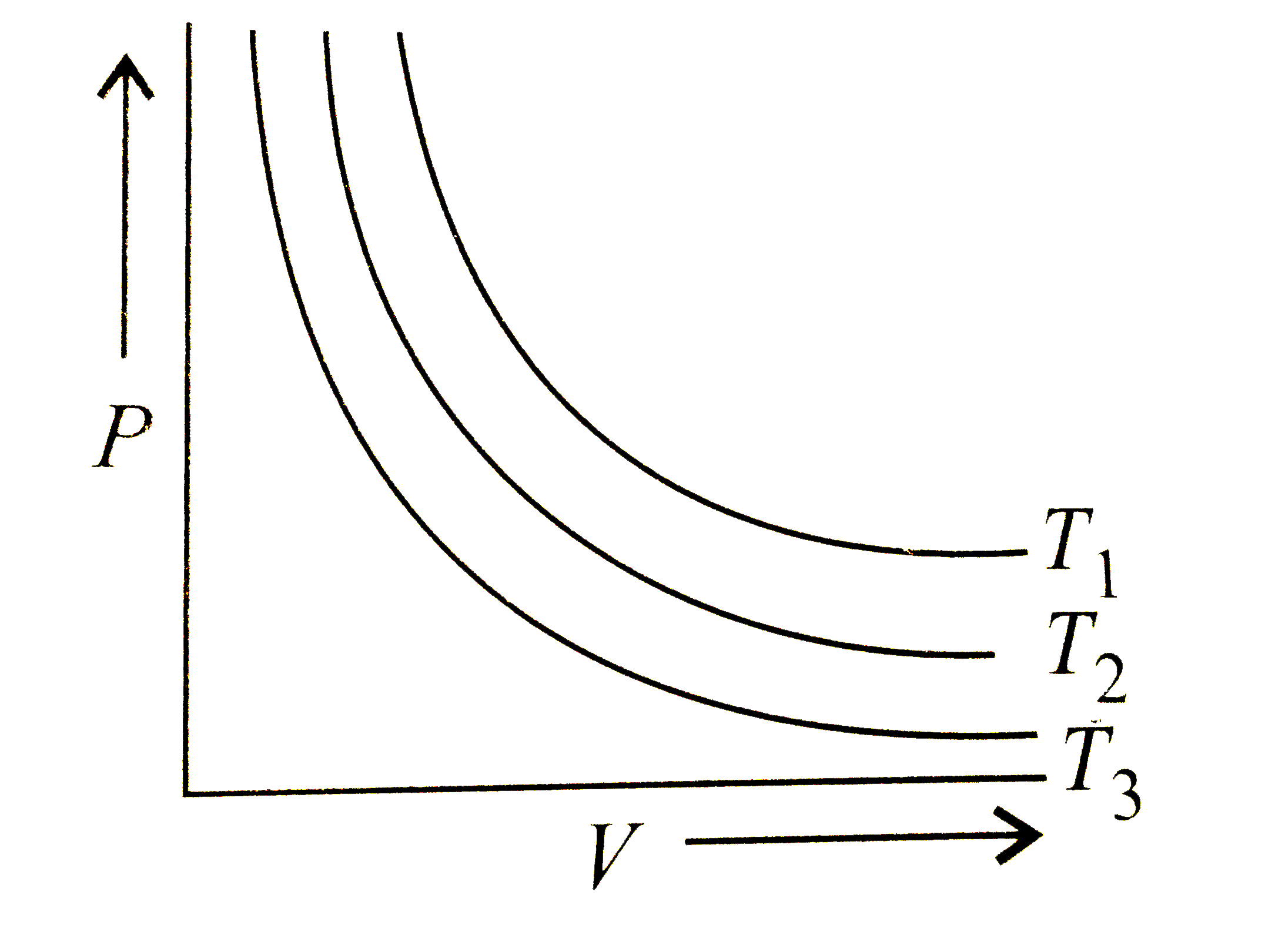
The graph of P vs V is given at differen...

The graph of P vs V is given at different temperature

The correct relationship is

A

`T_(1) gt T_(2) gt T_(3)`

B

`T_(1) lt T_(2) lt T_(3)`

C

`T_1=T_(2)=T_(3)`

D

`T_(2) gt T_(1) gt T_(3)`

Text Solution

Verified by Experts

The correct Answer is:

A
Promotional Banner

Topper's Solved these Questions

  • PRACTICE PAPER 3

    NCERT FINGERTIPS ENGLISH|Exercise Practice Paper 3|46 Videos
  • PRACTICE PAPER 2

    NCERT FINGERTIPS ENGLISH|Exercise Practice Paper 2|44 Videos
  • REDOX REACTIONS

    NCERT FINGERTIPS ENGLISH|Exercise Assertion And Reason|15 Videos

Similar Questions

Explore conceptually related problems

The graph of P vs V is given at temperature and number of moles : The correct relationship is/are

The graph of PV vs P for a gas is

Volume : Temperature relationship is given by

The plots of the extent of adsroption (x/m) Vs pressure at different temperature are as follows, The correct order of increasing temp for curves I, II, III, IV are ,

The plot of PV vs P at particular temperature is called isovbar.

The graph betwene P and V at constant temperature should look like

The current (I) and voltage (V) graphs for a given metallic wire at two different temperature (T_(1)) and (T_(2)) are shown in fig. It is concluded that

The given figure represent the V.S. of bulbs of Allium cepa identify the different parts and select the correct options

The graph between PV vs P at constant temperature is linear parallel to the pressure axis.

A graph plotted between (P)/(d) vs d (where p is osmotic pressure of solution of a solute of mol. Wt. m and d is its density temperature T . Pick out the correct statements about the plots :

NCERT FINGERTIPS ENGLISH-PRACTICE PAPER 3-Practice Paper 3
  1. The graph of P vs V is given at different temperature The correct...

    Text Solution

    |

  2. Compressibility factor for H(2) behaving as real gas is

    Text Solution

    |

  3. Which of the following statements is correct with respect to the prope...

    Text Solution

    |

  4. A sample of calcium carbonate (CaCO(3)) has the following percentage c...

    Text Solution

    |

  5. For the reaction, CO((g))+Cl(2(g))hArrCoCl(2(g)), the value of K(p)//K...

    Text Solution

    |

  6. Which of the following is not a basic physical quantity?

    Text Solution

    |

  7. In any subshell, the maximum number of electrons having same value of ...

    Text Solution

    |

  8. Clean water would have BOD value of less than

    Text Solution

    |

  9. Which of the followin will show least dipole character?

    Text Solution

    |

  10. Indicate the wrongly named compound.

    Text Solution

    |

  11. Heavy water is used as a

    Text Solution

    |

  12. The pH of 0.05 M Ba(OH)(2) solution is

    Text Solution

    |

  13. Which of the following solutions will have pH close to 1.0?

    Text Solution

    |

  14. The signs of DeltaH,DeltaS and DeltaG for a non-spontaneous reaction a...

    Text Solution

    |

  15. Which oxide is formed when potassium is heated in e3xcess of oxygen?

    Text Solution

    |

  16. What is the decreasing order of strength of the bases OH^(-),NH(2)^(-)...

    Text Solution

    |

  17. The electrons, identified by quantum numbers n and l(i) n=4,l=1 (ii) n...

    Text Solution

    |

  18. Conjugate base of a strong acid is

    Text Solution

    |

  19. A sample of gas has a volume of V(1) litre at temperature t(1).^(@)C. ...

    Text Solution

    |

  20. The liquefaction behaviour of temporary gases approacches that of perr...

    Text Solution

    |

  21. When the temperature is raised, viscosity o the liquid decreases. This...

    Text Solution

    |
