Home
Class 11
CHEMISTRY
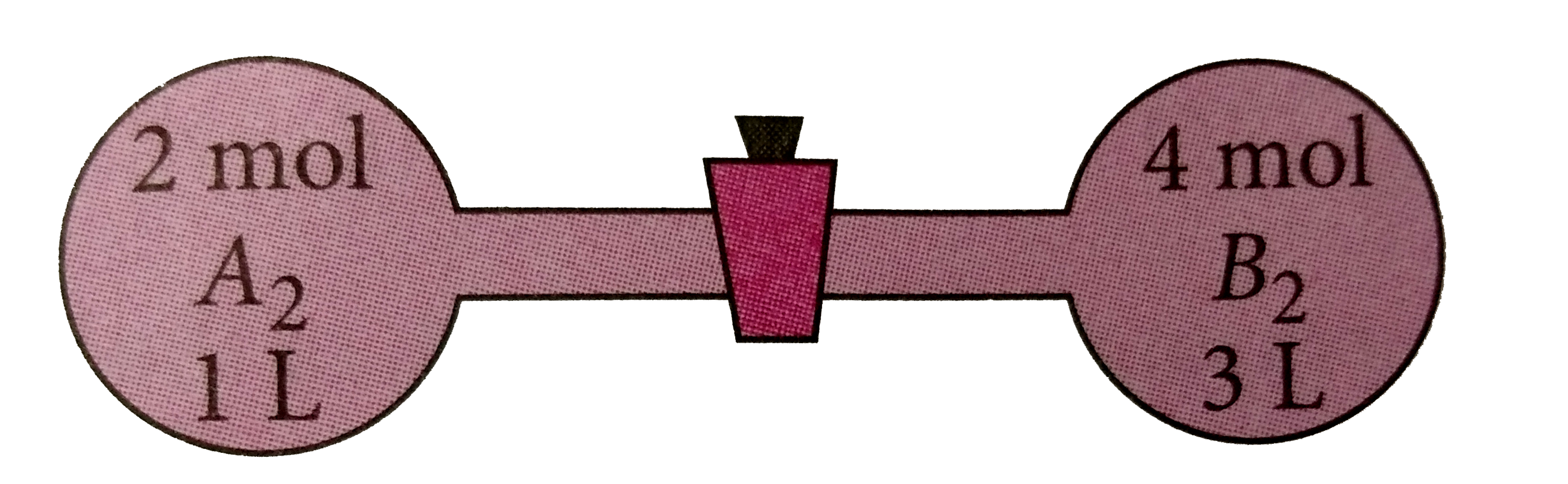
When A(2) and B(2) are allowed to react,...


When `A_(2) and B_(2)` are allowed to react, the equilibrium constant of the reaction at `27^(@)C` is found `(K_(c)=4)`.
`A_(2(g))+B_(2(g))hArr2AB_((g))`
what will be the equilibrium concentration of AB?

A

1.33 M

B

2.66 M

C

0.66 M

D

0.33 M

Text Solution

Verified by Experts

The correct Answer is:

C
Promotional Banner

Topper's Solved these Questions

  • PRACTICE PAPER 3

    NCERT FINGERTIPS ENGLISH|Exercise Practice Paper 3|46 Videos
  • PRACTICE PAPER 2

    NCERT FINGERTIPS ENGLISH|Exercise Practice Paper 2|44 Videos
  • REDOX REACTIONS

    NCERT FINGERTIPS ENGLISH|Exercise Assertion And Reason|15 Videos

Similar Questions

Explore conceptually related problems

When A_2 and B_2 are allowed to react, the equilibrium constant of the reaction at 27^@C is K_C = 4 What will be the equilibrium concentration of AB?

The equilibrium constant for the reaction A_(2)(g)+B_(2)(g) hArr 2AB(g) is 20 at 500K . The equilibrium constant for the reaction 2AB(g) hArr A_(2)(g)+B_(2)(g) would be

The equilibrium constant (K_(c)) for the reaction 2HCl(g)hArrH_(2)(g)+Cl_(2)(g) is 4xx10^(-34) at 25^(@)C .what is the equilibrium constant K_p for the reaction ?

At a certain temperature, the equilibrium constant (K_(c )) is 16 for the reaction: SO_(2)(g)+NO_(2)(g)hArrSO_(3)(g)+NO(g) If we take one mole of each of the equilibrium concentration of NO and NO_(2) ?

The equilibrium constant K_(p) for the reaction H_(2)(g)+I_(2)(g) hArr 2HI(g) changes if:

At 500 K, equlibrium constant, K_(c) for the following reaction is 5. 1//2 H_(2)(g)+ 1//2(g)hArr HI (g) What would be the equilibrium constant K_(c) for the reaction 2HI(g)hArrH_(2)(g)+l_(2)(g)

For the Chemical reaction A_(2(g)) + B_(2(g)) hArr 2 AB(g) the amount of AB at equilibrium is affected by

If equilibrium constant for the reaction A_(2)+B_(2) hArr 2AB is k, then for the backward reaction AB hArr 1//2 A_(2)+1//2B_(2) the equilibrium constant k' is 1//K .

10 moles of A_(2), 15 moles of B_(2) and 5 moles of AB are placed in a 2 litre vessel and allowed the come to equilibrium. The final concentration of AB is 10.5 M, A_(2)(g)+B_(2)(g)hArr 2AB(g) Determine the value of equilibrium constant (K_(C)) for the reaction.

For the reaction H_(2)(g)+I_(2)(g)hArr2HI(g) the equilibrium constant K_(p) changes with

NCERT FINGERTIPS ENGLISH-PRACTICE PAPER 3-Practice Paper 3
  1. When A(2) and B(2) are allowed to react, the equilibrium constant of t...

    Text Solution

    |

  2. Compressibility factor for H(2) behaving as real gas is

    Text Solution

    |

  3. Which of the following statements is correct with respect to the prope...

    Text Solution

    |

  4. A sample of calcium carbonate (CaCO(3)) has the following percentage c...

    Text Solution

    |

  5. For the reaction, CO((g))+Cl(2(g))hArrCoCl(2(g)), the value of K(p)//K...

    Text Solution

    |

  6. Which of the following is not a basic physical quantity?

    Text Solution

    |

  7. In any subshell, the maximum number of electrons having same value of ...

    Text Solution

    |

  8. Clean water would have BOD value of less than

    Text Solution

    |

  9. Which of the followin will show least dipole character?

    Text Solution

    |

  10. Indicate the wrongly named compound.

    Text Solution

    |

  11. Heavy water is used as a

    Text Solution

    |

  12. The pH of 0.05 M Ba(OH)(2) solution is

    Text Solution

    |

  13. Which of the following solutions will have pH close to 1.0?

    Text Solution

    |

  14. The signs of DeltaH,DeltaS and DeltaG for a non-spontaneous reaction a...

    Text Solution

    |

  15. Which oxide is formed when potassium is heated in e3xcess of oxygen?

    Text Solution

    |

  16. What is the decreasing order of strength of the bases OH^(-),NH(2)^(-)...

    Text Solution

    |

  17. The electrons, identified by quantum numbers n and l(i) n=4,l=1 (ii) n...

    Text Solution

    |

  18. Conjugate base of a strong acid is

    Text Solution

    |

  19. A sample of gas has a volume of V(1) litre at temperature t(1).^(@)C. ...

    Text Solution

    |

  20. The liquefaction behaviour of temporary gases approacches that of perr...

    Text Solution

    |

  21. When the temperature is raised, viscosity o the liquid decreases. This...

    Text Solution

    |
