Home
Class 12
PHYSICS
The following table gives the wavelength...

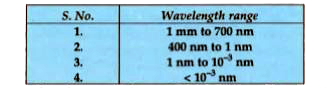
The following table gives the wavelength range of some constituents of the electromagnetic spectrum :

Select the wavelength range and name the electromagnetic waves that are (i) widely used in the remote switches of household electronic devices, (ii) produced in nuclear reactions.

Text Solution

Verified by Experts

(i) Infrared rays of wavelength range 1 mm to 700 nm.
(ii) Gamma rays of wavelength range `lambda=10^(-3)nm`.
Promotional Banner

Topper's Solved these Questions

  • ELECTROMAGNETIC WAVES

    U-LIKE SERIES|Exercise LONG ANSWER QUESTIONS-I|11 Videos
  • ELECTROMAGNETIC WAVES

    U-LIKE SERIES|Exercise SELF ASSESSMENT TEST (SECTION A)(MULTIPLE CHOICE QUESTIONS)|5 Videos
  • ELECTROMAGNETIC WAVES

    U-LIKE SERIES|Exercise VERY SHORT ANSWER QUESTIONS|35 Videos
  • ELECTRIC CHARGES AND FIELDS

    U-LIKE SERIES|Exercise SELF ASSESSMENT TEST (SECTION-B) (VERY SHORT ANSWER QUESTIONS)|4 Videos
  • ELECTROMAGNETICE INDUCTION

    U-LIKE SERIES|Exercise Self Assessment Test Section -D|1 Videos

Similar Questions

Explore conceptually related problems

Name the part of electromagnetic spectrum whose wavelength lies in the range of 10^-10m . Give its one use.

Name the radiation of the electromagnetic spectrum which is used for the following: (i) Radar (ii) Eye surgery

Which electromagnetic waves are used for the following purposes? (i) Diagnostic tool in medicine. (ii) Kill germs in water purifiers. (iii) Cellular phones. (iv) In remote switches of household electronic systems.

The French physicist Louis de Broglie in 1924 postulated that matter like radiation , should exhibit a dual behaviour. He proposed the following relationship between the wavelength .lambda of a material particle,its linear momentum P and Planck constant h. lambda=(h)/(p)=(h)/(mv) The de Broglie relaion that the wavelength of a particle should decrease as its velocity increases. It also implies that for a given velocity heavier particles should have shorter wavelength than lighter particles.The waves or de Broglie waves. These waves differ from the electromagnetic waves as they: (i) have lower velocities (ii) have no electrical and magnetic fields and (iii) are not emitted by the particle under consideration. The expermental confirmation of the de Broglie relation was obtained when Davission and Germer in 1927, observed. As diffraction is a characteristic property of waves, hence the beam of electrons behave as a wave as proposed by de Broglie. Werner Heisenberg considered the limits of how precisely we can measure properties of an electron or other microscopic particle like electron . He determined that there is a fundamental limit of how closely we can measure both position and momentum. The more accurately we can determine its position. The converse is also true. This is summed up in what we now call the ''Heisenberg uncertainty principle'' : It is impossible to determine simultaneously and precisely both the momentum and position of a particle. The product of uncertainty in the position, Deltax and the uncertainty in the momentum Delta(mv) must be greater than or equal to (h)/(4pi), i.e., Deltax Delta(mv)ge(h)/(4pi) The transition so that the de Broglie wavelength of electron becomes 3 times of its initial value in He^(+) ion will be :

The French physicist Louis de Broglie in 1924 postulated that matter like radiation , should exhibit a dual behaviour. He proposed the following relationship between the wavelength .lambda of a material particle,its linear momentum P and Planck constant h. lambda=(h)/(p)=(h)/(mv) The de Broglie relaion that the wavelength of a particle should decrease as its velocity increases. It also implies that for a given velocity heavier particles should have shorter wavelength than lighter particles.The waves or de Broglie waves. These waves differ from the electromagnetic waves as they: (i) have lower velocities (ii) have no electrical and magnetic fields and (iii) are not emitted by the particle under consideration. The expermental confirmation of the de Broglie relation was obtained when Davission and Germer in 1927, observed. As diffraction is a characteristic property of waves, hence the beam of electrons behave as a wave as proposed by de Broglie. Werner Heisenberg considered the limits of how precisely we can measure properties of an electron or other microscopic particle like electron . He determined that there is a fundamental limit of how closely we can measure both position and momentum. The more accurately we can determine its position. The converse is also true. This is summed up in what we now call the ''Heisenberg uncertainty principle'' : It is impossible to determine simultaneously and precisely both the momentum and position of a particle. The product of uncertainty in the position, Deltax and the uncertainty in the momentum Delta(mv) must be greater than or equal to (h)/(4pi), i.e., Deltax Delta(mv)ge(h)/(4pi) The correct order of wavelength of Hydrogen (._(1)H^(1)) Deuterium (._(1)H^(2)) and Tritium (._(1)H^(3)) moving with same kinetic energy is :

U-LIKE SERIES-ELECTROMAGNETIC WAVES-SHORT ANSWER QUESTIONS
  1. When an ideal capacitor is charged by a d.c. battery, no current flows...

    Text Solution

    |

  2. A capacitor, made of two parallel plates each of plate are A and separ...

    Text Solution

    |

  3. Why does a galvanometer show a momentary deflection at the time of cha...

    Text Solution

    |

  4. An electromagnetic wave is travelling in a medium with a velocity vecv...

    Text Solution

    |

  5. How does a charge q oscillating at certain frequency produce electroma...

    Text Solution

    |

  6. (a) Why are infra-red waves often called heat waves ? Explain. (b) W...

    Text Solution

    |

  7. The oscillating magnetic field in a plane electromagnetic wave is give...

    Text Solution

    |

  8. Identify the electromagnetic waves whose wavelengths vary as (a) 10^...

    Text Solution

    |

  9. Identify the electromagnetic waves whose wavelengths lie in the range ...

    Text Solution

    |

  10. Arrange the following electromagnetic radiations in ascending order of...

    Text Solution

    |

  11. Write one method each of (i) production, and (ii) detection of microwa...

    Text Solution

    |

  12. Briefly state the working principle of microwave ovens.

    Text Solution

    |

  13. (a) Give one use of electromagnetic radiations obtained in nuclear dis...

    Text Solution

    |

  14. The following table gives the wavelength range of some constituents of...

    Text Solution

    |

  15. (a) Why do welders wear special glass goggles or face masks with glass...

    Text Solution

    |

  16. How are infrared waves produced ? Why are these referred to as .heat w...

    Text Solution

    |

  17. (a) Arrange the following electromagnetic waves in the descending orde...

    Text Solution

    |

  18. Name the types of electromagnetic radiations which (i) are used in des...

    Text Solution

    |

  19. How does Ampere-Maxwell law explain the flow of current through a capa...

    Text Solution

    |

  20. Considering the case of a parallel plate capacitor being charged, show...

    Text Solution

    |
