Home
Class 12
PHYSICS
Considering the case of a parallel plate...

Considering the case of a parallel plate capacitor being charged, show how one is required to generalise Ampere.s circuital law to include the term due to displacement current.

Text Solution

Verified by Experts
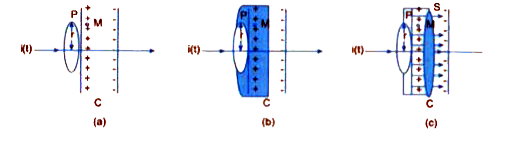
Consider charging of a parallel plate capacitor by a time-varying current iw Let us find the magnetic field at a point P in a region outside the capacitor. For this we consider a plane circular loop of radius r whose plane is perpendicular to the direction of the current carrying wire and which is centred symmetrically with respect to the wire [Fig]. Using symmetry condition and applying Ampere.s circuital law, we have
`B(2pir)=mu_(0)i_((t))" ....(i)"`
However, if we consider a different surface, having the same boundary [either as shown in Fig. or Fir. and apply Ampere.s circuital law as before, we find
`B(2pir)=mu_(0)(0)=0" ....(ii)"`
It is because nocurrent passes through the surface of Figs. and 8.04. It causes a contradiction because we get a finite value of magnetic field B by doing calculation in one way and zero value of B by doing calculation in another way. To remove this contradiction Maxwell introduced the concept of displacement current

`i_(D)=in_(0)(dphi_(E))/(dt),` where `(dphi_(E))/(dt)` is the rate of change of electric flux between the plates of given capacitor.
Now, the Ampere - Maxwell.s circuital law is expressed as
`oint vecB.vecdl=mu_(0)[i_((t))+i_(D)]`
Thus, Ampere - Maxwell law successfully explains the flow the current through a capacitor when it is being charged (or discharged) by a battery.
Promotional Banner

Topper's Solved these Questions

  • ELECTROMAGNETIC WAVES

    U-LIKE SERIES|Exercise LONG ANSWER QUESTIONS-I|11 Videos
  • ELECTROMAGNETIC WAVES

    U-LIKE SERIES|Exercise SELF ASSESSMENT TEST (SECTION A)(MULTIPLE CHOICE QUESTIONS)|5 Videos
  • ELECTROMAGNETIC WAVES

    U-LIKE SERIES|Exercise VERY SHORT ANSWER QUESTIONS|35 Videos
  • ELECTRIC CHARGES AND FIELDS

    U-LIKE SERIES|Exercise SELF ASSESSMENT TEST (SECTION-B) (VERY SHORT ANSWER QUESTIONS)|4 Videos
  • ELECTROMAGNETICE INDUCTION

    U-LIKE SERIES|Exercise Self Assessment Test Section -D|1 Videos

Similar Questions

Explore conceptually related problems

Considering the case of a parallel plate capacitor being charged, show how one is required to generalize Ampere's circuital law of include the term due to displacement current.

The potential difference between the plates of a parallel plate capacitor is changing at the rate of 10^(6)V/s .If the capacitance is 2 mu F ,the displacement current in the dielectric of the capacitor will be

The capacity of a parallel plate air capacitor is 2 mu F and voltage beteen the plates is changing at the rate of 3 v/s the displacement current in the capacitor is

Two circular plates of radius 0.1 m are used to from a parallel plate capacitor. If displacement current between the plates is 2pi .ampere, then find m agnetic filed produced by displacement current 4 cm from the axis of the plates.

The charge on a parallel plate capacitor varies as q = q_(0) "cos" 2 pit . The plates are very large and close together (area = A, separation = d). The displacement current through the capacitor is

The potential difference between the plates of a parallel plate capacitor of capacitance 2 mu F is changing at the rate of 10^(5)V//s . What is the displacement current in the dielectric of the capacitor?

Assertion: The force with which one plate of a parallel plate capacitor is attracted towards the other plate is equal to square of surface density per epsilon per unit area. Reason: The electric field due to one charged plate of the capacitor at the location of the other is equal to surface density per epsilon .

The voltage between the plates of a parallel plate capacitor of capacitance 1 muF is changing at the rate of 8 V/s. What is the displacement current in the capacitor?

U-LIKE SERIES-ELECTROMAGNETIC WAVES-SHORT ANSWER QUESTIONS
  1. When an ideal capacitor is charged by a d.c. battery, no current flows...

    Text Solution

    |

  2. A capacitor, made of two parallel plates each of plate are A and separ...

    Text Solution

    |

  3. Why does a galvanometer show a momentary deflection at the time of cha...

    Text Solution

    |

  4. An electromagnetic wave is travelling in a medium with a velocity vecv...

    Text Solution

    |

  5. How does a charge q oscillating at certain frequency produce electroma...

    Text Solution

    |

  6. (a) Why are infra-red waves often called heat waves ? Explain. (b) W...

    Text Solution

    |

  7. The oscillating magnetic field in a plane electromagnetic wave is give...

    Text Solution

    |

  8. Identify the electromagnetic waves whose wavelengths vary as (a) 10^...

    Text Solution

    |

  9. Identify the electromagnetic waves whose wavelengths lie in the range ...

    Text Solution

    |

  10. Arrange the following electromagnetic radiations in ascending order of...

    Text Solution

    |

  11. Write one method each of (i) production, and (ii) detection of microwa...

    Text Solution

    |

  12. Briefly state the working principle of microwave ovens.

    Text Solution

    |

  13. (a) Give one use of electromagnetic radiations obtained in nuclear dis...

    Text Solution

    |

  14. The following table gives the wavelength range of some constituents of...

    Text Solution

    |

  15. (a) Why do welders wear special glass goggles or face masks with glass...

    Text Solution

    |

  16. How are infrared waves produced ? Why are these referred to as .heat w...

    Text Solution

    |

  17. (a) Arrange the following electromagnetic waves in the descending orde...

    Text Solution

    |

  18. Name the types of electromagnetic radiations which (i) are used in des...

    Text Solution

    |

  19. How does Ampere-Maxwell law explain the flow of current through a capa...

    Text Solution

    |

  20. Considering the case of a parallel plate capacitor being charged, show...

    Text Solution

    |

