Text Solution
Verified by Experts
The correct Answer is:



Topper's Solved these Questions
PROBABILITY
KUMAR PRAKASHAN|Exercise Solutions of NCERT Exemplar Problems (Long Answer Type Questions)|8 VideosPROBABILITY
KUMAR PRAKASHAN|Exercise Solutions of NCERT Exemplar Problems (Objective type Questions)|12 VideosPROBABILITY
KUMAR PRAKASHAN|Exercise Textbook Illustrations for Practice Work|19 VideosPRINCIPLE OF MATHEMATICAL INDUCTION
KUMAR PRAKASHAN|Exercise NCERT EXEMPLAR PROBLEMS (QUESTION OF MODULE )|11 VideosRELATIONS AND FUNCTIONS
KUMAR PRAKASHAN|Exercise Solutions of NCERT Exemplar Problems (Question of Module)|16 Videos
Similar Questions
Explore conceptually related problems
KUMAR PRAKASHAN-PROBABILITY-Solutions of NCERT Exemplar Problems (Short Answer Type Questions)
- If the letters of the word ALGORITHM are arranged at random in a row w...
Text Solution
|
- Six new employees, two of whom are married to each other, are to be as...
Text Solution
|
- Suppose an integer from 1 through 1000 is chosen at random, find the p...
Text Solution
|
- An experiment consists of rolling a die until a 2 appears. (i) How m...
Text Solution
|
- An experiment consists of rolling a die until a 2 appears. (ii) How ...
Text Solution
|
- A die is loaded in such a way that each odd number is twice as likely ...
Text Solution
|
- In a large metropolitan area, the probabilities are .87,.36,.30 that a...
Text Solution
|
- If A and B are mutually exclusive events, P(A) = 0.35 and P(B)= 0.45, ...
Text Solution
|
- A team of medical students doing their internship have to assist durin...
Text Solution
|
- Four candidates A, B, C, D have applied for the assignment to coach a ...
Text Solution
|
- One of the four persons John, Rita, Aslam or Gurpreet will be promoted...
Text Solution
|
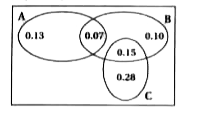
- The accompanying Venn diagram shows three events, A,B, and C, also the...
Text Solution
|