Home
Class 10
PHYSICS
To verify the Ohm.s law a circuit diagra...

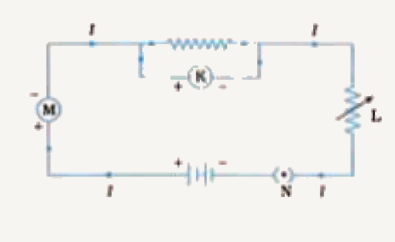
To verify the Ohm.s law a circuit diagram was drawn by a student as shown below:

What do K, L, M, N stand for?

Text Solution

Verified by Experts

K = voltmeter, L = rheostat, M = ammeter and N = plug key
Promotional Banner

Topper's Solved these Questions

  • ELECTRICITY

    KUMAR PRAKASHAN|Exercise VALUE BASED QUESTIN WITH ANSWERS|15 Videos
  • ELECTRICITY

    KUMAR PRAKASHAN|Exercise PRACTICAL SKILL BASED QUESTION WITH ANSWERS|20 Videos
  • ELECTRICITY

    KUMAR PRAKASHAN|Exercise OBJECTIVE QUESTIONS AND ANSWERS (Choose the correct option from those given below each question: )|55 Videos
  • MAGNETIC EFFECTS OF ELECTRIC CURRENT

    KUMAR PRAKASHAN|Exercise VALUE BASED QUESTIONS WITH ANSWERS|15 Videos

Similar Questions

Explore conceptually related problems

In a given ammeter, a student observes that the needle indicates 17 divisions in the ammeter when performing an experiment to verifY Ohm.s law. If the ammeter has 10 divisions between o and 0.5 A, then what is the value of 17 divisions?

An LCR circuit is equivalent to a damped pendulum. In an LCR circuit the capacitor is charged to Q_0 and then connected to the L and R as shown below: If a student plots graphs of the square of maximum charge (Q_"Max"^2) on the capacitor with time (t) for two different values L_1 and L_2 (L_1 gt L_2) of L then which of the following represents this graph correctly ? (plots are schematic and not drawn to scale)

The Class X students of a secondary school in Krishinagar have been allotted a rectangular plot of land for their gardening activity. Sapling of Gulmohar are planted on the boundary at a distance of 1 m from each other. There is a triangular grassy lawn in the plot as shown in the given figure. The students are to sow seeds of flowering plans on the remaining area of the plot. (1) Taking A as origin, find the coordinates of the vertices of the triangle. (2) What will be the coordinates of the vertices of Delta PQR if C is the origin ? Also calculate the areas of the triangles in these cases. What do you observe ?

A cylinderical container of length L is full to the brim with a liquid which has mass density rho . It is placed on a weight scale, the scale reading is w. A light wall ball which would float on the liquid if allowed to do so, of volume V and mass m is pushed gently down and held beneath the surface of the liquid with a rigid rod of negligible volume as shown on the left Q. What is the mass M of liquid which overflowed while the ball was being pushed into the liquid? (a). rhoV (b). m (c). m-rhoV (d). none of these

A cylinderical container of length L is full to the brim with a liquid which has mass density rho . It is placed on a weight scale, the scale reading is w. A light wall ball which would float on the liquid if allowed to do so, of volume V and mass m is pushed gently down and held beneath the surface of the liquid with a rigid rod of negligible volume as shown on the left Q. What is the reading of the scale when the ball is fully immersed (a). w-rhoVg (b). w (c). w+mg-rhoVg (d). none of these

A circus wishes to develop a new clown act. Fig. (1) shows a diagram of the proposed setup. A clown will be shot out of a cannot with velocity v_(0) at a trajectory that makes an angle theta=45^(@) with the ground. At this angile, the clown will travell a maximum horizontal distance. The cannot will accelerate the clown by applying a constant force of 10, 000N over a very short time of 0.24s . The height above the ground at which the clown begins his trajectory is 10m . A large hoop is to be suspended from the celling by a massless cable at just the right place so that the clown will be able to dive through it when he reaches a maximum height above the ground. After passing through the hoop he will then continue on his trajectory until arriving at the safety net. Fig (2) shows a graph of the vertical component of the clown's velocity as a function of time between the cannon and the hoop. Since the velocity depends on the mass of the particular clown performing the act, the graph shows data for serveral different masses. If a clown holds on to hoop instead of passing through it, what is the position of the cable so that he doesn't hit his head on the ceiling as he swings upward?

Consider one mole of perfect gas in a cylinder of unit cross section with a piston attached as shown in figure. A spring (spring constant k) is attached (unstretched length L ) to the piston and to the bottom of the cylinder. Initially the spring is unstretched and the gas is in equilibrium. A certain amount of heat Q is supplied to the gas causing an increase of value from V_0 to V_1 . (a) What is the initial pressure of the system ? (b) What is the final pressure of the system ? (c) Using the first law of thermodynamics, write down a relation between Q, P_a , V, V_0 and k.

Comprehension # 1 If net force on a system in a particular direction is zero (say in horizontal direction) we can apply: Sigmam_(R )x_(R )= Sigmam_(L)x_(L), Sigmam_(R )v_(R )= Sigmam_(L)v_(L) and Sigmam_(R )a_(R ) = Sigmam_(L)a_(L) Here R stands for the masses which are moving towards right and L for the masses towards left, x is displacement, v is veloctiy and a the acceleration (all with respect to ground). A small block of mass m = 1 kg is placed over a wedge of mass M = 4 kg as shown in figure. Mass m is released from rest. All surface are smooth. Origin O is as shown. Normal reaction between the two blocks at an instant when absolute acceleration of m is 5 sqrt3 m//s^(2) at 60^(@) with horizontal is ......... N. Normal reaction at this instant is making 30^(@) with horizontal :-

An inductor (L = 0.03 H) and a resistor (R = 0.15 kOmega ) are connected in series to a battery of 15 V EMF in a circuit shown below The key K_1 has been kept closed for a long time. Then at t = 0, K_1 is opened and key K_2 is closed simultaneously. At t = 1 ms, the current in the circuit will be : (e^5 cong 150)

Comprehension # 1 If net force on a system in a particular direction is zero (say in horizontal direction) we can apply: Sigmam_(R )x_(R )= Sigmam_(L)x_(L), Sigmam_(R )v_(R )= Sigmam_(L)v_(L) and Sigmam_(R )a_(R ) = Sigmam_(L)a_(L) Here R stands for the masses which are moving towards right and L for the masses towards left, x is displacement, v is veloctiy and a the acceleration (all with respect to ground). A small block of mass m = 1 kg is placed over a wedge of mass M = 4 kg as shown in figure. Mass m is released from rest. All surface are smooth. Origin O is as shown. Final velocity of the wedge is .......... m//s :-

KUMAR PRAKASHAN-ELECTRICITY-OBJECTIVE QUESTIONS AND ANSWERS (Answer the following questions as directed (Miscellaneous):)
  1. An ammeter has a range (0 - 3A) and there are 30 divisions on its scal...

    Text Solution

    |

  2. In a voltmeter there are 20 divisions between 0 mark and 0.5 V mark....

    Text Solution

    |

  3. To verify the Ohm.s law a circuit diagram was drawn by a student as sh...

    Text Solution

    |

  4. Four students connect 4 cells of 1.5 V each to get a battery of voltag...

    Text Solution

    |

  5. Which of the following statements is correct? (a) one volt is one j...

    Text Solution

    |

  6. Keeping the resistance constant, the potential difference applied acro...

    Text Solution

    |

  7. Keeping the potential difference constant, the resistance of a circuit...

    Text Solution

    |

  8. A potential difference of 10 V is needed to make a current of 0.02 A f...

    Text Solution

    |

  9. A current of 200 mA flows through a 4 kOhm resistor. What is the poten...

    Text Solution

    |

  10. The electrical resistivities of four materials A, B, C and D are given...

    Text Solution

    |

  11. The equivalent resistance of a series combination of two resistors is ...

    Text Solution

    |

  12. An electric lamp is labelled 12 V, 36 W. This indicate that it should ...

    Text Solution

    |

  13. Name two devices whose working is based on the heating effect of elect...

    Text Solution

    |

  14. Name the gases which are filled into the filament-type electric light ...

    Text Solution

    |

  15. Why are the filament-type electric light bulbs not power efficient?

    Text Solution

    |

  16. Under what conditions is the Ohm.s law applicable?

    Text Solution

    |

  17. Why is Nichrome used as a heating element?

    Text Solution

    |

  18. Why are Constantan and Manganin used for making standard resistors?

    Text Solution

    |

  19. Why is lead-tin alloy used for making a fuse?

    Text Solution

    |

  20. What is the difference between a resistor ~ and resistance?

    Text Solution

    |
