Home
Class 10
PHYSICS
Imagine that you are sitting in a chamb...

Imagine that you are sitting in a chamber with you back to one wall. An electron beam , moving horizontlly from back wall towards the front wall , is deflected by a stong magnetic field to your right side.
What is the direction of magnetic field ?

Text Solution

Verified by Experts
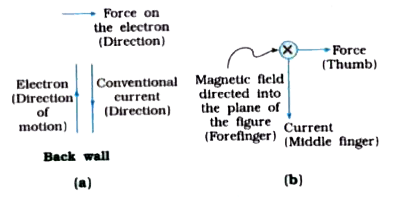

For reference , see figure (a) and (b) .
The direction of the conventional current is opposite to the direction of motion of the electron .
Applying Fleming.s left - hand rule , we find that when the middle finger points in the direction of the current and the thumb points in the direction of the force , the forefinger points downward giving the direction of the magnetic field .
Promotional Banner

Topper's Solved these Questions

  • MAGNETIC EFFECTS OF ELECTRIC CURRENT

    KUMAR PRAKASHAN|Exercise ADDITIONAL QUESTIONS AND ANSWER|6 Videos
  • MAGNETIC EFFECTS OF ELECTRIC CURRENT

    KUMAR PRAKASHAN|Exercise OBJECTIVE QUESTIONS AND ANSWERS ( ANSWER THE FOLLOWING QUESTIONS IN ONE WORD/SENTENCE:)|14 Videos
  • MAGNETIC EFFECTS OF ELECTRIC CURRENT

    KUMAR PRAKASHAN|Exercise VALUE BASED QUESTIONS WITH ANSWERS|15 Videos
  • ELECTRICITY

    KUMAR PRAKASHAN|Exercise PRACTICAL SKILL BASED QUESTION WITH ANSWERS|20 Videos
  • MODEL QUESTION PAPER 01

    KUMAR PRAKASHAN|Exercise SECTION-C|4 Videos

Similar Questions

Explore conceptually related problems

A plane electromagnetic wave travels in vacuum along z-direction. What can you say about the directions of its electric and magnetic field vectors? If the frequency of the wave is 30 MHz, what is its wavelength?

A plane electromagnetic wave travels in vacuum along z - direction. What can you say about the directions of its electric and magnetic field vectors ? If the frequency of the wave is 30 MHz, what is its wavelength ?

Figure shows a metal rod PQ resting on the smooth rails AB and positioned between the poles of a permanent magnet. The rails, the rod, and the magnetic field are in three mutual perpendicular directions. A galvanometer G connects the rails through a switch K. Length of the rod =15 cm, B =0.50 T, resistance of the closed loop containing the rod 9.0 m Omega . Assume the field to be uniform. (a) Suppose K is open and the rod is moved with a speed of 12 "cm s"^(-1) in the direction shown. Give the polarity and magnitude of the induced emf. (b) Is there an excess charge built up at the ends of the rods when K is open ? What if K is closed ? (c) With K open and the rod moving uniformly, there is no net force on the electrons in the rod PQ even though they do experience magnetic force due to the motion of the rod. Explain. (d) What is the retarding force on the rod when K is closed ? How much power is required (by an external agent) to keep the rod moving at the same speed (= 12 cm s^(-1) ) when K is closed ? How much power is required when K is open? (f)How much power is dissipated as heat in the closed circuit ? What is the source of this power ? (g) What is the induced emf in the moving rod if the magnetic field is parallel to the rails instead of being perpendicular ?

A monoenergetic (18 keV) electron beam initially in the horizontal direction is subjected to a horizontal magnetic field of 0.04 G normal to the initial direction. Estimate the up or down deflection of the beam over a distance of 30 cm (m_(e) = 9.11 xx 10^(-31) kg) . [Note : Data in this exercise are so chosen that the answer will give you an idea of the effect of earth's magnetic field on the motion of the electron beam from the electron gun to the screen in a TV set.)

A very long wire is held vertical in a direction perpendicular to the horizontal component of Earth's magnetic field. Find the value of current to be passed through this wire so that this resultant magnetic field at a point 10 cm away from this wire becomes zero. What will be the magnetic induction at a point 10 cm away from the wire on the opposite side of this point ? Horizontal component of Earth's magnetic field H=0.36xx10^(-4)T,mu_(0)=4pixx10^(-7)Tm//A .

A small ball of mass m and charge q is attached to the bottom end of a piece of negligible mass thread of length l, whose top end is fixed. The system formed by the thread and ball is in vertical plane and is in uniform horizontal magnetic field B, which is perpendicular to the plane of figure and points into the paper The ball is started with a velocity v_(0) from lower most point of circle in a direction perpendicular both to the magnetic induction and to direction of thread. The ball moves along a circular path such that thread remains tight during the whole motion. Neglect any loss of enery. What is the magnitude of magnetic induction B, if the minimum initial speed at which the described motion of ball (complete vertical circular motion) occurs is V_(0)=(1)/(2)sqrt(17gL)

An electron travelling west to east enters a chamber having a uniform electrostatic field in north to south direction. Specify the direction in which a uniform magnetic field should be set up to prevent the electron from deflecting from its straight line path.

A magnetic field that varies in magnitude from point to point but has a constant direction (east to west) is set up in a chamber. A charged particle enters the chamber and travels undeflected along a straight path with constant speed. What can you say about the initial velocity of the particle?

A square loop of side 12 cm with its sides parallel to X and Y axes is moved with a velocity of 8 "cm s"^(-1) in the positive x-direction in an environment containing a magnetic field in the positive z-direction. The field is neither uniform in space nor constant in time. It has a gradient of 10^(-3) "T cm"^(-1) along the negative x-direction (that is it increases by 10^(-3) "T cm"^(-1) as one moves in the negative x-direction), and it is decreasing in time at the rate of 10^(-3) T s^(-1) . Determine the direction and magnitude of the induced current in the loop if its resistance is 4.50 mOmega .

KUMAR PRAKASHAN-MAGNETIC EFFECTS OF ELECTRIC CURRENT -TEXTUAL EXERCISE
  1. The phenomenon of electromagnetic induction is…….

    Text Solution

    |

  2. The device used for producing electric current is called a……..

    Text Solution

    |

  3. The essential difference between and AC generator and a DC generato...

    Text Solution

    |

  4. At the time of short circuit , the current in the circuit……

    Text Solution

    |

  5. State whether the following statement are true or false : An elect...

    Text Solution

    |

  6. State whether the following statement are true or false : An elect...

    Text Solution

    |

  7. State whether the following statement are true or false : The mag...

    Text Solution

    |

  8. State whether the following statement are true or false : The wi...

    Text Solution

    |

  9. List two methods of producing magnetic fields .

    Text Solution

    |

  10. How does a solenoid behave like a magnet ? Can you determine the no...

    Text Solution

    |

  11. When is the force experienced by a current - carrying conductor pla...

    Text Solution

    |

  12. Imagine that you are sitting in a chamber with you back to one wall. ...

    Text Solution

    |

  13. Draw a labelled diagram of an electric motor . Explain its princple ...

    Text Solution

    |

  14. Name some devices in which electric motors are used .

    Text Solution

    |

  15. A coil of insulated copper wire is conncted to a galvnometer . What...

    Text Solution

    |

  16. Two circular coil A and B are placed close to each other . If the c...

    Text Solution

    |

  17. State the rule to determine the direction of a (i) magnetic field pr...

    Text Solution

    |

  18. Explain the underlying principle and working of an electric genera...

    Text Solution

    |

  19. When does an electric short circuit occur ?

    Text Solution

    |

  20. What is the function of an earth wire ? Why is it necessary to earth...

    Text Solution

    |

