
Home
Class 12
PHYSICS
Two masses m(1) and m(2) are suspended ...

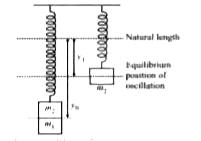
Two masses `m_(1)` and `m_(2)` are suspended w together by a light spring of spring constant k as shown in figure. When the system is in equilibrium, the mass `m_(1)` is removed without disturbing the system. As a result of this removal, mass `m_(2)` performs simple harmonic motion. For this situation mark the correct statement(s).

A

The amplitude of osciallation is `(m_(1)g)/k`

B

The amplitude of oscillations is `((m_(1) + m_(2))g)/k`

C

The system oscillates with angular frequency `sqrt(k/m_(2))`

D

The system oscillates with angular frequency `sqrt(k/(m_(1)+m_(2)))`

Text Solution

Verified by Experts

The correct Answer is:
A, C

When both the blocks are connected then in equilibrium position, the elongation in spring is given by:
`y_(0) =((m_(1) + m_(2))g)/k`

In equilibrium position, for resulting oscillation after removal of `m_(1)`, elongation in spring is:
`y_(1) =(m_(2)g)/k`
So, amplitude of oscillations is,
`y_(0)-y_(1) =(m_(1)g)/k`
Time period of simple harmonic motion is,
`T =2pi sqrt(m_(2)/k) rArr omega = sqrt(k/m_(2))`
Promotional Banner

Topper's Solved these Questions

  • OSCILLATIONS AND WAVES

    MTG-WBJEE|Exercise WB JEE PREVIOUS YEARS QUESTIONS (CATEGORY 1: SINGLE OPTION CORRECT TYPE (1 MARK))|16 Videos
  • OSCILLATIONS AND WAVES

    MTG-WBJEE|Exercise WB JEE PREVIOUS YEARS QUESTIONS (CATEGORY 2: SINGLE OPTION CORRECT TYPE (2 MARKS))|3 Videos
  • OSCILLATIONS AND WAVES

    MTG-WBJEE|Exercise WB JEE WORKOUT (CATEGORY 2: SINGLE OPTION CORRECT TYPE 2 MARKS)|15 Videos
  • NUCLEAR PHYSIC

    MTG-WBJEE|Exercise WB JEE PREVIOUS YEARS QUESTIONS|5 Videos
  • PARTICLE NATURE OF LIGHT AND WAVE PARTICLE DUALISM

    MTG-WBJEE|Exercise WB JEE PREVIOUS YEARS QUESTIONS|15 Videos

Similar Questions

Explore conceptually related problems

Two masses m_(1) and m_(2) are suspended together by a massless spring of constant K. When the masses are in equilibrium, m_(1) is removed without disturbing the system. Then the angular frequency of oscillation of m_(2) is -

Two masses m_(1) = 1kg and m_(2) = 0.5 kg are suspended together by a massless spring of spring constant 12.5 Nm^(-1) . When masses are in equilibrium m_(1) is removed without disturbing the system. New amplitude of oscillation will be

Two masses m_(1) and m_(2) are suspeded togther by a massless spring of spring constnat k (Fig). When the masses are in equilibrium, m_(1) is removed. Frequency and amplitude of oscillation of m_(2) are

Two masses m 1 and m 2 are suspended together by a massless spring of constant K . When the masses are in equilibrium, m 1 is removed without disturbing the system. The amplitude of oscillations is

Two mass m_(1) and m_(2) are suspended from a massless spring of force constant k. When the masses are in equilibrium, m_(1) is removed without disturbing the system. Find the angular frequency and amplitude of oscillations.

Two masses 8 kg 4 kg are suspended together by a massless spring of spring constant 1000 Nm^(-1) . When the masses are in equilibrium 8 kg is removed without disturbing the system . The amplitude of oscillation is

Two masses m1 and m2 are suspended together by a massless spring of constant k. When the masses are in equilibrium, m1 is removed without disturbing the system. The amplitude of oscillations is

Two masses M and m are suspended together by massless spring of force constant -k. When the masses are in equilibrium, M is removed without disturbing the system. The amplitude of oscillations.

Two masses m and M are attached to the strings as shown in the figure. If the system is in equilibrium, then

