Home
Class 11
BIOLOGY
Chemically hormones are divided into whi...

Chemically hormones are divided into which groups ?

Text Solution

Verified by Experts
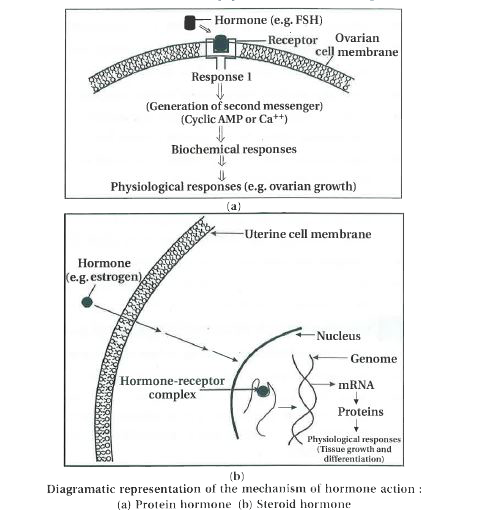

Hormones preduce their effects on target tissues by binding to specific proteins called hormone receptors located in the target tissues only.
Hormone receptors present on the cell membrane of the target cells are celled membrane bound receptors and the receptors present inside the target cell are called intracellular receptors, mostly nuclear receptors. Binding of a hormone to its receptor leads to the formation of a hormone receptor complex.
Each receptor is specific to one hormone only and hence receptors are specific.
Hormone receptor complex formation leads to certain biochemical changes in the target tissue.
Target tissue metabolism and hence physiological functions are regulated by hormones.
On the basis of their chemical nature, hormones can be divided into :
(i) Peptide, polypeptide, protein hormones (e.g., insulin, glucagon, pituitary hormones, hypothalamic hormones, etc.)
(ii) Steroids (e.g., cortisol, testosterone, estradiol and progesterone)
(iii) Iodothyronines (thyroid hormones)
(iv) Amino - acid derivatives (e.g., epinephrine).
Hormones which interact with membrane - bound receptors normally do not enter the target cell, but generate second messengers (e.g., cyclic AMP,`"IP"_(3)"Ca"^("++)` etc.) which in turn regulate cellular metabolism.
Hormones which interact with intracellular receptors (steroid, iodothyronines, etc.) mostly regulate gene expression or chromosome function by the interaction of hormone - receptor complex with the genome.
Cumulative biochemical actions result in physiological and developmental effects.
Promotional Banner

Topper's Solved these Questions

  • CHEMICAL COORDINATION AND INTEGRATION

    KUMAR PRAKASHAN|Exercise Section-B (Differentiate/Scientific Reason)|9 Videos
  • CHEMICAL COORDINATION AND INTEGRATION

    KUMAR PRAKASHAN|Exercise Section-C (Definition/Explanation-Terms/Location-Function/Differentive word)|17 Videos
  • CELL CYCLE AND CELL DIVISION

    KUMAR PRAKASHAN|Exercise Question Paper (Describe in detail )|1 Videos
  • DIGESTION AND ABSORPTION

    KUMAR PRAKASHAN|Exercise Question from Module (Question Paper)|11 Videos

Similar Questions

Explore conceptually related problems

A candidate is required to answer 7 questions out of 12 questions, which are divided into two groups, each containing 6 questions. He is not permitted to attempt more than 5 questions from either group. Find the number of different ways of doing questions.

The series of natural numbers is divided into groups :(1);(2,3,4);(5,6,7,8,9)... and so on. The sum of numbers in the n^(th) group is

The sequence of odd natural numbers is divided into groups 1,3,5,7,9,11,"…." and so on. Show that the sum of the numbers in nth group is n^(3) .

In animal cells lipid like steroid hormones are synthesised by which cell organelle?

Why are hormones called chemical messengers ?

Give example(s) of : (a) Hyperglycemic hormone and hypoglycemic hormone (b) Hypercalcemic hormone (c ) Gonadotrophic hormones (d) Progestational hormone (e ) Blood pressure lowering hormone (f) Androens and estrogens

Which hormone is secreted under the fight or flight situation ? State its effects.

