Home
Class 10
BIOLOGY
Identify the parts of a neuron in a diag...

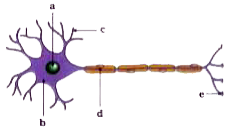
Identify the parts of a neuron in a diagram :
(1) where information is acquired,
(2) through which information travels as electrical impulse, and
(3) where this impulse in must be converted into a chemical signal for onward transmission.

Text Solution

Verified by Experts

Parts of a neuron : a - nucleus, b - cell body, c- dendrite, d-axon, e-nerve ending.
(1) Information acquired at the end of the dendrite tip (c) of a nerve cell.
( 2 ) Information travels through dendrite, cell body and along the axon
(d) to its end as an electrical impulse.
(3) At synapse, this impulse is converted into a chemical signal for onward transmission.
Promotional Banner

Topper's Solved these Questions

  • CONTROL AND COORDINATION

    KUMAR PRAKASHAN|Exercise TEXTUAL EXERCISE|12 Videos
  • CONTROL AND COORDINATION

    KUMAR PRAKASHAN|Exercise ADDITIONAL QUESTIONS AND ANSWERS|22 Videos
  • HEREDITY AND EVOLUTION

    KUMAR PRAKASHAN|Exercise PRACTICAL SKILL BASED QUESTIONS WITH ANSWERS|5 Videos

Similar Questions

Explore conceptually related problems

Find incorrect statement for cerebrum. a. It receives sensory impulses from various receptors. b. It has areas where information stored. c. It passes information to which control the movement of voluntary motor areas muscles. d. It maintains posture and balance of the body.

Carefully observe the given diagram/chart and answer the questions based on it. (1) Observe the following pie-chart showing the major sources of energy. Identify 'a' and state where is it used as a fuel to generate electric energy through conversion of heat energy.

A parabolic pulse given by equation y ("in cm") = 0.3 - 0.1(x-5t)^(2) (y ge 0) travelling in a uniform string. The pulse passes through a boundary beyond which its velocity becomes 2.5 m//s . What will be the amplitude of pulse in this medium after transmission ?

A narrow beam PQ of white light passes through a glass prism ABC as shown in the diagram. Trace it on your answer sheet and show the path of the emergent beam as observed on the screen DE. (1) Write the name and cause of the phenomenon observed. (2) Where else in nature is this phenomenon observed ? (3) Based on this observation, state the conclusion which can be drawn about the constituents of white light.

Two radio stations broadcast their programmes at the same amplitude A and at slightly different frequencies omega_(1) and omega_(2) respectively, where omega_(1) - omega_(2) = 10^(3) Hz . A detector receives the signals from the two stations simultaneously, it can only detect signals of intensity ge 2A^(2) . (i) Find the time interval between successive maxima of the intensity of the signal received by the detector. (ii) Find the time for which the detector remains idle in each cycle of the intensity of the signal.

In problems involving electromagenetism it is often convenlent and informative to express answers in terms of a constant, alpha , which is a combination of the Coulomb constant, k_(e) = 1//4piepsi_(0) , the charge of the electron, e, and h = h//2 , h being Planck's constant. For instant, the lowest energy that a hydrogen atom can have is given by E = 1//2 alpha^(2) mc^(2) , wherer m is the mass of the electron and c is the speed of light. Which of the following is the correct expression for alpha ? (HINt : non-relativistic kinetic energy is 1//2 mv^(2) , where v is speed.)

Answer carefully: (a) Two large conducting spheres carrying charges Q_(1) and Q_(2) are brought close to each other. Is the magnitude of electrostatic force between them exactly given by Q_(1),Q_(2)//4pi epsilon_(0)r^(2) , where r is the distance between their centres? (b) If Coulomb’s law involved 1//r^(3) dependence (instead of would Gauss’s law be still true ? (c) A small test charge is released at rest at a point in an electrostatic field configuration. Will it travel along the field line passing through that point? (d) What is the work done by the field of a nucleus in a complete circular orbit of the electron? What if the orbit is elliptical? (e) We know that electric field is discontinuous across the surface of a charged conductor. Is electric potential also discontinuous there? (f) What meaning would you give to the capacitance of a single conductor? (g) Guess a possible reason why water has a much greater dielectric constant (= 80) than say, mica (= 6).

An electromagnetic wave can be represented by E = A sin (kx- omega t + phi) , where E is electric field associated with wave, According this equation, for any value of x, E remains sinusoidal for -oolt t lt oo . Obviously this corresponds to an idealised situation because radiation from ordinary sources consists of finite size wavetrains. In general, electric field remains sinusoidal only for times of order tau_(c) ' which is called coherence time. In simpler language it means that for times of order tau_(c)' a wave will have a definite phase. The finite value of coherence time could be due to many factors, for example if radiating atom undergoes collision with another atom then wave train undergoes an abrupt phase change or due to the fact that an atom responsible for emitting radiation has a finite life time in the energy level from which it drops to lower energy level, while radiating. Concept of coherence time can be easily understood using young's double slit experiment. Let interference patten is observed around point P at time t , due to superposition of waves emanting from S_(1) and S_(2) at times t =(r_(1))/(c) and (r_(2))/(c) respectively, where r_(1) and r_(2) are the distances S_(1) P & S_(2)P . Obviously if (r_(2)-r_(1))/(c) lt lt tau_(e),{"where" " "c = 3xx10^(8)m//s} then, wavetrain arriving at point P from S_(1) & S_(2) will have a definite phase relationship and an interference pattern of good contranst will be obtained. If coherence time is of order 10^(-10) second and screen is placed at a very large distance from slits in the given figure, then:-

An electromagnetic wave can be represented by E = A sin (kx- omega t + phi) , where E is electric field associated with wave, According this equation, for any value of x, E remains sinusoidal for -oolt t lt oo . Obviously this corresponds to an idealised situation because radiation from ordinary sources consists of finite size wavetrains. In general, electric field remains sinusoidal only for times of order tau_(c) ' which is called coherence time. In simpler language it means that for times of order tau_(c)' a wave will have a definite phase. The finite value of coherence time could be due to many factors, for example if radiating atom undergoes collision with another atom then wave train undergoes an abrupt phase change or due to the fact that an atom responsible for emitting radiation has a finite life time in the energy level from which it drops to lower energy level, while radiating. Concept of coherence time can be easily understood using young's double slit experiment. Let interference patten is observed around point P at time t , due to superposition of waves emanting from S_(1) and S_(2) at times t =(r_(1))/(c) and (r_(2))/(c) respectively, where r_(1) and r_(2) are the distances S_(1) P & S_(2)P . Obviously if (r_(2)-r_(1))/(c) lt lt tau_(e),{"where" " "c = 3xx10^(8)m//s} then, wavetrain arriving at point P from S_(1) & S_(2) will have a definite phase relationship and an interference pattern of good contranst will be obtained. If coherence time is of order 10^(-10) second and screen is placed at a very large distance from slits in the given figure, then:-
