Home
Class 10
BIOLOGY
Design an experiment to demonstrate hydr...

Design an experiment to demonstrate hydrotropism.

Text Solution

Verified by Experts
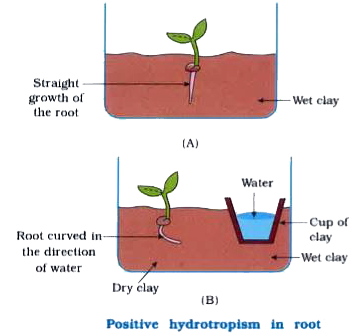
The type of movement of the growing plant organ, which is induced by stimulus of water is called hydrotropism.
To demonstrate hydrotropism.
Apparatus-Materials : clay, two plants, two glass
Precedure :
Take two glass troughs each filled to about `1//3` with clay. Label the trough as (A) and (B). Plant two, almost equal sized cuttings, one in each of the troughs. Add water in trough (A) and keep the clay of trough (B) dry. However in trough (B) place a small clay pot (or a cup of clay) filled with water quite close to the cutting. (See the figure) Add daily a small quantity of water in trough (A) but not in trough (B). Dig out the clay carefully in both the troughs after about a week or more.

Observation : It will be seen that the cutting in trough (A) shows a simple and straight growth of the root, while that in trough (B) shows the root curved in the direction of clay pot filled with water.
Conclusion : It can be concluded that the root grows and elongates in the direction of source of water. It means that the root shows positive hydrotropism.
Promotional Banner

Topper's Solved these Questions

  • CONTROL AND COORDINATION

    KUMAR PRAKASHAN|Exercise TEXTUAL EXERCISE|12 Videos
  • CONTROL AND COORDINATION

    KUMAR PRAKASHAN|Exercise ADDITIONAL QUESTIONS AND ANSWERS|22 Videos
  • HEREDITY AND EVOLUTION

    KUMAR PRAKASHAN|Exercise PRACTICAL SKILL BASED QUESTIONS WITH ANSWERS|5 Videos

Similar Questions

Explore conceptually related problems

Keep some freshly cut flowers in a solution of food colour. Wait for sometime for the days to rise in the flower, when the stem, of the flower is held up in light, coloured strands can be seen inside. Can this experiment demonstrate which tissue is conducting water up the stem ?

Explain the Young's experiment, arrangement and experiment to produce interference pattern.

Why is not any one parameter good enough to demonstrate growth throughout the life of a flowering plant?

