Home
Class 10
BIOLOGY
Your subject teacher arranged a potted p...

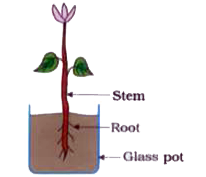
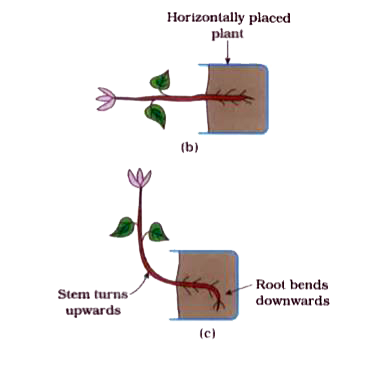
Your subject teacher arranged a potted plant as shown in figure (a). Next day turn its position horizontally as shown in figure (b). After few days, you observed the plant as shown in figure (c).


State the direction of growth of root and stem in the plant.

Text Solution

Verified by Experts

The growth of root is negative phototropic and positive geotropic. The growth of stem is positive phototropic.
Promotional Banner

Topper's Solved these Questions

  • CONTROL AND COORDINATION

    KUMAR PRAKASHAN|Exercise VALUE BASED QUESTIONS WITH ANSWERS|11 Videos
  • HEREDITY AND EVOLUTION

    KUMAR PRAKASHAN|Exercise PRACTICAL SKILL BASED QUESTIONS WITH ANSWERS|5 Videos

Similar Questions

Explore conceptually related problems

Your subject teacher arranged a potted plant as shown in figure (a). Next day turn its position horizontally as shown in figure (b). After few days, you observed the plant as shown in figure (c). What happens when the pot along with the plant is placed as in fig. (b)?

Your subject teacher arranged a potted plant as shown in figure (a). Next day turn its position horizontally as shown in figure (b). After few days, you observed the plant as shown in figure (c). Which type of movement does this experiment explain ?

A charged metallic sphere A is suspended by a nylon thread. Another charged metallic sphere B held by an insulating handle is brought close to A such that the distance between their centres is 10 cm, as shown in figure (a). The resulting repulsion of A is noted (for example, by shining a beam of light and measuring the deflection of its shadow on a screen). Spheres A and B are touched by uncharged spheres C and D respectively, as shown in figure (b). C and D are then removed and B is brought closer to A to a distance of 5.0 cm between their centres, as shown in figure (c). What is the expected repulsion of A on the basis of Coulomb's law ? Spheres A and C and spheres B and D have identical sizes. Ignore the sizes of A and B in comparison to the separation between their centres.

(a) A box of weight 10sqrt(3) N is held n equilibrium with the help of two strings OA and OB as shown in figure-1. the string OA is horizontal. Find the tensions in both the stings. (b) If you can change location of the point A on the wall and hence the orientation of the string OA without altering the orientation of the string OB as shown in figure-II. what angle should the string OA make with the wall so that a minimum tension is developed in it?

Two blocks each of mass m, connected by an un-stretched spring are kept at rest on a frictionless horizontal surface. A constant force F is applied on one of the blocks pulling it away from the other as shown in figure. (a)Find accelaration of the mass center. (b) Find the displacement of the centre of mass as function of time t. (c) If the extension of the spring is X_(0) at an instant t, find the displacements of the two blocks relative to the ground at this instant.

Internal micrometer is a measuring intrument used to measure internal diameter (ID) of a large cylinder bore with high accuracy. Construction is shown in figure. There is one fixed rod B (to the right in figure) and one moved rod A (to the left in figure). It is based on the particle of advancement of a screw when it is rotated in a nut with internal threads. Main scale reading can be directly seen on the hub which is fixed with respect to rod B. When the cap is rotated rod A moves in or cut depending on direction of rotation. The circular scale reading is seen by checking which division of circular scale coincide with the references line This is to be multiplied by LC to get circular scale reading. Least count = value of 1 circular scale division = ("pitch")/("number of division on circular scale") Length of rod A is chosen to match the ID(PQ) to be measured. Zero error is checked by taking reading between standard blocks fixed at normal value of ID to be measured. Zero error is positive if cap end is one the right of the main scale and negative it is on the left side. In the above instrument, while measuring an internal diameter. ID is set of 321 mm with no zero error. It cap end is after n^(th) division adn 17^(th) division of main scale coincides with the reference line, the ID is -

Internal micrometer is a measuring intrument used to measure internal diameter (ID) of a large cylinder bore with high accuracy. Construction is shown in figure. There is one fixed rod B (to the right in figure) and one moved rod A (to the left in figure). It is based on the particle of advancement of a screw when it is rotated in a nut with internal threads. Main scale reading can be directly seen on the hub which is fixed with respect to rod B. When the cap is rotated rod A moves in or cut depending on direction of rotation. The circular scale reading is seen by checking which division of circular scale coincide with the references line This is to be multiplied by LC to get circular scale reading. Least count = value of 1 circular scale division = ("pitch")/("number of division on circular scale") Length of rod A is chosen to match the ID(PQ) to be measured. Zero error is checked by taking reading between standard blocks fixed at normal value of ID to be measured. Zero error is positive if cap end is one the right of the main scale and negative it is on the left side. In an internal micrometer, main scale division is of 0.5 mm and there are 50 divisions in circular scale. The least count of the instrument is-

Consider the circuit arrangement shown in figure (1) for studying input and output characteristics of n-p-n transistor in CE configuration. Select the values of R_(B) and R_(C ) for a transistor whose V_(BE)=0.7V , so that the transistor is operating at point Q as shown in the characteristics shown in figure (2). Given that the input impedance of the transistor is very small and V_(C C)=V_(BB)=16V , also find the voltage gain and power gain of circuit making appropriate assumptions.
