Home
Class 10
BIOLOGY
Your subject teacher arranged a potted p...

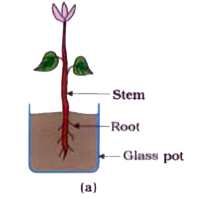
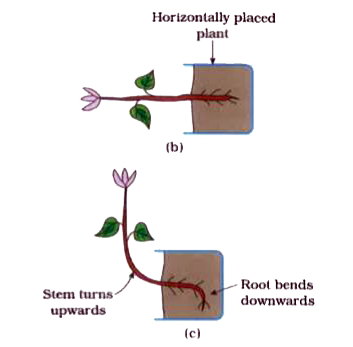
Your subject teacher arranged a potted plant as shown in figure (a). Next day turn its position horizontally as shown in figure (b). After few days, you observed the plant as shown in figure (c).


What happens when the pot along with the plant is placed as in fig. (b)?

Text Solution

Verified by Experts

When the plant was placed as in fig. (b), both stem and root were initially horizontal.
Promotional Banner

Topper's Solved these Questions

  • CONTROL AND COORDINATION

    KUMAR PRAKASHAN|Exercise VALUE BASED QUESTIONS WITH ANSWERS|11 Videos
  • HEREDITY AND EVOLUTION

    KUMAR PRAKASHAN|Exercise PRACTICAL SKILL BASED QUESTIONS WITH ANSWERS|5 Videos

Similar Questions

Explore conceptually related problems

Your subject teacher arranged a potted plant as shown in figure (a). Next day turn its position horizontally as shown in figure (b). After few days, you observed the plant as shown in figure (c). State the direction of growth of root and stem in the plant.

Your subject teacher arranged a potted plant as shown in figure (a). Next day turn its position horizontally as shown in figure (b). After few days, you observed the plant as shown in figure (c). Which type of movement does this experiment explain ?

A ball of mass m is released from A inside a smooth wedge of mass m as shown in figure. What is the speed of the wedge when the ball reaches point B?

A charged metallic sphere A is suspended by a nylon thread. Another charged metallic sphere B held by an insulating handle is brought close to A such that the distance between their centres is 10 cm, as shown in figure (a). The resulting repulsion of A is noted (for example, by shining a beam of light and measuring the deflection of its shadow on a screen). Spheres A and B are touched by uncharged spheres C and D respectively, as shown in figure (b). C and D are then removed and B is brought closer to A to a distance of 5.0 cm between their centres, as shown in figure (c). What is the expected repulsion of A on the basis of Coulomb's law ? Spheres A and C and spheres B and D have identical sizes. Ignore the sizes of A and B in comparison to the separation between their centres.

Positive and negative charges of 1 muC each are placed at two points as shown in the figure. Find the potential difference between A and B

(a) A box of weight 10sqrt(3) N is held n equilibrium with the help of two strings OA and OB as shown in figure-1. the string OA is horizontal. Find the tensions in both the stings. (b) If you can change location of the point A on the wall and hence the orientation of the string OA without altering the orientation of the string OB as shown in figure-II. what angle should the string OA make with the wall so that a minimum tension is developed in it?

Two bodies A and B of masses 5 kg and 10 kg in contact with each other rest on a table against a rigid wall as shown in figure. The coefficient of friction between the bodies and the table is 0.15. A force of 200 N is applied horizontally to A. What are (a) the reaction of the partition, (b) The action-reaction forces between A and B ? What happens when the wall is removed ? Does the answer to (b) change, when the bodies are in motion ? Ignore the difference between p_(s) and p_(k) .

A block of mass M is tied to one end of a massless rope the other end of the rope is in the hands of a man of mass 2M as shown in the figure. The block and the man are resting on a rough plank of mass M as shown in the figure. The whole system is resting on a smooth horizontal surface. The man pulls the rope. Pulley is massless and frictionless. What is the displacement of the plank when the block meets the pulley ( Man does not leave his position on plank during the pull)
