
Home
Class 10
BIOLOGY
Your subject teacher arranged a potted p...

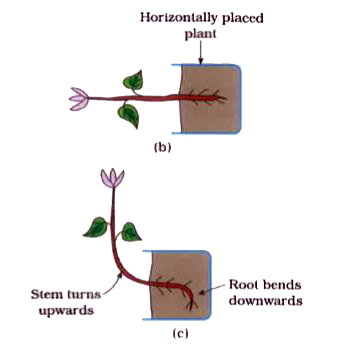
Your subject teacher arranged a potted plant as shown in figure (a). Next day turn its position horizontally as shown in figure (b). After few days, you observed the plant as shown in figure (c).


Which type of movement does this experiment explain ?

Text Solution

Verified by Experts

This experiment explains tropic movements due to growth in plant.
Promotional Banner

Topper's Solved these Questions

  • CONTROL AND COORDINATION

    KUMAR PRAKASHAN|Exercise VALUE BASED QUESTIONS WITH ANSWERS|11 Videos
  • HEREDITY AND EVOLUTION

    KUMAR PRAKASHAN|Exercise PRACTICAL SKILL BASED QUESTIONS WITH ANSWERS|5 Videos

Similar Questions

Explore conceptually related problems

Your subject teacher arranged a potted plant as shown in figure (a). Next day turn its position horizontally as shown in figure (b). After few days, you observed the plant as shown in figure (c). What happens when the pot along with the plant is placed as in fig. (b)?

Your subject teacher arranged a potted plant as shown in figure (a). Next day turn its position horizontally as shown in figure (b). After few days, you observed the plant as shown in figure (c). State the direction of growth of root and stem in the plant.

A charged metallic sphere A is suspended by a nylon thread. Another charged metallic sphere B held by an insulating handle is brought close to A such that the distance between their centres is 10 cm, as shown in figure (a). The resulting repulsion of A is noted (for example, by shining a beam of light and measuring the deflection of its shadow on a screen). Spheres A and B are touched by uncharged spheres C and D respectively, as shown in figure (b). C and D are then removed and B is brought closer to A to a distance of 5.0 cm between their centres, as shown in figure (c). What is the expected repulsion of A on the basis of Coulomb's law ? Spheres A and C and spheres B and D have identical sizes. Ignore the sizes of A and B in comparison to the separation between their centres.

A block of mass'm' it kept over the smooth surface of the plank of mass M. the plank of length l is kept over the smooth horizontal surface. A constant horizontal force F is applied onto the plank as shown in figure. Calculate the time after which the block falls off the plank?
