

Home
Class 12
CHEMISTRY
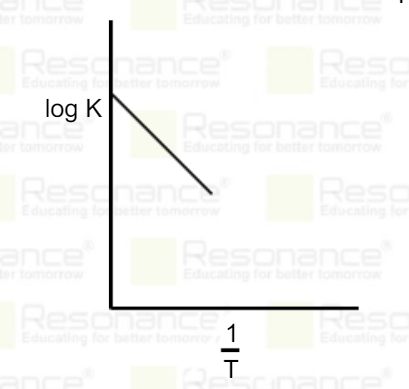
For a reaction graph between logK vs 1/T...

For a reaction graph between logK vs `1/T` is as with slope = -10,000.

At temperature 500K rate constant k = `10^(-5)` .
Find the temperature in K at which rate constant = `10^(-4)`

Promotional Banner

Similar Questions

Explore conceptually related problems

Graph of logK and 1/T was given for which valuue of slope is -10000 K if T is 500K and rate constant is 10^(-5) at which temperature value rate constant will be 10^-4

For a reaction, consider the plot of In K versus 1//T given in the figure. If the rate constant of this reaction at 400 K is 10^(-5)s^(-1) , then the rate constant at 500 K is :

For the reaction aA+bBrarrcC+dD , the plot of log k vs 1/T is given below, The temperature at which the rate constant of the reaction is 10^(-4) s^(-1) is _____K. (Rouded -off the nerest integer) [Given : The rate constant of the reaction is 10^(-5) s^(-1) at 500 K.]

The slope of straight line graph between ln k us (1)/(T) is equal to 2.4 xx 10^(4)K . Calculate the activation energy of the reaction at 400 K. (K represents rate constant)

The rate of a reaction increases to 2.3 times when the temperature is raised form 300K to 310 K . If Q is the rate constant at 300K, then the rate constant at 310 K will be equal to

Graph between log k and 1//T [ k rate constant (s^(-1)) and T and the temperature (K) ] is a straight line with OX =5, theta = tan^(-1) (1//2.303) . Hence -E_(a) will be

The rate of reaction increases isgnificantly with increase in temperature. Generally, rate of reactions are doubled for every 10^(@)C rise in temperature. Temperature coefficient gives us an idea about the change in the rate of a reaction for every 10^(@)C change in temperature. "Temperature coefficient" (mu) = ("Rate constant of" (T + 10)^(@)C)/("Rate constant at" T^(@)C) Arrhenius gave an equation which describes aret constant k as a function of temperature k = Ae^(-E_(a)//RT) where k is the rate constant, A is the frequency factor or pre-exponential factor, E_(a) is the activation energy, T is the temperature in kelvin, R is the universal gas constant. Equation when expressed in logarithmic form becomes log k = log A - (E_(a))/(2.303 RT) For a reaction E_(a) = 0 and k = 3.2 xx 10^(8)s^(-1) at 325 K . The value of k at 335 K would be