Home
Class 12
PHYSICS
Obtain an equation of current for AC vol...

Obtain an equation of current for AC voltage applied to an inductor and draw a graph of V and I.

Text Solution

Verified by Experts
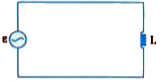
In figure shows an AC source connected to an inductor.

Inductor has negligible resistance. Thus, the circuit is a purely inductive AC circuit.
Let the voltage across the source be `V= V_(m) sin omega t ` . Using the Kirchoff.s loop rule,
`V - L (dI)/(dt ) = 0 ` where `- L (dI )/(dt)` is the self induced emf.
`:. V = L ( dI )/( dt ) `
` :. (dI)/(dt) = ( V )/( L )`
But `V = V_(m) sin omega t `
`:. ( dI )/( dt ) = ( V_(m) sin omega t )/( L )`
`:. dI = ( V _(m))/( L ) sin omega dt ` .....(1)
where L is the self inductance. Equation (1) indicates that current I ( t) as a function of time,must be such that its slope `(dI)/(dt)` is sine an sinusoidally varying quantity with the same phase as the source voltage and an amplitude given by `(V_(m))/( L )`.
To obtain the current integrate equations (1) with respective to time,
`:. int dI = (V_(m))/( L ) int sin omega t dt `
`:. I = ( V_(m))/( L ) xx ( cos omega t )/( omega ) +` constant ....(2)
Here, integration constant has the dimension of current and is time independent
At t=0, time I = 0
`:.` 0 `+` constant
`:.` Constant =0
`:.` From equation (2),
`:. I = - (V_(m))/( L omega ) cos omega t `
`:. I = ( V_(m))/( omega L ) sin ( omega t - ( pi )/( 2)) [ :. - cos omega t = sin ( omega t - ( pi )/( 2))]`
`omega L` is called inductive reactance denoted by `X_(L)`.
`:. X_(l) = omega L ` and its unit is Ohm.
The inductive reactance limits the current in a purely inductive circuit in the same way as the resistance limits the current in a purely resistive circuit.
The inductive reactance is directly proportional to the inductance and frequency of the current.
Hence , for the source voltage and the current in an indeuctor `V = V_(m) sin omega t ` and `I = I _(m) sin( omega t - ( pi )/( 2))` . This shows the that hte current lags the voltag by `( pi )/(2)` or one -quarter `((1)/(4))` cycle.
In this case figure (a) shows that voltage and current phasors in the present case at instant `( t_(1))`.

The current phasor I is `( pi )/(2)` behind the voltage phasor V. ( Lags)
`( pi )/(2) = ( T )/( 4) :. ( pi )/( 2) = ( T )/( 2pi ) xx ( 2pi )/( 4) = (( pi )/( 2))/( omega ) = ( pi )/( 2 omega )`
When rotated with frequency `omega ` counter clockwise, they generate the voltage and current given by `V = V_(m) sin omega t ` and `I = I _(m) sin ( omega t - ( pi )/( 2))` respectively and as shown by figure (b). This graphs is for V and I versus `omega t `.
Promotional Banner

Topper's Solved these Questions

  • ALTERNATING CURRENTS

    KUMAR PRAKASHAN|Exercise SECTION B NUMERICALS (TEXTUAL ILLUSTRATIONS)|33 Videos
  • ALTERNATING CURRENTS

    KUMAR PRAKASHAN|Exercise SECTION B NUMERICALS ( TEXTUAL EXERCISE )|13 Videos
  • ALTERNATING CURRENTS

    KUMAR PRAKASHAN|Exercise SECTION-D MCQs (COMPETITIVE EXAMS)|64 Videos
  • ATOMS

    KUMAR PRAKASHAN|Exercise Section-D -MCQs asked in GUJCET / Board Exam|34 Videos

Similar Questions

Explore conceptually related problems

Obtain the relation of voltage applied to a series LCR circuit.

Explain AC voltage applied to a resistor and explain it with necessary graph.

Write the equation for ac voltage.

When an AC voltage of 220 V is applied to the capacitor C

Derive an expression for current I passing through an AC circuit containing only inductor L. Draw a Phasor diagram and graph of v and I versus omega t . Explain instantaneous power and the average power.

The force applied on a body of mass 6 kg. is directly proportional to the acceleration produced in the body. Write an equation to express this observation and draw the graph of the equation.

A student measures the terminal potential difference (V) of a cell (of emf epsilon and internal resistance r ) as a function of the current (I) flowing through it. The slope and intercept of the graph between V and I is

In a series resonant circuit, the A. C. voltages across resistance R, inductor L and capacitor C are 5 V, 10 V and 10 V respectively. The A.C. voltage applied to the circuit will be .........

The relation between the phase of current and voltage in a circuit containing only inductor is ….

KUMAR PRAKASHAN-ALTERNATING CURRENTS -SECTION-A (QUESTIONS-ANSWERS)
  1. Give definition and formula of root mean square plot graph of current ...

    Text Solution

    |

  2. Explain AC circuit for circuit with only resistor.

    Text Solution

    |

  3. Obtain an equation of current for AC voltage applied to an inductor an...

    Text Solution

    |

  4. Discuss the power in AC circuit with only an inductor.

    Text Solution

    |

  5. Explain AC circuit with only capacitor.

    Text Solution

    |

  6. Discuss power in AC circuit containing only capacitor.

    Text Solution

    |

  7. Obtain the relation of voltage applied to a series LCR circuit.

    Text Solution

    |

  8. Obtain the relation of phase between instantaneous current and voltage...

    Text Solution

    |

  9. Draw phasor diagram for X(C ) gt X(L) and X(C ) lt X(L) and give the d...

    Text Solution

    |

  10. Obtain an anaalytical solution for the relation of phase between insta...

    Text Solution

    |

  11. What is resonance? Give its example.

    Text Solution

    |

  12. Explain resonance for an L-C-R series circuit and write its uses. In w...

    Text Solution

    |

  13. Obtain an equation for sharpness of resonance in an L-C-R series AC ci...

    Text Solution

    |

  14. Obtain the equation of the bandwidth for an L-C-R series AC circuit an...

    Text Solution

    |

  15. What is sharpness of resonance ? Derive equation of Q-factor

    Text Solution

    |

  16. If L= 1.00 mH, C = 1.00nF, then find the resonant frequency.

    Text Solution

    |

  17. Define the power for AC circuit. Obtain an equation of average power f...

    Text Solution

    |

  18. Write an equation of average power for L-C-R series AC circuit and dis...

    Text Solution

    |

  19. What is meant by LC circuit? What are LC oscillations ?

    Text Solution

    |

  20. Obtain the differential equation for a LC circuit.

    Text Solution

    |

