Home
Class 12
PHYSICS
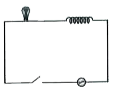
After closing the key in above circuit, ...


After closing the key in above circuit, after some time, a glass rod is inserted in the inductor. Will the brightness of bulb . (a) Give answer with reason. Increase (b) decrease or (c) remain same ?

Text Solution

Verified by Experts

(c) brightness will remain same because inductance of inductor remains same.
Promotional Banner

Topper's Solved these Questions

  • ALTERNATING CURRENTS

    KUMAR PRAKASHAN|Exercise SECTION B NUMERICALS ( TEXTUAL EXERCISE )|13 Videos
  • ALTERNATING CURRENTS

    KUMAR PRAKASHAN|Exercise SECTION B NUMERICALS (ADDITONAL EXERCISE )|32 Videos
  • ALTERNATING CURRENTS

    KUMAR PRAKASHAN|Exercise SECTION-A (QUESTIONS-ANSWERS)|35 Videos
  • ATOMS

    KUMAR PRAKASHAN|Exercise Section-D -MCQs asked in GUJCET / Board Exam|34 Videos

Similar Questions

Explore conceptually related problems

A light bulb and an open coil inductor are connected to an ac source through a key as shown in Fig. The switch is closed and after sometime, an iron rod is inserted into the interior of the inductor. The glow of the light bulb (a) increases, (b) decreases, (c) is unchanged, as the iron rod is inserted. Give your answer with reasons.

Figure shows a metal rod PQ resting on the smooth rails AB and positioned between the poles of a permanent magnet. The rails, the rod, and the magnetic field are in three mutual perpendicular directions. A galvanometer G connects the rails through a switch K. Length of the rod =15 cm, B =0.50 T, resistance of the closed loop containing the rod 9.0 m Omega . Assume the field to be uniform. (a) Suppose K is open and the rod is moved with a speed of 12 "cm s"^(-1) in the direction shown. Give the polarity and magnitude of the induced emf. (b) Is there an excess charge built up at the ends of the rods when K is open ? What if K is closed ? (c) With K open and the rod moving uniformly, there is no net force on the electrons in the rod PQ even though they do experience magnetic force due to the motion of the rod. Explain. (d) What is the retarding force on the rod when K is closed ? How much power is required (by an external agent) to keep the rod moving at the same speed (= 12 cm s^(-1) ) when K is closed ? How much power is required when K is open? (f)How much power is dissipated as heat in the closed circuit ? What is the source of this power ? (g) What is the induced emf in the moving rod if the magnetic field is parallel to the rails instead of being perpendicular ?

In an elastic collision of two billiard balls,which of the the following quantities remain conserved during the short time of collision of the balls ? (i.e. when they are in contact) (a) Kinetic energy. (b) Total linear momentum. Give reason for your answer in each case.

As we go from species to kingdom in a taxonomic hierarchy, the number of common characteristics (A) will decrease (B) will increase (C) remain same (D) may increase or decrease

Thin films, including soap bubbles and oil slicks, show patterns of alternating dark and bright regions resulting from interference among the reflected light waves. If two waves are in phase their crest and troughs will coincide. The interference will be constructive and the aplitude of the resultant wave will be greater than the amplitude of either constituent wave. if the two waves are out of phase, the crests of one wave will coincide with the troughs of the other wave. The interference will be destructive and the amplitude of the resultant wave will be less than that of either constituent wave. at the interface between two transparent media some light is reflected and some light is refracted. * When incident light, reaches the surface at point a, some of the light is reflected as ray R_(a) and and some is refracted following the path ab to the back of the film. *At point b some of the light is refracted out of the film and part is reflected back refracted out of the fiml as ray R_(c) . R_(a) and R_(c) are parallel. However, R_(c) has travelled the extra distance within the film of abc. if the angle of incidence is small then abc is approximately twice the film's thickness. if R_(a) and R_(c) are in phase they will undergo constructive interference and the region ac will be bright if R_(a) and R_(c) are out of phase, they will undergo destructive interference. * Refraction at an interface never changes the phase of the wave. * For reflection at the interface between two media 1 and 2, if n_(1)ltn_(2) the reflected wave will change phase by pi . if n_(1)gtn_(2) the reflected wave will not undergo a phase change. for reference n_(air)=1.00 * if the waves are in phase after refection at all interfaces, then the effects of path length in the film are Constructive interference occur when (n= refractive index) 2t=mlamda//n" "m=0,1,2,3... .. Destructive interference occurs when 2t=(m+1//2)lamda//n" "m=0,1,2,3... Q. The average human eye sees colors with wavelengths between 430 nm to 680 nm. For what visible wavelength will a 350 nm thick n=1.35 soap film produce maximum destructive interference?

Thin films, including soap bubbles and oil slicks, show patterns of alternating dark and bright regions resulting from interference among the reflected light waves. If two waves are in phase their crest and troughs will coincide. The interference will be constructive and the aplitude of the resultant wave will be greater than the amplitude of either constituent wave. if the two waves are out of phase, the crests of one wave will coincide with the troughs of the other wave. The interference will be destructive and the amplitude of the resultant wave will be less than that of either constituent wave. at the interface between two transparent media some light is reflected and some light is refracted. * When incident light, reaches the surface at point a, some of the light is reflected as ray R_(a) and and some is refracted following the path ab to the back of the film. *At point b some of the light is refracted out of the film and part is reflected back refracted out of the fiml as ray R_(c) . R_(a) and R_(c) are parallel. However, R_(c) has travelled the extra distance within the film of abc. if the angle of incidence is small then abc is approximately twice the film's thickness. if R_(a) and R_(c) are in phase they will undergo constructive interference and the region ac will be bright if R_(a) and R_(c) are out of phase, they will undergo destructive interference. * Refraction at an interface never changes the phase of the wave. * For reflection at the interface between two media 1 and 2, if n_(1)ltn_(2) the reflected wave will change phase by pi . if n_(1)gtn_(2) the reflected wave will not undergo a phase change. for reference n_(air)=1.00 * if the waves are in phase after refection at all interfaces, then the effects of path length in the film are Constructive interference occur when (n= refractive index) 2t=mlamda//n" "m=0,1,2,3... .. Destructive interference occurs when 2t=(m+1//2)lamda//n" "m=0,1,2,3... Q. A 600 nm light is perpendicularly incident on a soap film suspended in air. The film is 1.00 mum thick with n=1.35. Which statement most accurately describes the interference of the light reflected by the two surfaces of the film?

KUMAR PRAKASHAN-ALTERNATING CURRENTS -SECTION B NUMERICALS (TEXTUAL ILLUSTRATIONS)
  1. A sinusoidal voltage of peak value of 283 V and frequency 50 Hz is app...

    Text Solution

    |

  2. Suppose the frequency of the source in the previous example can be var...

    Text Solution

    |

  3. Suppose the frequency of the source in the previous example can be var...

    Text Solution

    |

  4. At an airport, a person is made to walk through the doorway of a metal...

    Text Solution

    |

  5. Show that in the free oscillations of an LC circuit, the sum of energi...

    Text Solution

    |

  6. A light bulb is rated at 200W for a 230 V supply. Find the resistance...

    Text Solution

    |

  7. A light bulb is rated at 200W for a 230 V supply. Find the peak volta...

    Text Solution

    |

  8. A light bulb is rated at 200W for a 230 V supply. Find the rms curren...

    Text Solution

    |

  9. A inductor of 5 mH is connected to a source of 220 V . Find the induct...

    Text Solution

    |

  10. A lamp is connected in series with a capacitor. Predict your observati...

    Text Solution

    |

  11. A 10muF capacitor is connected to a 230 V, 50 Hz source. Find the capa...

    Text Solution

    |

  12. After closing the key in above circuit, after some time, a glass rod i...

    Text Solution

    |

  13. A resistor of 100 Omega and a capacitor of 250 muF are connected in se...

    Text Solution

    |

  14. A resistor of 100 Omega and a capacitor of 250 muF are connected in se...

    Text Solution

    |

  15. A sinusoidal voltage of peak value 283 V and frequency 50 Hz is applie...

    Text Solution

    |

  16. A sinusoidal voltage of peak value 283 V and frequency 50 Hz is applie...

    Text Solution

    |

  17. A sinusoidal voltage of peak value 283 V and frequency 50 Hz is applie...

    Text Solution

    |

  18. A sinusoidal voltage of peak value 283 V and frequency 50 Hz is applie...

    Text Solution

    |

  19. For one series LCR ac circuit, 200 V, 50 Hz source is connected . Here...

    Text Solution

    |

  20. For one series LCR ac circuit, 200 V, 50 Hz source is connected . Here...

    Text Solution

    |
