Home
Class 11
CHEMISTRY
Explain the non-linear shape of H(2)S an...

Explain the non-linear shape of `H_(2)`S and a non-planer shape of `PCl_(3)` using valence shell elecilron pair repuJsion theory.

Text Solution

Verified by Experts
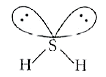
Central atom do this is S.
There are 6 electrons in its valence shell `(""_(16)S = 2, 8, 6 )`.
From this two electrons are shared with two H-atoms and the remaining four electrons are present as two lone pairs.

So, total pairs of electrons are four (2 bonding pairs and 2 lone pairs).
As the presence of 2 lone pairs the shape becomes distorted tetrahedral or angular or bent (non-linear).

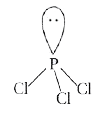
`PCl_(3)` : Central atom is phosphorus. There are 5 electrons in its valence shell (`""_(15)`P = 2, 8, 5). Three electrons are shared with three 0 -atoms and the remaining two elecirons are present as one lone pair.
So, total pairs of electrons are four (1 lone pair and 3 bond pajrs). Due to the presence of one lone pair, the shape becomes pyramidal (non- planar).
Promotional Banner

Topper's Solved these Questions

  • CHEMICAL BONDING AND MOLECULAR STRUCTURE

    KUMAR PRAKASHAN|Exercise SECTION -D (SOLUTIONS OF NCERT EXEMPLAR PROBLEMS) (MATCH THE COLUMNS )|5 Videos
  • CHEMICAL BONDING AND MOLECULAR STRUCTURE

    KUMAR PRAKASHAN|Exercise SECTION -D (SOLUTIONS OF NCERT EXEMPLAR PROBLEMS) (ASSERTION AND REASON)|3 Videos
  • CHEMICAL BONDING AND MOLECULAR STRUCTURE

    KUMAR PRAKASHAN|Exercise SECTION -D (SOLUTIONS OF NCERT EXEMPLAR PROBLEMS) (MCQs (MORE THAN ONE OPTIONS))|8 Videos
  • CLASSIFICATION OF ELEMENTS AND PERIODICITY IN PROPERTIES

    KUMAR PRAKASHAN|Exercise Section -D SOLUTIONS OF NCERT EXEMPLAR PROBLEMS (Long Answer Type Questions )|7 Videos

Similar Questions

Explore conceptually related problems

A spherical conducting shell of inner radius r_(1) and outer radius r_(2) has a charge Q. ls the electric field inside a cavity (with no charge) zero, even if the shell is not spherical, but has any irregular shape ? Explain.

Explain the following observations: (a) Azide ion (N_(3)) react with 2- bromopentane thousand times faster than with neopentyl bromide in a S_(N)2 reaction through former isa secondary halide while latter is primary. (b) What will happen to teh stereochemistry of product of the following reaction: (c) What will happens to the rate if the concentration of alkyl bromide in (b) is doubled? (d) Wha will happen to the rate if the concentration of azide ion in (b) is doubled? (e) How the sign of optical rotation of reactant and product are related in (b) (f) When allowed to stand in dilute H_(2)SO_(4) laevo-rotatory 2-butanol slowly loss optical activity.

Rachel, an engineering student, was asked to make a model shaped like a cylinder with two cones attached at its two ends by using a thin aluminium sheet. The diameter of the model is 3 cm and its length is 12 cm. If each cone has a height of 2 cm, find the volume of air contained in the model that Rachel made. (Assume the outer and inner dimensions of the model to be nearly the same.)

When a particle is restricted to move aong x axis between x =0 and x = a , where a is of nanometer dimension. Its energy can take only certain specific values. The allowed energies of the particle moving in such a restricted region, correspond to the formation of standing waves with nodes at its ends x = 0 and x = a . The wavelength of this standing wave is realated to the linear momentum p of the particle according to the de Breogile relation. The energy of the particl e of mass m is reelated to its linear momentum as E = (p^(2))/(2m) . Thus, the energy of the particle can be denoted by a quantum number 'n' taking values 1,2,3,"......." ( n=1 , called the ground state) corresponding to the number of loop in the standing wave. Use the model decribed above to answer the following three questions for a particle moving in the line x = 0 to x =a . Take h = 6.6 xx 10^(-34) J s and e = 1.6 xx 10^(-19) C . The allowed energy for the particle for a particular value of n is proportional to

When a particle is restricted to move aong x axis between x =0 and x = a , where a is of nanometer dimension. Its energy can take only certain specific values. The allowed energies of the particle moving in such a restricted region, correspond to the formation of standing waves with nodes at its ends x = 0 and x = a . The wavelength of this standing wave is realated to the linear momentum p of the particle according to the de Breogile relation. The energy of the particl e of mass m is reelated to its linear momentum as E = (p^(2))/(2m) . Thus, the energy of the particle can be denoted by a quantum number 'n' taking values 1,2,3,"......." ( n=1 , called the ground state) corresponding to the number of loop in the standing wave. Use the model decribed above to answer the following three questions for a particle moving in the line x = 0 to x =a . Take h = 6.6 xx 10^(-34) J s and e = 1.6 xx 10^(-19) C . The speed of the particle, that can take disrete values, is proportional to

KUMAR PRAKASHAN-CHEMICAL BONDING AND MOLECULAR STRUCTURE-SECTION -D (SOLUTIONS OF NCERT EXEMPLAR PROBLEMS) (SHORT ANSWER TYPE QUESTIONS)
  1. Explain the non-linear shape of H(2)S and a non-planer shape of PCl(3)...

    Text Solution

    |

  2. Using molecular orbital theory, compare the bond energy and magnetic c...

    Text Solution

    |

  3. Explain the shape of BrF(5).

    Text Solution

    |

  4. Structures of molecules of two compounds are given below : (a) Wh...

    Text Solution

    |

  5. Why does type or overlap given in the following figure not result in b...

    Text Solution

    |

  6. Explain why PCl(5) is trigonal bipyramidal whereas IF(5) is square pyr...

    Text Solution

    |

  7. In both water and dJmethyl ether (CH(3) - underset(..)overset(..)(O) -...

    Text Solution

    |

  8. Write Lewis structure or the following compounds and show formal charg...

    Text Solution

    |

  9. The energy of sigma 2p(z) molecular orbital is greater than pi 2p(x) a...

    Text Solution

    |

  10. What is the effect of the following processes on the bond order in N(2...

    Text Solution

    |

  11. Covalent bonds are directional bonds while ionic bonds are non-directi...

    Text Solution

    |

  12. Water molecule has bent structure whereas carbon dioxide molecule is l...

    Text Solution

    |

  13. Ethyne molecule is linear

    Text Solution

    |

  14. Whal is an ionic bond ? With two suitable examples explain the differe...

    Text Solution

    |

  15. Arrange the following bonds in order of increasing ionic character giv...

    Text Solution

    |

  16. Explain why CO(3^(2-) ion cannot be represented by a single Lewis stru...

    Text Solution

    |

  17. Predict the hybridization of each carbon in the molecule of organic co...

    Text Solution

    |

  18. Group the following as linear and non-linear molecules: H(2) O, HOCl, ...

    Text Solution

    |

  19. Elements X, Y and Z have 4, 5 and 7 valence electrons respectively, ...

    Text Solution

    |

  20. Draw the resonating structure of (A) Ozone molecule (B) Nitrate ion

    Text Solution

    |