Home
Class 11
CHEMISTRY
Alkenes undergo electrophilic addition w...

Alkenes undergo electrophilic addition with many reagents like HX, `H_2O`, HOCI etc. Except in the case of addition of `X_2^(-)` in other additions carbocation is formed as intermediate. The rate of such reactions depends on the stability of carbocation. Rearrangements and ring expansion are also common in such reactions.
1-methylcyclohex-1-ene is subjected to hydro-boration oxidation. The product is

A

Cis-2-methyl cyclohexanol

B

Trans-2-methyl cyclohexanol

C

1-methyl cyclohexanol

D

Both a & b

Text Solution

Verified by Experts

The correct Answer is:
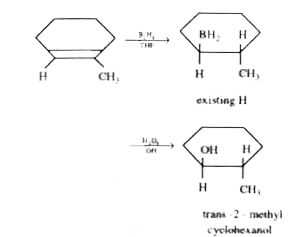
B

Hydroboration oxidation is syn addition
Promotional Banner

Topper's Solved these Questions

  • HYDROCARBONS

    AAKASH SERIES|Exercise ADDITIONAL PRACTICE SHEET ( LEVEL-II (PRACTICE SHEET (ADVANCED) (LINKED COMPREHENSION TYPE QUESTIONS(PASSAGE-III))))|3 Videos
  • HYDROCARBONS

    AAKASH SERIES|Exercise ADDITIONAL PRACTICE SHEET ( LEVEL-II (PRACTICE SHEET (ADVANCED) (LINKED COMPREHENSION TYPE QUESTIONS(PASSAGE-IV))))|3 Videos
  • HYDROCARBONS

    AAKASH SERIES|Exercise ADDITIONAL PRACTICE SHEET ( LEVEL-II (PRACTICE SHEET (ADVANCED) (LINKED COMPREHENSION TYPE QUESTIONS(PASSAGE-I))))|3 Videos
  • GENERAL ORGANIC CHEMISTRY

    AAKASH SERIES|Exercise QUESTIONS FOR DESCRIPTIVE ANSWERS|35 Videos
  • HYDROGEN AND ITS COMPOUNDS

    AAKASH SERIES|Exercise QUESTIONS FOR DESCRIPTIVE ANSWERS|20 Videos

Similar Questions

Explore conceptually related problems

Alkenes undergo electrophilic addition with many reagents like HX, H_2O , HOCI etc. Except in the case of addition of X_2^(-) in other additions carbocation is formed as intermediate. The rate of such reactions depends on the stability of carbocation. Rearrangements and ring expansion are also common in such reactions. Propene on reaction with HI in presence of peroxide will give

Alkenes undergo electrophilic addition with many reagents like HX, H_2O , HOCI etc. Except in the case of addition of X_2^(-) in other additions carbocation is formed as intermediate. The rate of such reactions depends on the stability of carbocation. Rearrangements and ring expansion are also common in such reactions. The correct order of reactivity of the following towards electrophilic addition is P) Vinyl chloride Q) Pent-2-ene R) 3-methyl pent-2-ene S) 2,3-dimethyl but-2-ene

Birch reduction : Birch reduction involves controlled reduction of alkynes & atomic compounds in the preseance of alkali metals & alcohol. It provides a method to sterospecifically prepare alkenes of E- configuration R - C -= C -R overset(M,EtOH)to The characteristic type of reaction of alkynes is electrophilic addition reaction like alkenes. The alkynes show various reactions such as halagenation, hydration, hydrogenation etc... 0.40 5g sample of hydrocarbon occupies 229.54ml at 100^(@)C & 1 atm pressure. It decolouses KMnO_4 & Br_2 water. When it reacts with dil. H_2SO_4 under appropriate conditions methyl ethyl, ketone is formed The hydrocarbon exists in (structural isomer)

Birch reduction : Birch reduction involves controlled reduction of alkynes & atomic compounds in the preseance of alkali metals & alcohol. It provides a method to sterospecifically prepare alkenes of E- configuration R - C -= C -R overset(M,EtOH)to The characteristic type of reaction of alkynes is electrophilic addition reaction like alkenes. The alkynes show various reactions such as halagenation, hydration, hydrogenation etc... 0.40 5g sample of hydrocarbon occupies 229.54ml at 100^(@)C & 1 atm pressure. It decolouses KMnO_4 & Br_2 water. When it reacts with dil. H_2SO_4 under appropriate conditions methyl ethyl, ketone is formed The molecular formula of the hydrocarbon is

Birch reduction : Birch reduction involves controlled reduction of alkynes & atomic compounds in the preseance of alkali metals & alcohol. It provides a method to sterospecifically prepare alkenes of E- configuration R - C -= C -R overset(M,EtOH)to The characteristic type of reaction of alkynes is electrophilic addition reaction like alkenes. The alkynes show various reactions such as halagenation, hydration, hydrogenation etc... 0.40 5g sample of hydrocarbon occupies 229.54ml at 100^(@)C & 1 atm pressure. It decolouses KMnO_4 & Br_2 water. When it reacts with dil. H_2SO_4 under appropriate conditions methyl ethyl, ketone is formed The hydrocarbon is

1) The -=C-H unit of an alkyne is more acidic than a C – H unit of an alkene or alkane, allowing acetylene and terminal alkynes to be converted to their conjugate bases -= C . 2) Unlike alkenes, alkynes are reduced by metals, especially Li, Na and K. 3) Unlike alkenes, alkynes can undergo nucleophilic as well as electrophilic addition. Which of the following best describes what happens in the first step in the mechanism of the reaction shown? CH_3 CH_2CH_2CHBr_2 + 3NaNH_2 overset(NH_3)to CH_3CH_2C -=CNa +2NaBr +3NH_3

