Home
Class 12
PHYSICS
Three particles A, B and C of mass m, m ...

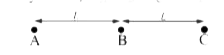
Three particles A, B and C of mass m, m and 2m lie in a straight line as shown. The only force acting on these particles is due to the gravitational attraction towards each other. Let the magnitude of net force on them be `F_(A), F_(B)` and `F_(C )` respectively. Then,`F_(A):F_(B):F_(C )` is equal to :

A

`3:2:5`

B

`3:1:4`

C

`2:2:3`

D

`6:1:5`

Text Solution

Verified by Experts

The correct Answer is:

A

Taking rightward direction as positive,
`F_(A)=(G(m)(m))/(L^(2))hati+(G(m)(2m))/((2L)^(2))hati=(3)/(2)(Gm^(2))/(L^(2))hati`
`F_(B)=-(G(m)(m))/(L^(2))hati+(G(m)(2m))/(L^(2))hati=(Gm^(2))/(L^(2))`
`F_(C)=-(G(2m)(m))/((2L)^(2))hati-(G(2m)(m))/(L^(2))hati=-(5)/(2)(Gm^(2))/(L^(2))hati`
So, `|F_(A)| : |F_(B)| : |F_(C)|=(3)/(2):1:(5)/(2)=3:2:5`
Promotional Banner

Similar Questions

Explore conceptually related problems

The force F acting on a particle is moving in a straight line as shown in figure. What is the work done by the force on the particle in the 4 m of the trajectory?

Two particles A and B, each of mass m, are kept stationary by appyling a horizontal force F=mg on particle B as shown in fig.

Three particles, each of mass m are fixed at the vertices of an equilateral triangle of side length a . The only forces acting on the particles are their mutual gravitational forces. Then answer the following questions. Force acting on particle C , due to particle A and B

Force acting on a particle of mass m moving in straight line varies with the velocity of the particle as F=K//V K is constant then speed of the particle in time t

Three uniform spheres, A, B and C each of mass M and radius R are kept in such a way that each sphere touches the other two. What is the magnitude of the gravitational force acting on A due to B and C ?

Two particle A & B each of mass m are in equilibrium in a vertical plane under action of a horizontal force F=mg on particle B, as shown in figure Then :

Two particle of masses m and 2m are at a distance 3r apart at the ends of a straight line AB . C is the centre of mass of the system. The magnitude of the gravitational force on a unit mass placed at C due to the masses is

Let F_1 be the magnitude of the gravitational force exerted on the Sun by Earth and F_2 be the magnitude of the force exerted on Earth by the Sun. Then:

A particles of mass m moving in a circle of radius r with unform speed v . The force F acting on a particle is proportional ot m^(a) v^(b) r^(c ) . Find the values of a, b and c.

A solid sphere of mass m, suspended through a string in a liquid as shown. The string has some tension Magnitudes of net force due to liquid on upper hemisphere and that on lower hemisphere are F_(A) and F_(B) respectively. Which of the following is // are true.
