v24
v24
A
`I_("CC'")+Md^(2)`
B
`I_("CC'")-Md^(2)`
C
`I_("CC'")+3Md^(2)`
D
`I_("CC'")+4Md^(2)`
Text Solution
Verified by Experts
The correct Answer is:
C
Let BB. be an axis passing through centre of mass and parallel to CC.
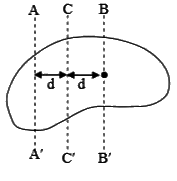
`:.I_("AA." )=I_("BB." )+4Md^(2)`
`=I_("CC.")-Md^(2)+4Md^(2)`
`I_("AA." )=I_("CC." )+3Md^(2)`
`:.I_("AA." )=I_("BB." )+4Md^(2)`
`=I_("CC.")-Md^(2)+4Md^(2)`
`I_("AA." )=I_("CC." )+3Md^(2)`



Similar Questions
Explore conceptually related problems
Two light bulbs shown in the circuit have rating A(24 V, 24W) and B(24 V and 36W) as shown. When the switch is closed,
The output voltage of an ideal transformer, connected to a 240 V a.c. mains is 24 V. when this transformer is used to light a bulb with rating 24 V, 24 W, calculate the current in the primary coil of the circuit.
How many cells each marked (6V-12A) should be connected in mixed grouping so that it may be marked (24V-24VA)
How many cells each marked (6V - 12A) should be connected in mixed grouping so that it may be marked (24V - 24A)
If "S" denotes "multiplied by", "V" denotes "subtracted from", "M" denotes "added to" and "L" denotes "divided by", then 7 V 24 M 77 L 11 S 5 = ?
Represent each of the following rational numbers on the number line.: (i) (5)/(7) (ii) (8)/(3) (iii) -(23)/(6) (iv) 1.3 (v) -2.4
For X ~ B (n, P) , If v(x) = 2.4 and P = 0.4 then n = ..............
1st excitation potential for the H-like (hypothetical) sample is 24 V. Then:
If v = sqrt(5000+24x) m/s then calculate acceleration.