Home
Class 11
PHYSICS
Figure shows a small wheel fixed coaxial...

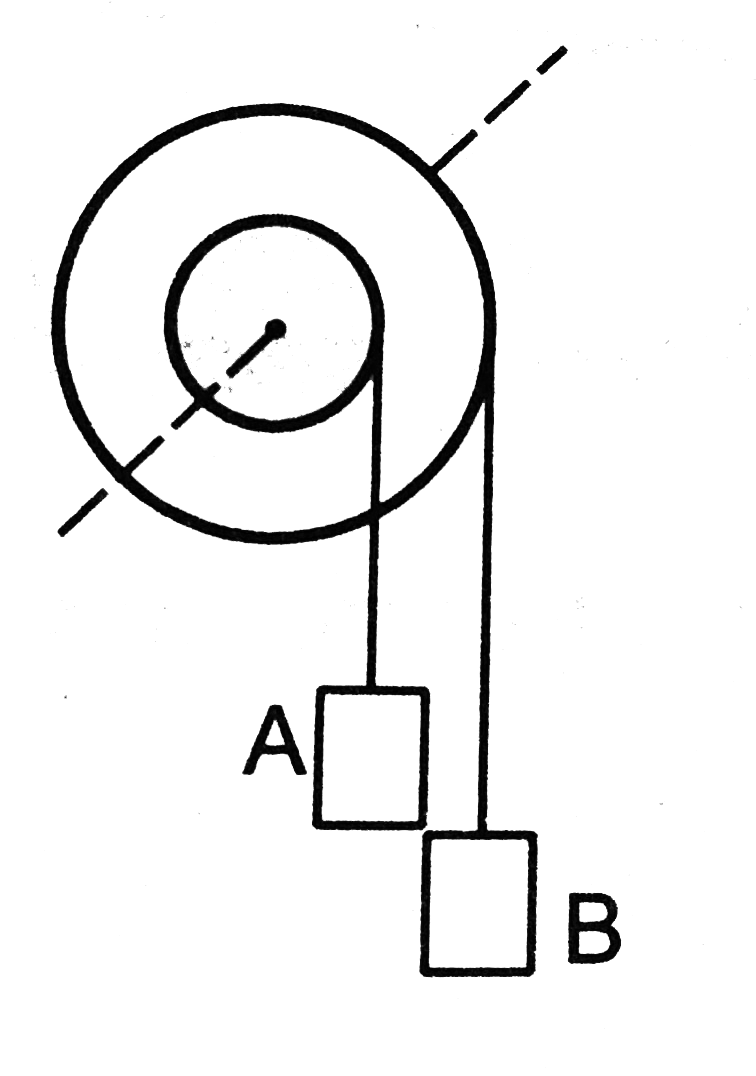
Figure shows a small wheel fixed coaxially on a bigger one of double the radius. The system rotates about the common axis. The strings supporting A and B do not slip on the wheels. If x and y be the distances travelled by A and B in the same time interval, then

A

x = 2y

B

x = y

C

y = 2x

D

None of these

Text Solution

Verified by Experts

The correct Answer is:

C

Linear displacement (S) = Radius (r ) `xx` Angular displacement `(theta)`
`therefore S prop r` (if `theta =` constat)
`("Distance travelled by mass A (x)")/("Distance travelled by mass B (y)")=("Radius of pulley concerned with mass A (r )")/("Radius of pulley concerned with mass B (2r)")=(1)/(2) rArr y = 2x`.
Promotional Banner

Topper's Solved these Questions

  • ROTATIONAL MOTION

    ERRORLESS |Exercise Practice Problems (Problems based on centre of mass)|12 Videos
  • ROTATIONAL MOTION

    ERRORLESS |Exercise Practice Problems (Problems based on angular displacement, velocity and acceleration)|16 Videos
  • NEWTONS LAWS OF MOTION

    ERRORLESS |Exercise Self Evaluation Test|16 Videos
  • SIMPLE HARMONIC MOTION

    ERRORLESS |Exercise simple Harmonic Motion|21 Videos

Similar Questions

Explore conceptually related problems

Figure shows a small wheel fixed coaxially on a bigger one of double the radius. The system rotates about the comon axis. The strings supporting A and B do not slip on the wheels. If x and y be thedistances travelled by A and B in the same time interval, then

A wheel of radius R rolls without slipping on a horizontal ground. The distance travelled by a point on the rim in one complete rotation is:

In the figure A and B are two blocks of mass 4 kg and 2 kg respectively attached to the two ends of light string passing overa disc C of mass 40 kg and radius 0.1 m . The disc is free to rotate about a fixed horizontal the string does not string does not slip over the disc. Find. (i) The linear acceleration of mass B . (ii) the number of revolutions made by the disc at the end of 10 sec . from the start. (iii) the tension in teh string segment supporting the block A . .

figure shows the graph of velocity versus tie for a particle going along the X-axis. Find a. the acceleration, b. The distance travelled in 0 to 10 s and c. the displacement in 0 to 10 s.

A 4kg block is attached to a vertical rod by means of two strings of equal length. When the system rotates about the axis of the rod, the strings are extended as shown in figure. (a) How many revolutions per minute must the system make in order for the tension in the upper string to be 200N ? (b) What is the tension in the lower string then ?

A disc of radius R stands at the edge of a table. If the given a gentle push and it beings to fall. Assume that the disc does not slip at A and it rotates about the point as it falls. The falling disc hits the edge of another table placed at same height as the first one at a horizontal distance of sqrt2 R . Imagine that the disc hits the edge B and rotates (up) about the edge (a) Find the speed of the centre of the disc at the instant just before it hits the edge B. (b) Find the angular speed of the disc about B just after the hit.

A wire is bent to form a semicircle of the radius a. The wire rotates about its one end with angular velocity omega . Axis of rotation is perpendicular to the plane of the semicircle . In the space , a uniform magnetic field of induction B exists along the aixs of rotation as shown in the figure . Then -

A wheel A is connected to a second wheel B by means of inextensible string, passing over a pulley C , which rotates about a fixed horizontal axle O , as shown in the figure. The system is released from rest. The wheel A rolls down the inclined plane OK thus pulling up wheel B which rolls along the inclined plane ON . Determine the velocity (in m/s) of the axle of wheel A , when it has travelled a distance s = 3.5 m down the to be slope. Both wheels and the pulley are assumed homogeneous disks of identical weight and radius. Neglect the weight of the string. The string does not over C . [Take alpha =53^@ and beta=37^@ ]

Figure shows a student, sitting on a stool that can rotate freely about a vertical axis. The student, initially at rest, is holding a bicycle wheel whose rim is loaded with lead and whose moment of inertia is I about its central axis. The wheel is rotating at an angular speed omega_i from an overead perspective, the rotation is counter clockwise. The axis of the wheel point vertical, and the angular momentum vecL_i of the wheel points vertically upward. The student now inverts the wheel, as a result, the student and stool rotate about the stool axis. With what angular speed and direction does the student then rotate? (The moment of inertia of the student+stool+wheel system about the stool axis is I_0 )
