Home
Class 11
PHYSICS
Consider a body, shown in figure, consis...

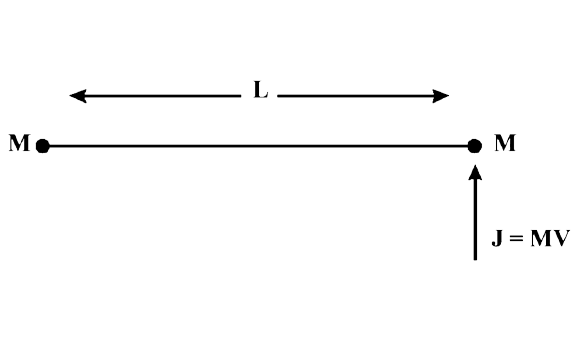
Consider a body, shown in figure, consisting of two identical balls, each of mass M connected by a light rigid rod. If an impulse J = MV is imparted to the body at one of its ends what would be it angular velocity?

A

`v//L`

B

`2v//L`

C

`v//3L`

D

`v//4L`

Text Solution

Verified by Experts

The correct Answer is:
A

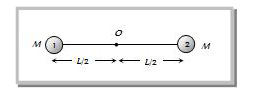
Initial angular momentum of the system about point O
= Linear momentum `×` Perpendicular distance of linear momentum from the axis of rotation =`Mv((L)/(2))…(i)`
Final angular momentum of the system about point `O=I_(1)omega+I_(2)omega=(I_(1)+I_(2))omega=[M((L)/(2))^(2)+M((L)/(2))^(2)]omega...(ii)`
Applying the law of conservation of angular momentum
`implies Mv((L)/(2))=2M((L)/(2))^(2)omega`
`implies omega=(v)/(L)`
Promotional Banner

Topper's Solved these Questions

  • ROTATIONAL MOTION

    ERRORLESS |Exercise Practice Problems (Problems based on centre of mass)|12 Videos
  • ROTATIONAL MOTION

    ERRORLESS |Exercise Practice Problems (Problems based on angular displacement, velocity and acceleration)|16 Videos
  • NEWTONS LAWS OF MOTION

    ERRORLESS |Exercise Self Evaluation Test|16 Videos
  • SIMPLE HARMONIC MOTION

    ERRORLESS |Exercise simple Harmonic Motion|21 Videos

Similar Questions

Explore conceptually related problems

Consider a system consisting of two identical balls each of mass M connected by a light rigid rod as shown in figure. An impulse J=MV is imparted to the system at one of its ends. The angular velocity of the system would be

Two identical rods each of mass m and length are connected as shown. Locate c.m.

Two small balls, each of mass m are connected by a light rigid rod of length L. The system is suspended from its centre by a thin wire of torsional constant k. The rod is rotated about the wire through an angle theta_0 and released. Find the tension in the rod as the system passes through the mean position.

Figure a rigid body consisting of two particles of mass m connected by a rod of length L and negligible mass. (a) What is the rotational inertia I_(com) about an axis through the center of mass, perpendicular to the rod as shown? (b) What is the rotational inertia I of the body about an axis through the left end of the rod and parallel to the first axis.

A uniform rod of length L and mass M is lying on a frictionless horizontal plane and is pivoted at one of its ends as shown in Fig. There is no friction at the pivot. An inelastic ball of mass m is fixed with the rod at a distance L//3 from O . A horizontal impulse J is given to the rod at a distance 2L//3 from O in a direction perpendicular to the rod. Assume that the ball remains in contact with the rod after the collision and impulse J acts for a small time interval /_\t . Now answer the following questions: Find the resulting instantaneous angular velocity of the rod after the impulse.

A uniform rod of length L and mass M is lying on a frictionless horizontal plane and is pivoted at one of its ends as shown in Fig. There is no friction at the pivot. An inelastic ball of mass m is fixed with the rod at a distance L//3 from O . A horizontal impulse J is given to the rod at a distance 2L//3 from O in a direction perpendicular to the rod. Assume that the ball remains in contact with the rod after the collision and impulse J acts for a small time interval /_\t . Now answer the following questions: Find the impulse acted on the ball during the time /_\t

In the figure, a ball of mass m is tied with two strings of equal as shown. If the rod is rotated with angular velocity omega_(1) when

