Home
Class 11
PHYSICS
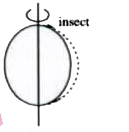
A solid sphere is rotating about an axis...

A solid sphere is rotating about an axis as shown in the figure. An insect follows the dotted path on the circumference of sphere as shown. Match the following.
`{:(" Column-I"," Column-II"),("(A) moment of inertia","(P) will remain constant"),("(B) angular velocity","(Q) will first increase then decrease"),("(C) angular momentum","(R) will first decrease then increase"),("(C) angular momentum ","(R) will first decrease then increase"),("(D) rotational kinetic energy","(S) will continuously decrease"),(,"(T) will continuously increase"),(,"(U) data is insufficient"):}`

Text Solution

Verified by Experts

The correct Answer is:

A-Q;B-R;C-P;D-R
Promotional Banner

Topper's Solved these Questions

  • ROTATIONAL DYNAMICS

    AAKASH SERIES|Exercise ADDITIONAL PRACTICE EXERCISE (LEVEL-I Straight Objective Type Questions)|51 Videos
  • ROTATIONAL DYNAMICS

    AAKASH SERIES|Exercise LEVEL - II LECTURE SHEET (ADVANCED) More than One correct answer Type Questions|14 Videos
  • ROTATIONAL DYNAMICS

    AAKASH SERIES|Exercise PRACTICE SHEET (Exercise - VI) (LEVEL - II Linked Comprehension Type Questions)|3 Videos
  • RIVISION EXERCISE

    AAKASH SERIES|Exercise MOTION IN A PLANE (LAMNI.S THEOREM)|6 Videos
  • ROTATIONAL MECHANICS

    AAKASH SERIES|Exercise Questions for Descriptive Answers|20 Videos

Similar Questions

Explore conceptually related problems

The angular momentum of rotating body is increased by 20%. What will be the increase in its rotational kinetic energy ?

{:("Column-I","Column-II"),("A)" gamma_(g) "is" +ve & lt gamma_(r) , "P) when heated, liquid level does not change"),("B)" gamma_(g) "is" -ve,"Q) when heated, liquid level increases"),("C)" gamma_(g) = gamma_(r) ,"R) when heated, liquid level decreases"),("D)" gamma_(g) gt gamma_(r) ,"S) when heated, liquid level first decreases and then increases"):}

(A) : When water is heated from 0^(@)C to 10^(@)C , its volume first decreases and then increases. ( R) : When water is heated from 0^(@)C to 10^(@)C , its density first decreases and then increases.
