Home
Class 12
PHYSICS
A particle with charge q moves with a ve...

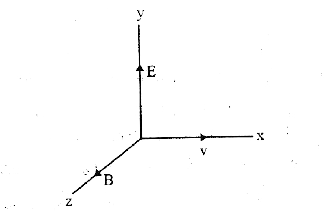
A particle with charge q moves with a velocity V in a direction perpendicular to the directions of uniform electric and magnetic fields, E and B respectively, which are mutually perpendicular to each other. Which one of the following gives the condition for which the particle moves undeflected in its original trajectory ?

A

`v=E/B`

B

`v=B/E`

C

`v=sqrt(E/B)`

D

`v=qB/E`

Text Solution

Verified by Experts

Promotional Banner

Topper's Solved these Questions

  • QUESTION PAPER 2019

    WB JEE PREVIOUS YEAR PAPER|Exercise PHYSICS (CATEGORY -III)|3 Videos
  • QUESTION PAPER 2019

    WB JEE PREVIOUS YEAR PAPER|Exercise PHYSICS (CATEGORY -III)|3 Videos
  • QUESTION PAPER 2018

    WB JEE PREVIOUS YEAR PAPER|Exercise PHYSICS|40 Videos
  • QUESTION PAPER 2021

    WB JEE PREVIOUS YEAR PAPER|Exercise PHYSICS (CATEGORY -II)|6 Videos

Similar Questions

Explore conceptually related problems

A particle with charge q is moving with a velocity vecv in a magnetic field vecB . If the force acting on the particle is vecF then,

A charged particle released from rest in a region of steady and uniform electric and magnetic fields, which are parallel to each other. What will be the nature of the path followed by the charged particle?

An electromagnetic wave in vacuum has the electric and magnetic fields vecE and vecB , which are always perpendicular to each other. The direction of polarization is given by vecX and that of wave propagation by veck . Then

A particle with charge q moves with velocity vecv in a direction perpendicular to the magnetic field lines. What would be the direction of force experienced by the particle ? What is the nature of the path described by the particle ? Find the cyclotron Frequency.

A cahrged particle is released from rest in a region of steady and uniform electric and magnetic and magnetic fields, which are parallel to each other what will be the nature of the path followed by the charged particle?

Find the magnitude and direction of the resultant of two vectors which are perpendicular to each other.

An electron having charge e moves with velocity vecn in +x direction. An electric field act on it along+y direction. The force on the electron acts along .

A particle of mass 'm' and carrying a charge q enters with a velocity 'v' perpendicular to a uniform magnetic field. The time period of rotation of the particle

