

Home
Class 11
PHYSICS
The identical solid sphere each having m...

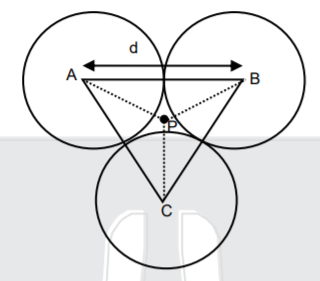
The identical solid sphere each having mass `m` and diameter `d` are touching each other as shown in figure. Calculate ratio of moment of inertia about an axis (perpendicular to plane of paper) passing through point P ans B as shown inn fingure.Given P is centroid of triangle ABC.

Promotional Banner

Similar Questions

Explore conceptually related problems

Four spheres each of mass M and diameter 2a are placed at the corners of square of side b as shown below. Calculate the moment of inertia about axis BB'

Four spheres each of mass M and diameter 2a are placed at the corners of square of side b as shown below. Calculate the moment of inertia about axis AA'

Two rods each having length l and mass m joined together at point B as shown in figure.Then findout moment of inertia about axis passing thorugh A and perpendicular to the plane of page as shown in figure.

Two thin discs each of mass M and radius r metre are attached to form a rigid body as shown in figure. The rotational inertia of this body about an axis perpendicular to the plane of disc B and passing through its centre is

Two thin discs each of mass M and radius r are attached as shown in figure, to from a rigid body. The rotational inertia of this body about an axis perpendicular to the plane of disc B and passing through its centre is : .

Three identical solid discs, each of mass M and radius R, are arranged as shown in figure. The moment of inertia of the system about an axis AB will be

Two identical rods each of mass M and length L are kept according to figure. Find the moment of inertia of rods about an axis passing through O and perpendicular to the plane of rods.

Thee spheres each of mass M and radius R are placed in contact with each other as shown in the figure here. Then the moment of inertia of the system about the axis CC' is

Two identical circular plates each of mass 0.1 kg and radius 10cm are joined side by side as shown in figure. Their moment of inertia about an axis passing through their common tangent is