

Home
Class 11
PHYSICS
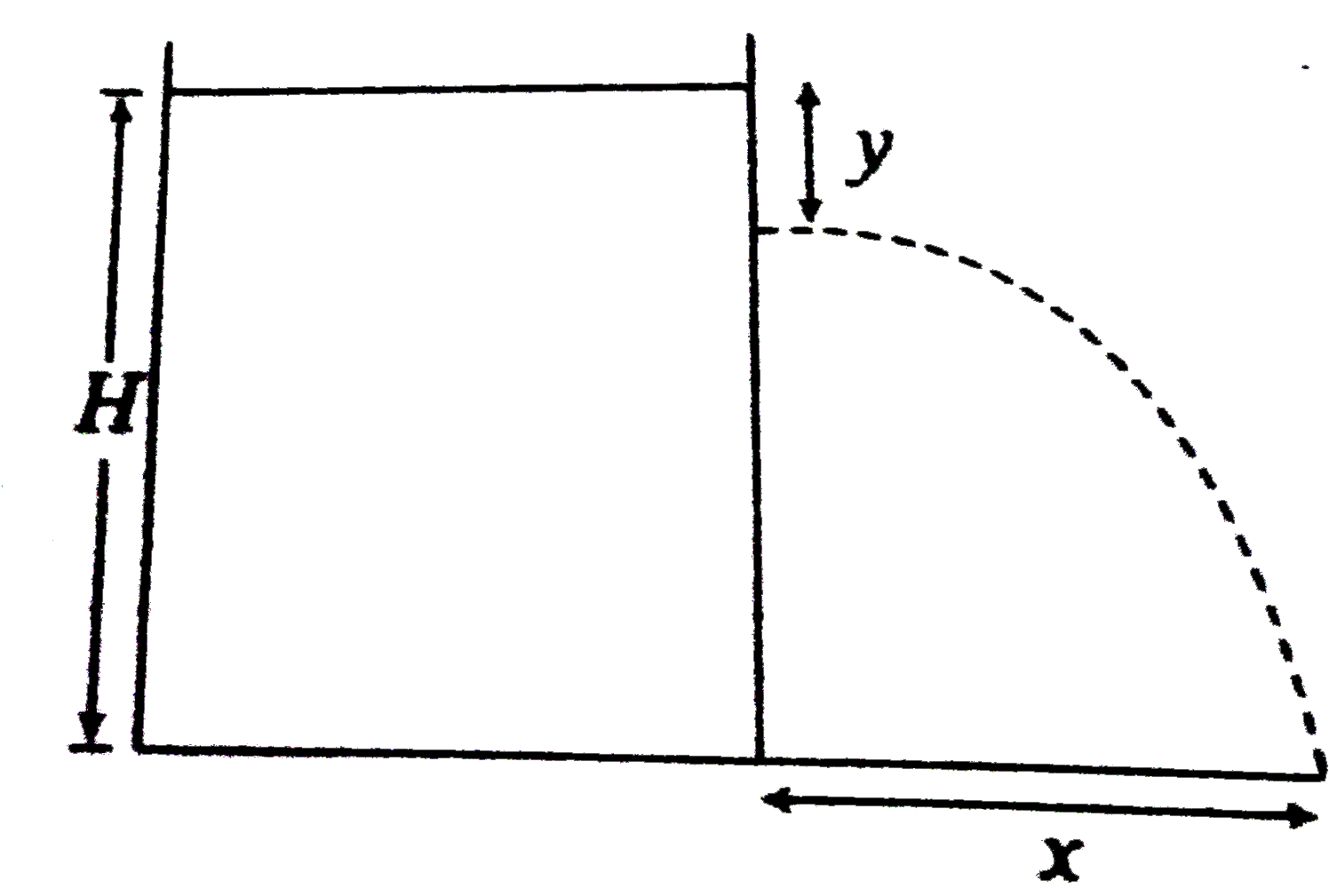
A cylindrical vessel is filled with a li...

A cylindrical vessel is filled with a liquid up to a height H. A small hole is made in the vessel at a distance y below the liquid surface as shown in figure. The liquid emerging from the hole strike the ground at distance x

Promotional Banner

Similar Questions

Explore conceptually related problems

A tank, which is open at the top, contains a liquid up to a height H. A small hole is made in the side of the tank at a distance y below the liquid surface. The liquid emerging from the hole lands at a distance x from the tank :

A cylinderical vessel is filled with water up to height H. A hole is bored in the wall at a depth h from the free surface of water. For maximum range h is equal to

A liquid of density rho is filled in a vessel up to height H and a hole of cross section area A is made at a depth h below the free surface of liquid. The speed of liquid coming out of the hole is independent of

Water stands at a depth H in a tank whose side walls are vertical. A hole is made in one of the walls at a height h below the water surface. The stream of water emerging from the hole strikes the floor at a distance R from the tank, where R is given by

A cylindrical vessel of area of cross section A is filled with a liquid up to a height H . A very small hole of area of cross section a is made at the bottom of the vellel. Find the time taken by the vessel to become empty.

A cylindrical vessel filled with water to a hight H. A vessel has two small holes in the side, from which water iins rushing out horizontal and the two steams stike the ground at the same poin, if the lower hole Q Q is h height above the ground, then the height of hole P above the ground will be

A cylinder is filled with non viscous liquid of density d to a hegiht h_(0) and a hole is made at a height h_(1) from the bottom of the cylinder. The velocity of liquid issuing out of the hole is

A cylindrical vessel of radius r is filled with a homogeneous liquid upto a height h. It is found that the force exerted by the liquid column on the bottom of the cylinder is equal to the force exerted by the liquid on the sides of the cylinder. What is the relation between r and h?