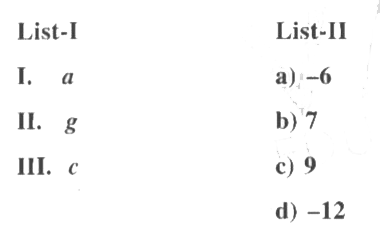
A
B
C
D
Text Solution
Verified by Experts
The correct Answer is:



Topper's Solved these Questions
PAIR OF STRAIGHT LINES
AAKASH SERIES|Exercise PRACTICE EXERCISE|85 VideosPAIR OF STRAIGHT LINES
AAKASH SERIES|Exercise LECTURE SHEET (EXERCISE-I Homogeneous pair of lines) (Straight Objective Type Questions)|64 VideosPAIR OF STRAIGHT LINES
AAKASH SERIES|Exercise EXERCISE -I|50 VideosMULTIPLE PRODUCT OF VECTORS
AAKASH SERIES|Exercise PRACTICE EXERCISE|62 VideosPERIODICITY AND EXTEME VALUES
AAKASH SERIES|Exercise PRACTICE SHEET (EXERCISE) LEVEL-I(MAIN) Extreme values ( Single answer type questions )|23 Videos
Similar Questions
Explore conceptually related problems
AAKASH SERIES-PAIR OF STRAIGHT LINES-EXERCISE -II
- The equation ax^(2)+2hyx+by^(2)+2gx+2ry+c=0 represents a pair of paral...
Text Solution
|
- If ax^(2)+2hxy+by^(2)+2gx+2fy+c=0 represents a pair of parallel lines...
Text Solution
|
- The equation ax^(2)-24xy+16y^(2)+2gx+16y+c=0 represents a pair of para...
Text Solution
|
- Let P(1),p(2),p(3) be the perpendicular distance between pair of paral...
Text Solution
|
- The figure formed by the pairs of lines 2x^(2)+3xy-2y^(2)=0 and 2x^(2)...
Text Solution
|
- The figure formed by the pairs of lines 3x^(2)+10xy+3y^(2)=0 and 3x^(2...
Text Solution
|
- If fg = ch, the lines represented by hxy+ gx+ fy + c = 0 form a quadri...
Text Solution
|
- The lines (y-mx)^(2)=a^(2)(1+m^(2)) and (y-nx)^(2)=a^(2)(1+n^(2)) form...
Text Solution
|
- Quadrilateral formed by xy + x + y + 1=0 and xy + 3x + 3y + 9 =0 is qu...
Text Solution
|
- The figure formed by the two pairs of lines x^(2)-3x + 2 = 0, y^(2) + ...
Text Solution
|
- The figure formed by the pairs of lines x^(2)-2=0 and 9x^(2)-24xy+16y^...
Text Solution
|
- The sides of a parallelogram are given by 2x^(2)-5xy+2y^(2)=0 and 2x^(...
Text Solution
|
- The equation of the diagonal passing through the origin of the paralle...
Text Solution
|
- If two of the sides of a parallelogram are represented by ax^2+2hxy+by...
Text Solution
|
- The equation to a pair of oppite sides of parallelogram are x^2-sx+6=0...
Text Solution
|
- The combined equation of the diagonals of the square formed by the pai...
Text Solution
|
- If the pair of lines 6x^(2)-5xy-6y^(2)=0, 6x^(2)-5xy-6y^(2)+x+5y-1=0 f...
Text Solution
|
- In the above problem, the length of its side is
Text Solution
|
- If the pair of lines 8x^(2)+2xy-3y^(2)=0 forms a parallelogram with pa...
Text Solution
|
- If the equation 2hxy + 2gx + 2fy + c = 0 represents two straight lines...
Text Solution
|