

Home
Class 11
MATHS
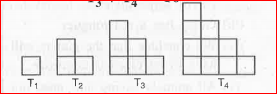
Let us observe the triangular numbers (s...

Let us observe the triangular numbers (see Fig.). Add two consecutive numbers. For example , `T_1+T_2=4` `T_2+T_3=9` `T_3+T4` =16

Promotional Banner

Similar Questions

Explore conceptually related problems

Consider the so-called triangular numbers T_n : The dots here are arranged in such a way that they form a triangle. Here T_1 = 1, T_2 = 3, T_3 = 6, T_4 = 10, and so on. Can you guess what T_5 is? What about T_6 ? What about T_n ?

The numbers 1,3,6,10,15,21,28"..." are called triangular numbers. Let t_(n) denote the n^(th) triangular number such that t_(n)=t_(n-1)+n,AA n ge 2 . The number of positive integers lying between t_(100) and t_(101) are:

The numbers 1,3,6,10,15,21,28"..." are called triangular numbers. Let t_(n) denote the n^(th) triangular number such that t_(n)=t_(n-1)+n,AA n ge 2 . The value of t_(50) is:

The numbers 1,3,6,10,15,21,28"..." are called triangular numbers. Let t_(n) denote the n^(th) triangular number such that t_(n)=t_(n-1)+n,AA n ge 2 . If (m+1) is the n^(th) triangular number, then (n-m) is

Let T be the set of all triangles in a plane with R a relation in T given by : R = {(T_1, T_2) : T_1 is congruent to T_2}. Show that R is an equivalence relation.

The base of a triangle is divided into three equal parts. If t_1, t_2,t_3 are the tangents of the angles subtended by these parts at the opposite vertex, prove that (1/(t_1)+1/(t_2))(1/(t_2)+1/(t_3))=4(1+1/(t_2)^ 2))dot

Solve the following equations: 16 = 4 + 3(t + 2)

Find the matrices of transformation T_(1)T_(2) and T_(2)T_(1) when T_(1) is rotated through an angle 60^(@) and T_(2) is the reflection in the Y-asix Also, verify that T_(1)T_(2)!=T_(2)T_(1).