Home
Class 11
MATHS
The length of 40 leaves of a plant are m...

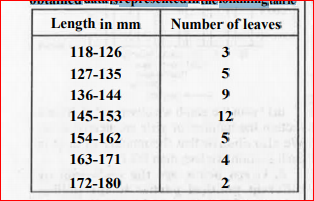
The length of 40 leaves of a plant are measured correct to one millimetre, and the obtained data is represented in the following table.
: Is there any other suitable graphical representation for the same data ?


Promotional Banner

Similar Questions

Explore conceptually related problems

The length of 40 leaves of a plant are measured correct to one millimetre, and the obtained data is represented in the following table. : Draw a histogram to represent the given data.

The length of 40 leaves of a plant are measured correct to one millimetre, and the obtained data is represented in the following table. : Is it correct to conclude thatthemaximum number of leaves are 153 mm long ? Why ?

The length of 40 leaves of a plant are measured correct to one millimetre, and the obtained data is represented in the following table: Is it correct to coclude that the maximum number of leaves is 153 mm long? why?

The lengths of 40 leaves of a plant are measured correct to the nearest millimetre, and the data obtained is represented in the following table . Find the median length of the leaves. (Hint : The data needs to be converted to continuous classes for finding the median, since the formula assumes continuous classes, The classes then change to 117.5 -126.5, 126.5-135.5,....171.5 - 180.5.)

Consider the following frequency distribution table representing the weights of 40 students of a class . Draw a histogram to represent the above data.

An insurance company selected 2000 drivers at random (i.e., without any preference of one driver over another) in a particular city to find a relationship between age and accidents. The data obtained are given in the following table: Find the probabilities of the following events for a driver chosen at random from the city: having no accidents in one year.

An insurance company selected 2000 drivers at random (i.e., without any preference of one driver over another) in a particular city to find a relationship between age and accidents. The data obtained are given in the following table: Find the probabilities of the following events for a driver chosen at random from the city: being 30-50 years of age and having one or more accidents in a year.

An insurance company selected 2000 drivers at random (i.e., without any preference of one driver over another) in a particular city to find a relationship between age and accidents. The data obtained are given in the following table: Find the probabilities of the following events for a driver chosen at random from the city: being 18-29 years of age and having exactly 3 accidents in one year.

The height of 50 students, measured to the nearest centimetres have been found to be as follows: Represent the data given above by a grouped frequency distribution table, taking the class intervals as 160-165, 165-170 etc.