Home
Class 11
PHYSICS
The pulleys A and C are fixed while the ...

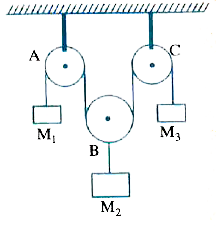
The pulleys A and C are fixed while the pulley B is movable . A mass `M_(2)` is attached to pulley B , while the string has masses `M_(1) "and " M_(3)` at the two ends . Find the acceleration of each mass .

Text Solution

Verified by Experts
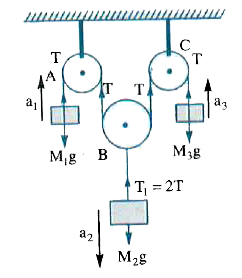
The force acting on masses `M_(1),M_(2)"and " M_(3)` are shown in figure .
Let `a_(1) "and" a_(3)` be upward acceleration of masses `M_(1)"and" M_(3) "and" a_(2)`
the downward acceleration of mass `M_(2)`.
For motion of mass M_(1)
`T-M_(1) g=M_(1)a_(1)` ....(1)
For motion of mass `M_(3)`
`T-M_(3)g=M_(3) a_(3)` ....(2)
For motion of mass `M_(2)`
`M_(2)g-2T=M_(2)a_(2)` ....(3)
Let `l_(1),l_(2),l_(3)` be the lengths of vertical portions of the string between pulley at any instant . `M_(1) ` goes up through `x_(2) M_(2)` goes down through y and `M_(3)` goes up through z.
Then `l_(1)+2l_(2)+l_(3)=(l_(1)-x)+2(l_(2)+y)+l_(3)-z`
`rArr x+z =2y rArr (d^(2)x)/(dt^(2))+(d^(2)z)/(dt^(2))=2(d^(2)y)/(dt^(2))`
`a_(1)+a_(3)=2a_(2) rArr a_(2)=(a_(1)+a_(3))/2` ....(4)
From (1), a_(1)=T/M_(3)-g` ....(5)
From (2),` a_(3)=T/M_(3)-g` ....(6)
substituting `a_(1) "and" a_(3)` in (4) , we get
`a_(2)=T/2(1/M_(1)+1/M_(3))-g` ....(7)
From (3), `T=(m_(2)(g-a_(2))/2` ....(8)
substituting this value in (7), we get
`a_(2)=M_(2)/4 (g-a_(2))(1/M_(1)+1/M_(3))-g "or" a_(2)=(M_(2)(g-a_(2))(M_(3)+M_(1)))/(4M_(1)M_(3))-g`
or `4M_(1)M_(3)a_(2)-M_(2)(M_(1)+M_(3))g-M_(2)(M_(1)+M_(3)a_(2)-4M_(1)M_(3)g`
or `[4M_(1)M_(3)+M_(2)(M_(1)+M_(3))]a_(2)=(M_(1)+M_(3))M_(2)g-4M_(1)M_(3)g`
`a_(2)=((M_(1)+M_(3))M_(2)g-4M_(1)M_(3)g)/(4M_(1)M_(3)+M_(2)(M_(1)+M_(3))) a_(2)=(M_(1)M_(2)+M_(2)M_(3)-4M_(1)M_(3))/(M_(1)M_(2)+M_(2)M_(3)+4M_(1)M_(3)) ....(9)
Substituting value of `a_(2)` in above equation , we get
`a_(1)=(-M_(1)M_(2)+3M_(2)M_(3)-4M_(1)M_(3))/(M_(1)M_(2)+M_(2)M_(3)+4M_(1)M_(3))g` ....(10)
similarly from (6)and (9)
`a_(3)=(3M_(1)M_(2)-M_(2)M_(3)-4M_(1)M_(3))/(M_(1)M_(2)+M_(2)M_(3)-4M_(1)M_(3))` ....(11)
Promotional Banner

Similar Questions

Explore conceptually related problems

pulley in the diagram is mass less but there is friction between pulley and string then the acceleration of system is

In the adjacent figure, pulley 'A' is fixed and 'B' is movable. The strings are massless, masses of pulleys can be neglected and friction between the strings and pulley also can be neglected, The acceleration of the masses 4 m and 'm' are _____and _____respectively.

In the adjacent figure, pulley 'A' is fixed and 'B' is movable. The strings are massless, masses of pulleys can be neglected and friction between the strings and pulley also can be neglected, The acceleration of mass '2m' is

